Diamond Certification Explained
On this page
Not all diamond certificates carry equal weight. If you are buying a natural diamond, whether it’s a white solitaire, a fancy pink stone, or an antique cut, the certificate that comes with it may be the most important document in the transaction. Understanding what it actually tells you, and which lab issued it, is knowledge that can protect you from overpaying and help you buy with genuine confidence.
Harsh Shah, Graduate Diamonds (GIA), De Beers Institute-trained diamantaire, and Director of PASAVAJA Gems LLP, has taken stones back to GIA for re-examination where the issued grade did not match his own reading. GIA reviews each case independently, and in some the grade was revised. That depth of engagement with the grading process is what we bring to every piece of diamond education we publish.
This guide covers what a diamond grading certificate actually is, how GIA, IGI, and HRD compare honestly, and how to read a GIA report section by section. By the end, you will know exactly what to look for before you buy.

What Is a Diamond Grading Certificate?
A diamond grading certificate, also called a diamond grading report, is an independent laboratory’s objective written assessment of a diamond’s key characteristics. It records the stone’s shape, measurements, the 4Cs (cut, color, clarity, carat weight), fluorescence, polish, symmetry, any treatments, and in some cases origin. It is not an appraisal. It does not tell you what the diamond is worth in dollar terms. It tells you what the diamond is.
The critical word here is independent. A certificate only has value if the lab that issued it has no financial interest in how the diamond grades. The best labs grade diamonds the same way regardless of who submitted them or what the outcome means for the seller.
Certification exists because most buyers cannot objectively assess a diamond’s color or clarity with the naked eye, and even trained professionals use controlled conditions and comparison masterstones to ensure consistency. A certificate removes the guesswork.
Why Certification Is Non-Negotiable
Buying a diamond without an independent grading certificate means you are entirely relying on the seller’s description. That is a significant risk on a purchase that often runs to thousands or tens of thousands of dollars.
A certificate lets you compare stones objectively across different dealers. It allows you to understand price in the context of verified grade. And for fancy color diamonds specifically, where color is the primary value driver, a GIA grading report is the only document the global market treats as authoritative.
For any serious purchase, a certificate from a respected independent laboratory is the minimum standard. At PASAVAJA, it is non-negotiable.
To understand the full relationship between a diamond’s 4Cs and how they affect value, our white diamond buying guide is the right starting point. For fancy color diamonds, the grading picture is considerably more complex, our complete colored diamonds guide explains why GIA certification matters even more in that category.
GIA, The Global Standard for Diamond Grading
GIA, the Gemological Institute of America, is the most respected and consistently applied diamond grading standard in the world. Founded in 1931, GIA created the 4Cs system and the D-to-Z color scale that the entire industry still uses today. It is not a commercial entity in the conventional sense; it is a non-profit research and education institute, which matters for grading independence.
What makes GIA the benchmark is not reputation alone. It is methodology. GIA grades every diamond using a panel of trained graders, not a single assessor. Color is graded face-down against a white background using controlled lighting and compared to calibrated master stones. Clarity is assessed at 10x magnification by multiple graders, and the final grade requires consensus. The resulting reports are consistent enough that the global trade prices diamonds specifically against GIA grades.
For fancy color diamonds, GIA is particularly important. Fancy color grading requires assessing hue, tone, and saturation simultaneously, and assigning one of 27 hue positions and one of nine intensity grades. The margin for subjectivity is significant, and GIA’s consistency across these assessments is what gives their fancy color reports their authority.
Harsh Shah’s expertise in fancy color grading is precise enough that he has engaged directly with GIA gemologists on grading discussions, including cases that contributed to certificate revisions. That level of engagement reflects both how rigorous GIA’s process is and how much a trained specialist can bring to those conversations.
GIA issues several types of reports. The most common are the Diamond Grading Report (full) and the Diamond Dossier (smaller stones, with laser inscription but no plotted clarity diagram). For fancy color stones, the Fancy Color Diamond Grading Report is the authoritative document.

IGI, An Honest Comparison
IGI, the International Gemological Institute, is a significant presence in the diamond market, particularly for lab-grown diamonds and for lower and mid-tier natural stones. Founded in Antwerp in 1975, IGI now operates grading labs across multiple countries and has substantially increased its market share.
The honest assessment is that IGI and GIA are not equivalent standards for natural diamonds, particularly for fancy color. Multiple independent studies and consistent trade experience indicate that IGI grades color and clarity more generously than GIA for the same stone. A diamond graded G/VS1 by IGI may grade H/VS2 or I/VS2 by GIA. This difference can translate to a meaningful price gap that buyers need to understand.
This does not mean an IGI certificate is worthless. For certain categories, lower value naturals, smaller stones, and the lab-grown market where IGI has built genuine competence: it is a functional document. But for higher value purchases, for fancy color diamonds, and for any stone where significant money is involved, GIA certification is the standard that protects the buyer.
If you are offered a diamond with an IGI certificate at a price that seems comparable to a GIA-certified stone of the same stated grade, that price comparison is not valid. The grades may not be equivalent.
HRD Antwerp, The European Standard
HRD Antwerp is the grading laboratory of the Diamond Office in Antwerp, Belgium, the world’s historic Diamond Trading Centre. For European buyers, HRD has historically carried significant trust, particularly in the trade.
HRD’s grading methodology is rigorous and its reports are respected in the European market and among Antwerp trade buyers. For white diamonds sourced through European channels, HRD is a credible certificate. For fancy color diamonds, GIA remains the preferred standard globally because the market for rare color stones is international and GIA’s color grading system is universally understood.
HRD underwent significant changes in 2022 when the Antwerp World Diamond Centre transferred grading activities. Buyers working with HRD-certified stones should verify the issuing entity and date of the report.
Grading Lab Comparison
| Lab | Founded | Headquarters | Grading Consistency | Best Known For | PASAVAJA Assessment |
|---|---|---|---|---|---|
| GIA | 1931 | Carlsbad, USA | Highest | 4Cs originator; fancy color authority | Mandatory for fancy color; preferred for all natural diamonds |
| IGI | 1975 | Antwerp, Belgium | Moderate | Lab-grown diamonds; volume grading | Functional for lower-value naturals; not equivalent to GIA for significant purchases |
| HRD | 1976 | Antwerp, Belgium | High (white diamonds) | European market; trade use | Respected in European channels; GIA preferred for fancy color |
IGI and HRD stones may be priced lower than GIA-certified equivalents of the same stated grade. In some cases this represents value; in others it reflects a genuine grade difference. Always understand which scenario applies before buying.
How to Read a GIA Diamond Report, Section by Section
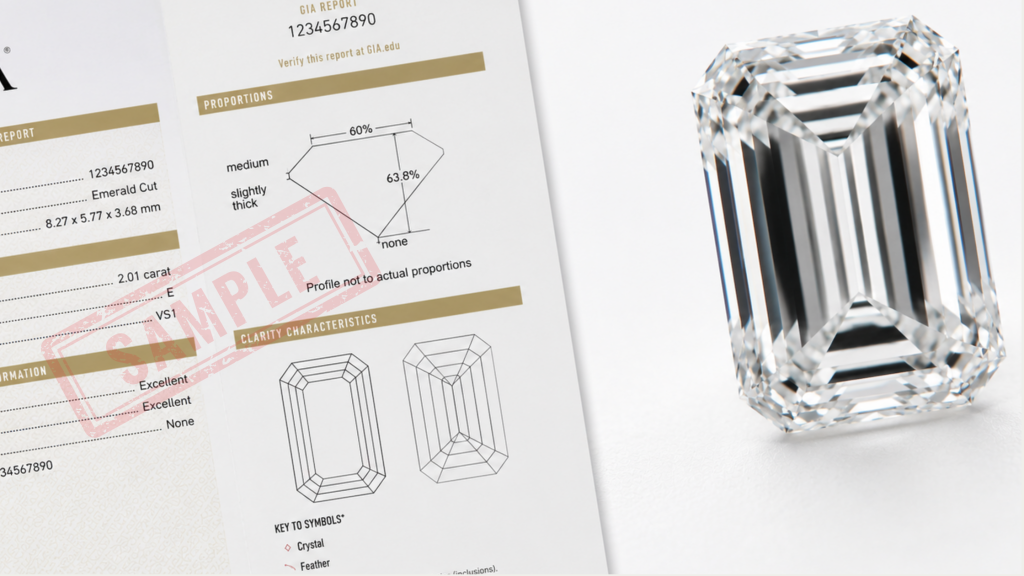
A GIA Diamond Grading Report contains more information than most buyers know to look for. Here is what each section tells you.
Shape and cutting style. This describes the outline and facet arrangement, for example, “Round Brilliant” or “Oval Modified Brilliant.” Not a quality indicator, just a descriptor.
Measurements. The stone’s dimensions in millimetres. For a round brilliant: minimum diameter, maximum diameter, and depth. For fancy shapes: length x width x depth. This is how you verify the stone matches what you are being shown.
Carat weight. The weight to two decimal places. Every 0.01 carat is recorded.
Color grade. For white diamonds, the D-to-Z scale. For fancy color, the full hue, tone, saturation, and intensity grade. This is the section that requires the most expertise to interpret correctly for colored stones.
Clarity grade. One of the 11 grades from Flawless to I3. The accompanying clarity diagram (if present) plots inclusion positions and types. Knowing what type of inclusion is present is as important as the grade itself. A cloud near the center of an SI1 is different from a pinpoint near the girdle.
Cut grade. For round brilliants only, GIA does not assign cut grades to fancy shapes. Excellent is the top grade.
Polish and symmetry. Each graded from Excellent to Poor. For any serious purchase, both should be Very Good or Excellent.
Fluorescence. Described as None, Faint, Medium, Strong, or Very Strong, with the predominant color (usually Blue). Strong blue fluorescence in D-F stones can cause concern; in H-J stones it can actually improve appearance. Neither is automatically good or bad.
Comments. This section notes anything that is not captured by standard grading, surface graining, clarity characteristics not shown on the plot, and for chameleon diamonds and fancy color stones, specific notes on color origin or behaviour.
Laser inscription. The GIA report number inscribed on the girdle. Verify this against the physical diamond using a loupe or provided viewer.
PASAVAJA’s Certification Standard
At PASAVAJA, GIA certification is mandatory for all fancy color diamonds we source and supply. For natural white diamonds, GIA is strongly preferred. For certain categories, particularly antique cuts and specialty shapes where GIA reports may reflect modern cut grading criteria that do not apply, we may work with appropriately certified alternatives, and we explain this context clearly to every client.
Harsh Shah’s GIA alumni background, combined with his training at the De Beers Institute of Diamonds and Rapaport Academy, means that our reading of a grading report goes beyond the grades themselves. We assess the full report in the context of what a buyer needs to know: whether a clarity characteristic affects beauty, whether a color grade accurately reflects what the eye sees, and whether the stone as graded represents genuine value at its asking price.
For buyers considering a significant purchase, our diamond buying consultation service includes a full GIA report review, with no sales agenda attached.
Expert Buying Tips for Diamond Certification
The single most important piece of guidance on certification is simple: always buy from a GIA-certified stone for any significant natural diamond purchase, especially for fancy color.
Beyond that:
Always verify the GIA report number through GIA’s online Report Check at gia.edu before completing a purchase. This confirms the report is genuine and matches the stone you are buying.
Understand that a certificate is a snapshot. It reflects the diamond’s condition at the time of grading. Treatments, damage, or recutting after grading are not reflected on the original report.
For fancy color diamonds, the certificate’s color description matters more than any other single factor. A “Fancy Vivid Yellow” and a “Fancy Intense Yellow” can differ significantly in value for stones of the same carat weight and clarity. The intensity grade drives the price.
Do not confuse certification with appraisal. A GIA report tells you what a diamond is. An independent appraisal tells you what it might be worth to sell or insure. These are different documents serving different purposes.
If a seller is reluctant to provide a GIA certificate for a stone of meaningful value, treat that reluctance as a serious red flag.
Conclusion
Diamond certification is not a formality. It is the document that protects your investment, allows honest price comparison, and tells you exactly what you are buying. For natural diamonds, GIA remains the global benchmark, not because it is the only option, but because its grading methodology is the most consistently applied and the most widely trusted in the industry. For fancy color diamonds specifically, a GIA Fancy Color Diamond Grading Report is the only document that carries real authority in the global market.
IGI has a legitimate role in the market, particularly for lab-grown diamonds and lower-value naturals. But understanding the grade difference between labs before you buy is essential, especially when significant money is involved.
At PASAVAJA, every fancy color diamond we source comes with GIA certification as a non-negotiable standard. Our approach to white diamonds is the same: GIA first, and always with a full expert reading of the report to ensure you understand what the grades mean in practice.
All PASAVAJA diamonds come with the right certification. Request a price quotation and let us walk you through the grading report together.
Thinking about a natural diamond and want an expert eye on the certificate before you commit? We would love to help.
Connect with Harsh Shah and the PASAVAJA team directly:
WhatsApp: +91 887 9999 787 (fast reply guaranteed) Email: info@pasavaja.com
We can help you with:
- GIA certified natural diamonds, white and fancy color
- Certificate analysis and grading report review
- Fancy color diamond sourcing and assessment
- Antique and rare diamond shapes
- Bespoke fine jewelry
Or book a diamond buying consultation for a full expert review before you buy.
FAQ
1. What is a GIA diamond certificate?
A GIA diamond certificate is an independent assessment of a diamond’s key characteristics: shape, measurements, carat weight, color, clarity, cut, polish, symmetry, and fluorescence. Produced by the Gemological Institute of America, it is the global benchmark for natural diamond certification.
2. What is the difference between GIA and IGI?
GIA grades more consistently and strictly than IGI, especially for color and clarity. A stone graded G/VS1 by IGI may grade H or I in color by GIA. For fancy color diamonds, only GIA carries full global authority. IGI is more common for lab-grown diamonds and lower-value natural stones.
3. Is a GIA certified diamond worth more?
GIA-certified diamonds typically command a market premium because buyers trust GIA’s grading consistency. An IGI-graded stone at the same stated grade may represent a lower-quality stone, which is why GIA stones generally cost more at the same listed grade.
4. How do I read a GIA diamond grading report?
Start with the four main grades: color, clarity, cut, and carat weight. For fancy color diamonds, read the full color description including hue, tone, saturation, and intensity. Check the clarity diagram for inclusion type and position. Verify the report number matches the laser inscription on the diamond’s girdle.
5. Can a diamond have two certificates?
Yes. Some diamonds are submitted to more than one lab. If a seller provides two certificates and the grades differ significantly, the more generous grade may not be accurate. GIA’s report takes precedence in the global market.
6. Does lab certification change a diamond’s quality?
No. Certification describes quality: it does not change it. A GIA report is a reliable, independent description of what a stone is. The certificate allows you to make a proper value assessment, but the quality of the diamond itself is unchanged by which lab assessed it.
7. What does the comments section of a GIA report mean?
The GIA comments section notes anything outside standard grading descriptions, surface graining, clarity characteristics not on the plot, treatments, and for chameleon or fancy color diamonds, notes on color behaviour or origin. Always read this section before buying.
Every stone is photographed and graded before it is listed. Join the list to see them before they reach the shop.
New stones only, no more than once a month. Unsubscribe any time.
Tell us the grade, shape and range. We will only send stones that genuinely match.