Purple Color Diamond Explained
On this page
If you have ever come across a purple diamond and felt completely captivated, you are not alone. Purple diamonds sit in a rare category of fancy color stones that most people have never seen in person, and very few dealers can speak about with real authority. Harsh Shah, who has spent years studying the science and market behind fancy color diamonds at the highest level, finds purple diamonds particularly fascinating precisely because so much about them remains scientifically unsettled. That mystery, combined with their extraordinary scarcity, makes them one of the most compelling stones a collector can pursue.
This guide covers everything you need to know about purple diamonds, what causes their color, how GIA grades them, the critical difference between purple and violet, what drives their price, and how to find a stone worth owning. If you already know what you are looking for, browse our natural purple diamonds for sale.
What Is a Purple Diamond?
A natural purple diamond is a fancy color diamond that displays a violet-to-purple hue caused by structural distortions within the diamond’s crystal lattice, most likely linked to the presence of hydrogen. Unlike yellow or brown diamonds, which are relatively common, true purple diamonds are extraordinarily rare and appear on the market only occasionally.
Purple diamonds range in tone from soft lavender and lilac to deep plum and grape. The color can appear as a primary hue or in combination with modifiers such as pink, gray, or violet. GIA-certified natural purple diamonds are found in only a handful of sources worldwide, with the Argyle mine in Western Australia historically producing some of the finest and deepest examples, though the Argyle mine closed in 2020, making existing stones from that source increasingly collectible.
What makes purple diamonds unusual is that their color mechanism is not as well understood as other fancy color diamonds. Yellow diamonds get their color from nitrogen. Blue diamonds from boron. But for purple diamonds, the scientific consensus points toward hydrogen as a contributing factor, though this has not been definitively proven. Harsh Shah is candid about this gap in the science, and that honesty matters, because it separates genuine diamond expertise from recycled information.
You can explore the broader world of natural fancy color diamonds on the PASAVAJA fancy colored diamonds education page.

Purple vs Violet: The GIA Distinction That Matters
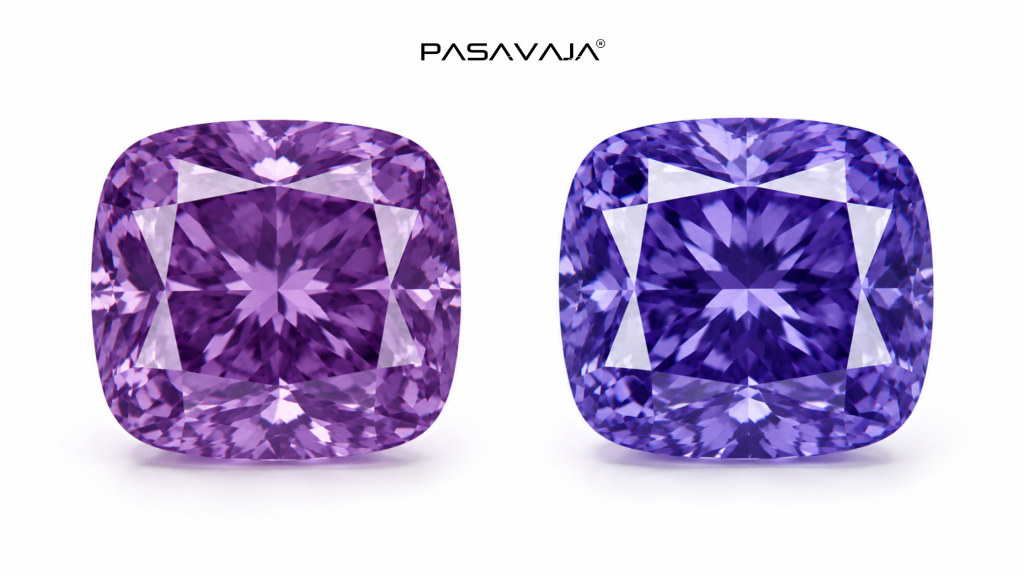
Many buyers use the words purple and violet interchangeably. GIA does not. The difference between a purple diamond and a violet diamond on a GIA grading report is specific, deliberate, and has real implications for how a stone is valued and positioned in the market.
On a GIA report, purple describes a diamond where the dominant hue is purple, a warm, red-leaning color. Violet describes a diamond where the dominant hue is violet, which sits closer to blue on the spectrum. The two colors are related but visually distinct, and GIA’s trained gemologists assess them separately.
This distinction matters enormously for buyers and collectors. A stone graded Fancy Vivid Purple carries a very different market positioning than one graded Fancy Violet or Fancy Grayish Violet. Many consumers who search for “purple diamond” will actually encounter violet diamonds in the results, because dealers sometimes use the terms loosely. Knowing the difference before you shop protects you from buying the wrong stone at the wrong price.
| Characteristic | Purple Diamond | Violet Diamond |
|---|---|---|
| GIA Hue Name | Purple | Violet |
| Position on Spectrum | Warm, red-leaning | Cool, blue-leaning |
| Common Modifiers | Pink-Purple, Grayish-Purple | Grayish-Violet, Bluish-Violet |
| Visual Impression | Grape, plum, lavender | Blue-lilac, periwinkle |
| Argyle Rarity Tier | Yes (PP designation) | Yes (V designation) |
| Collector Appeal | Very high | Very high |
| Typical Source | Australia, Russia | Australia, rare globally |
The Argyle mine used its own classification system that distinguished Purplish Pink (PP) from Violet (V) grades. Both are now post-Argyle stones, making the market increasingly constrained for both categories.
How GIA Grades Purple Diamonds
GIA grades all fancy color diamonds using the same standardised system that evaluates hue, tone, and saturation together to arrive at a color grade. For purple diamonds, the color grades run from Faint through Fancy Light, Fancy, Fancy Intense, Fancy Deep, and the pinnacle, Fancy Vivid.
Faint and Very Light purple diamonds appear almost neutral with only a suggestion of purple. These are affordable entry points but do not deliver the saturated color most collectors seek. Fancy and Fancy Intense purple diamonds show clear, attractive color that reads confidently as purple in normal lighting. Fancy Vivid and Fancy Deep grades are exceptionally rare, commanding significant premiums.
Secondary hues also appear on the GIA report. Common modifiers for purple diamonds include:
- Pinkish Purple (warm, highly desirable)
- Grayish Purple (cooler, more muted, lower premium)
- Bluish Purple (rare, exotic, commands serious collector attention)
- Pink Purple (straddling both colors, often commanding a premium similar to pink diamonds)
For any purple diamond purchase, a GIA grading report is non-negotiable. The color grade and modifier language on the GIA certificate is the only reliable basis for comparison and pricing. You can read GIA’s own overview of fancy color grading at gia.edu.
How Rare Are Natural Purple Diamonds?
Natural purple diamonds are among the rarest of all fancy color diamonds. To put this in context: for every 10,000 carats of diamonds mined globally, fewer than one carat will qualify as a fancy color diamond of any kind. Within that already rare group, purple diamonds represent one of the smallest categories.
The Argyle mine in Western Australia was the world’s most significant source of purple and violet diamonds. Since Argyle’s closure in 2020, no comparable source has emerged to replace it. Some purple diamonds are found in Russia (Yakutia region) and occasionally in Africa, but volume from these sources is sporadic and generally lower in saturation.
This supply constraint has a straightforward implication: fine purple diamonds are becoming harder to source with every passing year. Collectors who acquired Argyle violet and purple stones before the mine closed have seen their pieces appreciate significantly.
What Drives Purple Diamond Prices?
Natural purple diamond prices vary significantly based on the intensity of color, clarity, size, and the presence or absence of a desirable secondary hue. There is no single market price, every stone is evaluated individually, and GIA reports are the foundation for pricing discussions.
As a general framework:
| GIA Color Grade | Approximate Price Range (per carat, USD) | Notes |
|---|---|---|
| Faint to Very Light Purple | $3,000, $8,000 | Gentle suggestion of color |
| Fancy Light Purple | $8,000, $18,000 | Clear color, entry collector level |
| Fancy Purple | $18,000, $45,000 | Confident, attractive saturation |
| Fancy Intense Purple | $45,000, $120,000+ | Strong color, rare in market |
| Fancy Vivid Purple | $120,000+ (often significantly more) | Extremely rare, investment-grade |
| Fancy Deep Purple | Varies; premium for depth and unusual tone | Collector and auction-level |
These ranges are indicative only. A Fancy Intense purple diamond with a Pinkish modifier and VS clarity will trade very differently from a Grayish Fancy Intense of similar grade. The secondary hue, origin (Argyle stones carry a provenance premium), and carat weight all interact to set the final price.
Natural purple diamonds do not have a commodity market the way round brilliant white diamonds do. Each stone is priced on its individual merits, which is why working with an expert who can assess the stone directly is essential, not an online price calculator.
Secondary Colors and What They Mean for Value
Purple diamonds rarely appear in pure, unmodified purple. Most stones carry a secondary hue, and that modifier has a real effect on how desirable, and how valuable, the stone is considered.
Pinkish Purple is widely regarded as the most desirable modifier for purple diamonds. The warmth of the pink component lifts the color and gives the stone a jewelry-ready vibrancy. Stones with this modifier tend to sit at the upper end of the price range for their color intensity grade.
Grayish Purple, by contrast, cools the color and mutes its intensity. These stones are still natural and still rare, but the gray modifier suppresses the visual impact. They typically trade at a discount relative to pure purple or pinkish purple stones of similar grade.
Bluish Purple is genuinely exotic. It sits at the intersection of two of the rarest color families in the diamond world, blue and purple. These stones attract serious collector attention and tend to appear at specialist auction houses rather than in standard trade.
Gray and violet modifiers occupy a middle ground. A Grayish Violet diamond is distinct from a purple diamond in GIA’s system, but buyers in the collector community often track both categories together as part of a rare-color portfolio.
Expert Buying Tips for Purple Diamonds
Buying a purple diamond correctly requires a different approach from buying a white diamond or even a yellow diamond. Here are the principles Harsh Shah applies when sourcing purple stones for clients:
1. Verify the GIA report language carefully. The difference between “purple” and “violet” is not a stylistic choice: it is a specific grading determination. Make sure the stone you are considering is graded with the hue name that matches what you are looking for.
2. Assess color in multiple light sources. Purple diamonds can shift noticeably between daylight, incandescent light, and fluorescent light. A stone that looks strongly purple under gallery lighting might appear grayer under natural light. Ask to see the stone, or quality video footage, in at least two light environments.
3. Treat hydrogen science with appropriate humility. The color mechanism in purple diamonds is not fully resolved scientifically. Any dealer who claims absolute certainty about why a specific stone is purple is overstating what is known. Honest uncertainty here is a sign of real expertise.
4. Consider Argyle provenance. If a seller claims a stone is from the Argyle mine, ask for documentation. Argyle stones often came with an Argyle certificate of authenticity. Post-Argyle, provenance claims without documentation should be treated with caution.
5. Clarity standards are more flexible for purple diamonds. Unlike colorless diamonds, where clarity grade affects visual appearance significantly, a purple diamond’s color saturation can mask inclusions. VS2 and even SI1 purple diamonds can be eye-clean and visually stunning. Prioritise color over clarity in this category.
6. Do not compare prices to white diamonds. Purple diamonds operate in a thin, specialist market. Pricing logic from the white diamond world does not apply here. Work with a dealer who trades in fancy color regularly and can provide real market comparables.
For a broader context on the full spectrum of rare natural fancy color diamonds, visit the PASAVAJA fancy color education hub.
Settings and Jewelry Styles for Purple Diamonds
The setting you choose for a purple diamond should serve the stone’s color, specifically, it should protect and amplify what makes the diamond special.
White gold and platinum are the most common choices for purple and violet diamonds. The neutral metal does not compete with the stone’s hue and allows the purple to register clearly. For lighter lavender stones with a grayish modifier, platinum’s cool white can actually help brighten the color perception.
Rose gold is worth considering for Pinkish Purple diamonds specifically. The warmth of rose gold flatters the pink modifier and creates a beautifully cohesive color story between the metal and the stone.
Yellow gold is generally not recommended for purple diamonds. The yellow undertone of the metal can shift the visual perception of the stone toward a brownish-lavender that flattens the color rather than enhancing it.
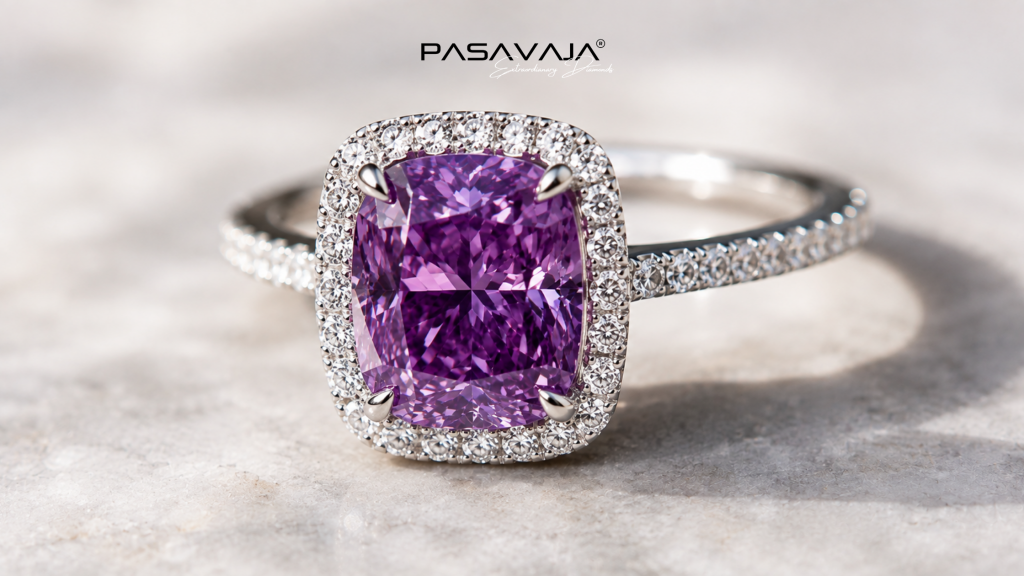
Bezel and halo settings work particularly well for smaller purple diamonds because they add apparent size and help concentrate the color at the center. For larger, well-saturated stones, a classic four- or six-prong solitaire lets the color speak without visual competition.

PASAVAJA’s Expertise in Purple and Rare Fancy Color Diamonds
At PASAVAJA, sourcing rare fancy color diamonds like purple diamonds is not a side offering: it is one of the things we do most carefully. Harsh Shah is personally involved in evaluating every significant fancy color stone the team considers, and purple diamonds receive particular attention because the science behind them demands a level of grading literacy that goes beyond what most dealers bring to the table.
Every purple diamond at PASAVAJA is GIA-certified. We do not sell natural fancy color diamonds without a GIA grading report, and we will always walk you through the report language in detail, including what the hue modifier means for value and how the color grade was determined.
Our services include:
- Loose natural purple and violet diamond sourcing
- Bespoke fine jewelry manufacturing in platinum and 18K gold
- Transparent education-first guidance, no pressure, no sales tactics
- GIA-certified natural diamonds across all fancy color categories
- Free worldwide shipping
- Fully insured delivery
- Personalized buying assistance via WhatsApp or email
We are a second-generation diamond family business, and Harsh’s direct involvement in every sourcing decision is what separates PASAVAJA from a retail operation. When you ask about a purple diamond, you are speaking with someone who has studied them at the grading level, sourced them in the market, and can speak honestly about what is known and what is not.
If you are exploring other rare color categories, you may also find our pink diamond guide and gray diamond guide useful, both are closely related to the purple and violet family.
Conclusion: Why Purple Diamonds Are Worth Understanding
Purple diamonds are one of the most genuinely rare and least understood categories in the fancy color world. Their color mechanism is still not completely resolved by science. Their primary source, the Argyle mine, is permanently closed. And the distinction between purple and violet, which GIA makes with precision, is lost on most buyers and even many dealers.
That gap in understanding is exactly where an educated buyer can find exceptional value and make acquisition decisions with real confidence. A fine Fancy Intense Pinkish Purple diamond, correctly identified and properly certified, is the kind of stone that becomes a centrepiece of a serious collection.
Whether you are a first-time fancy color buyer or an experienced collector looking to add a purple stone to your portfolio, we would love to help you find something truly exceptional.
Connect with Harsh Shah and the PASAVAJA team directly:
WhatsApp: +91 887 9999 787 (fast reply guaranteed) Email: info@pasavaja.com Contact page: contact the team
We can help you with:
- Loose natural purple and violet diamonds
- Fancy color diamonds across all hues and grades
- Antique and rare diamond shapes
- Bespoke fine jewelry in platinum and 18K gold
- GIA-certified investment-grade and collector-grade diamonds
- Custom sourcing for one-of-a-kind stones
FAQ
1. What is a purple diamond?
A natural purple diamond is a fancy color diamond displaying a purple hue caused by structural distortions in the crystal lattice, most likely related to hydrogen. They are among the rarest of all fancy color diamonds. All investment-grade purple diamonds carry a GIA grading report.
2. What is the difference between a purple diamond and a violet diamond?
GIA treats purple and violet as separate hue designations. Purple diamonds lean warm, toward red. Violet diamonds lean cool, toward blue. They are visually distinct, priced differently, and should not be confused. Always check the GIA report hue name when considering a purchase.
3. What causes the purple color in a diamond?
The scientific consensus points toward hydrogen as a contributing factor to purple color in diamonds. However, the exact mechanism has not been fully proven. Honest experts acknowledge this uncertainty rather than overstating what is currently known about the color cause.
4. Are natural purple diamonds rare?
Yes, extremely rare. Purple diamonds are one of the smallest categories within fancy color diamonds. With the Argyle mine permanently closed since 2020, fine purple diamonds are becoming increasingly difficult to source, adding to their collectibility and investment appeal.
5. How much does a natural purple diamond cost?
Natural purple diamonds range from approximately $3,000 per carat for Faint grades to over $120,000 per carat for Fancy Vivid examples. GIA color grade, secondary hue modifier, clarity, and carat weight all affect price. Pinkish Purple stones command a premium over Grayish Purple at equivalent grades.
6. What is the difference between a lilac diamond and a purple diamond?
Lilac is a trade description, not a GIA grading term. It typically refers to a light, cool purple, what GIA would grade Faint to Fancy Light Purple. Always rely on GIA grading language rather than trade descriptors when evaluating a purple diamond.
7. Are violet and purple diamonds the same thing?
No. GIA grades them separately. Violet diamonds have a cool, blue-leaning hue. Purple diamonds are warmer and red-leaning. Both are exceptionally rare, but they are distinct color categories with different visual identities and separate market positioning.
Every stone is photographed and graded before it is listed. Join the list to see them before they reach the shop.
New stones only, no more than once a month. Unsubscribe any time.
Tell us the grade, shape and range. We will only send stones that genuinely match.