Black Color Diamond Explained
On this page
Most black diamond jewelry you see in stores and online is made with treated stones, not natural ones. That distinction matters more than most buyers realize, and it directly affects value, rarity, and what you are actually purchasing. Harsh Shah, Director at PASAVAJA Gems LLP and Graduate Diamonds (GIA), whose expertise in fancy color diamond grading is recognized at the highest levels of the trade, is direct about this: “Most black diamond jewelry on the market is treated, not natural. The difference in value is significant and buyers deserve to know this upfront.” This guide gives you the complete picture on black diamonds so you can buy with full confidence.
What Is a Black Diamond?
A black diamond is a diamond that appears entirely opaque and black rather than transparent. Black diamonds are formed from carbon just like all other natural diamonds, but the mechanism that creates their color is very different from how yellow or pink diamonds get their hue. Instead of atomic-level trace elements causing color, black diamonds owe their appearance to a high concentration of mineral inclusions and internal fractures throughout the crystal structure.
These inclusions, often consisting of graphite, pyrite, or hematite, absorb light rather than reflecting or refracting it. This is why black diamonds look opaque rather than transparent. They have a metallic, almost mirror-like luster when polished, which gives them a dramatically different visual character from any other colored diamond.
There are two types of black diamonds in the market: natural and treated. Understanding this distinction is the foundation of everything in this guide.

Natural vs Treated Black Diamonds, The Most Important Distinction
Natural black diamonds and treated black diamonds look almost identical to the naked eye. Both appear opaque black with a metallic surface. But they are fundamentally different products, and the difference in value is significant.
Natural black diamonds are diamonds that formed in the earth with their black color already present. The most well-known type of natural black diamond is the carbonado. Their color is a result of millions of years of natural inclusion formation inside the crystal.
Treated black diamonds are diamonds that started as low-quality white or brown diamonds with heavy inclusions, typically I2 or I3 in clarity. These stones are then subjected to high heat or irradiation processes to darken the inclusions and turn the entire stone black. The treatment is a manufacturing intervention. A treated black diamond begins its life as a near-worthless colorless stone and is artificially converted.
Here is a direct comparison:
| Characteristic | Natural Black Diamond | Treated Black Diamond |
|---|---|---|
| Origin of color | Natural inclusions formed over millions of years | Artificial heat or irradiation treatment |
| Starting material | Naturally dark rough (often carbonado) | Low-quality white/brown diamond (I2/I3) |
| GIA notation | “Natural Fancy Black” | “Fancy Black” (no “Natural” prefix) |
| Rarity | Genuinely rare | Very common |
| Value | Significantly higher | Low |
| Appearance | Near-identical to treated | Near-identical to natural |
| Certification | GIA report required to distinguish | GIA report required to distinguish |
The only reliable way to tell the difference between natural and treated black diamonds is through a GIA grading report. Without certification, you cannot know what you are buying. This is not an opinion. It is a practical reality of the black diamond market.
You can read more about why GIA certification matters across all diamond categories on our GIA diamond certification guide.
Carbonado, The Unique Natural Black Diamond
Carbonado is the rarest and most scientifically fascinating type of natural black diamond. Unlike most natural diamonds that form as a single crystal deep in the earth’s mantle, carbonado has a polycrystalline structure, meaning it is made up of millions of tiny interlocked diamond crystals rather than one continuous lattice.
Carbonado is found almost exclusively in the Central African Republic and Brazil. Its formation is still not fully understood by scientists, and several theories have been proposed including an extraterrestrial origin, which remains a subject of genuine scientific debate. What is certain is that carbonado cannot be replicated in a treatment process. Its structural difference from a treated black diamond is detectable under advanced gemological testing.
Carbonado black diamonds are typically not faceted in the traditional sense. Their polycrystalline nature makes them challenging to cut. Most are shaped into cabochons or given minimal faceting. This is part of what makes them so visually distinct from other diamonds, and part of what makes them genuinely rare collector stones.
How GIA Grades Black Diamonds
GIA uses a specific and deliberately simple grading approach for black diamonds, and understanding this is essential for any buyer.
For colorless and near-colorless diamonds, GIA uses its 23-grade D-to-Z color scale along with its standard clarity grading system. Black diamonds do not follow this system. They cannot be graded on that scale because they are entirely opaque.
GIA grades black diamonds on a simple three-grade color scale: Fancy Black, Fancy Gray-Black, and Fancy Black with a secondary hue modifier where applicable. The critical element is the word “Natural” in the description.
A GIA report that states “Natural Fancy Black” confirms that the color is of natural origin. A report that states only “Fancy Black” without the word Natural indicates a treated stone. This one word is the key to everything.
GIA does not assign a clarity grade to black diamonds because the concept of clarity does not apply to an opaque stone in the traditional sense. They are simply noted as opaque. GIA will note whether the color origin is natural or treated in the “Color Origin” field on the grading report.
Always request the full GIA Colored Diamond Grading Report for any black diamond you consider purchasing, not just a GIA Dossier or memo. The Color Origin notation is one of the most important pieces of information on that document.
For a deeper understanding of how GIA grades all colored diamonds, our colored diamonds guide covers the full intensity grading system and what to look for across all fancy color categories.

How to Verify Natural vs Treated Black Diamonds
The question buyers often ask is: can you tell the difference just by looking? The honest answer is no. Not reliably, not even for an experienced professional, and certainly not without specialist equipment.
Here is what you need to do to verify what you are purchasing:
Step 1: Request the GIA Grading Report. This is non-negotiable. Ask for the report number, verify it at gia.edu, and confirm the Color Origin field reads “Natural.” If the report does not exist or the seller hesitates to share it, that is your answer.
Step 2: Confirm the report is a Colored Diamond Grading Report, not a simplified document. Some sellers present GIA Dossiers or other abbreviated reports. For black diamonds, you need the full Colored Diamond Grading Report which includes the Color Origin field.
Step 3: Check the surface luster. Natural black diamonds, particularly carbonados, often have a slightly different surface texture than treated stones. Treated diamonds may show faint surface cracking or a more uniform matte appearance. This distinction requires experience to identify and should never replace a GIA report, but it is worth noting.
Step 4: Work with a specialist. If you are making a significant purchase, work with a dealer who can explain the provenance of the stone and has a track record of transparent disclosure. At PASAVAJA, every black diamond we source is GIA certified, and the certification documents are shared in full before any purchase decision.
Value and Market Pricing
Natural and treated black diamonds occupy entirely different market positions, and understanding this prevents costly mistakes.
| Diamond Type | Typical Price Range (per carat) | Best For |
|---|---|---|
| Treated black diamond (commercial quality) | USD 50 to USD 300 per carat | Fashion jewelry, trend-driven purchases |
| Natural fancy black diamond (GIA certified) | USD 1,500 to USD 5,000+ per carat | Collectors, investment-grade purchases |
| Natural carbonado black diamond | USD 3,000 to USD 10,000+ per carat | Serious collectors, rare stone category |
Prices vary based on size, surface quality, shape, and the specific characteristics of the stone. These are indicative ranges based on general trade knowledge.
The treated black diamond market is dominated by commercial jewelry production. Many fashion jewelry brands use treated stones at low price points and do not disclose the treatment prominently. There is nothing inherently wrong with purchasing a treated black diamond for fashion jewelry, as long as you know what you are buying and pay accordingly.
The natural black diamond market is a genuine specialist category. Demand has grown meaningfully over the past decade, partly driven by the growing interest in non-traditional engagement rings, and partly by collectors who appreciate the stone’s rarity and unusual character.
For investment-grade black diamond purchases, natural carbonado stones certified by GIA represent the highest tier. These stones are rare, scientifically unique, and genuinely scarce in the global market.
Expert Buying Tips for Black Diamonds
When buying a black diamond, the principles of good diamond buying are magnified because the visual inspection cannot reveal what the certification can.
Start with the GIA report and work backward to the stone. If a seller cannot provide a GIA Colored Diamond Grading Report with a “Natural” Color Origin notation, do not assume the stone is natural. Assume it is treated until proven otherwise.
Understand that size can be found more easily in treated stones. Natural black diamonds above 5 carats are genuinely rare. If someone offers you a natural 10-carat black diamond at an unusually low price, ask to verify the GIA report immediately.
Think about setting choice carefully. Black diamonds are striking in platinum and white gold, which creates a high-contrast, modern look. Yellow gold softens the contrast and creates a warmer aesthetic. Rose gold creates an interesting tension between warmth and drama. Heer Shah, who leads jewelry design and bespoke manufacturing at PASAVAJA, recommends bezel or half-bezel settings for black diamonds because the opaque nature of the stone benefits from a clean, enclosed setting that emphasizes the surface rather than any depth within the stone.
Consider the occasion and intent. Natural black diamonds in collector or investment contexts should always be loose stones first, certified, then set. If you are purchasing for fashion jewelry and a treated stone meets your budget and aesthetic, that is a legitimate choice, provided you understand the distinction.
For engagement rings, natural black diamonds are a bold, meaningful choice. They carry a striking visual contrast against pale skin tones and work beautifully with pavé white diamond side stones or halo settings. Our colored diamonds guide has more on choosing fancy color stones for meaningful occasions.
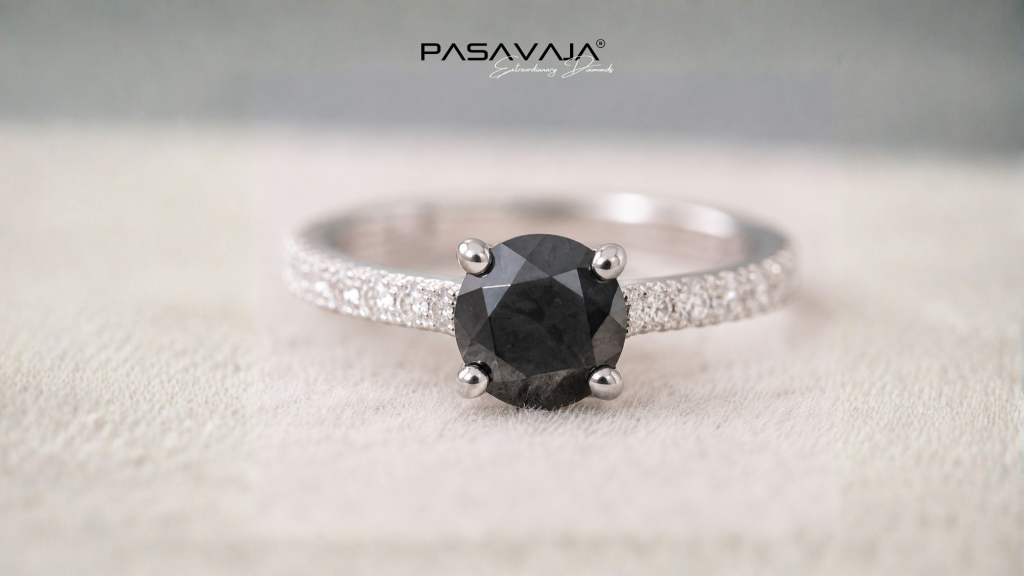
Settings and Jewelry Styles for Black Diamonds
Black diamonds have a bold, high-contrast visual presence that responds well to specific setting styles and metal choices.
Platinum is the most popular metal for black diamond jewelry. The cool silver of platinum against the near-black surface of the diamond creates maximum contrast and a contemporary, sophisticated look. Platinum is also extremely durable, which matters for daily-wear pieces like rings.
18K white gold produces a very similar result to platinum visually and is slightly more affordable. It requires rhodium plating to maintain its white appearance over time, but for rings worn regularly, this is a straightforward maintenance consideration.
18K yellow gold creates a warmer, more vintage-adjacent aesthetic. The contrast between gold and black is dramatic and luxurious in a different way to the platinum pairing. Many bespoke commissions for collectors who want something distinctive use yellow gold with a black diamond as the centrepiece.
Bezel settings work particularly well because they protect the perimeter of the stone and create a clean, architectural frame. Black diamonds do not benefit from prong settings the way transparent diamonds do, since you are not trying to maximize light entry.
Halo settings with white diamonds are popular for black diamond engagement rings. The surrounding white diamonds amplify the visual impact of the center stone and add traditional sparkle to what is otherwise a dramatically different choice.
For bespoke black diamond jewelry or to explore setting options with PASAVAJA’s in-house design expertise, you can reach us through our contact page.
PASAVAJA’s Expertise in Natural Black Diamonds
At PASAVAJA, our position on black diamonds is the same as our position on every diamond category: transparency first, education always. Harsh Shah personally reviews the sourcing and certification of every colored diamond we offer, and natural black diamonds are no exception.
We source only GIA-certified natural black diamonds. Every stone we offer includes the full GIA Colored Diamond Grading Report, and we provide the report details before any commitment is made. If a stone is treated, we say so. We do not obscure the distinction between natural and treated because it matters to every buyer who is making an informed purchase.
PASAVAJA offers:
- Loose natural black diamonds with full GIA certification
- Natural carbonado black diamonds for serious collectors
- Bespoke fine jewelry manufacturing in platinum and 18K gold
- Transparent, expert-led guidance through Harsh Shah and Heer Shah directly
- Free worldwide shipping on all purchases
- Fully insured delivery
- Personalized buying assistance via WhatsApp and email
Our second-generation family diamond legacy means you are working with specialists who have a genuine stake in your satisfaction and in the long-term reputation of our business. We are not a catalog retailer. Every significant purchase is guided personally.
Conclusion
Black diamonds occupy a genuinely fascinating and misunderstood category. They are dramatic, unusual, and increasingly sought after by buyers who want something bold and meaningful. But the market is deeply divided between natural stones that carry real rarity value and treated stones that are commercially common.
The takeaway is simple: if you are considering a black diamond, start with the GIA grading report. The word “Natural” in the Color Origin field is the difference between a rare collector-grade stone and a commercially treated product. Once you understand that distinction, you can make a genuinely informed decision about what fits your intention, budget, and aesthetic.
Natural black diamonds, particularly carbonado stones, are one of the more unusual and scientifically remarkable categories in the entire colored diamond world. For the right buyer, they represent something genuinely rare.
Thinking about adding a natural black diamond to your collection or designing something completely distinctive? We would love to help.
Connect with Harsh and the PASAVAJA team directly:
WhatsApp: +91 887 9999 787 (fast reply guaranteed) Email: info@pasavaja.com
We can help you with:
- Natural GIA-certified black diamonds (natural and carbonado)
- Antique and rare diamond shapes
- Bespoke fine jewelry in platinum and 18K gold
- Investment-grade and collector colored diamonds
- Custom sourcing for rare and one-of-a-kind stones
Ask About Natural Black Diamond Certification
FAQ
1. Are black diamonds real diamonds?
Yes, black diamonds are genuine diamonds made of carbon. Natural black diamonds form in the earth over millions of years. Their color comes from mineral inclusions that absorb light, making them appear opaque. They are chemically identical to colorless diamonds.
2. What is the difference between natural and treated black diamonds?
Natural black diamonds form with their color already present due to mineral inclusions. Treated black diamonds start as low-quality white or brown diamonds that are heated or irradiated to darken them. A GIA Colored Diamond Grading Report is the only reliable way to distinguish the two.
3. What is a carbonado black diamond?
Carbonado is a rare natural black diamond with a polycrystalline structure composed of millions of interlocked diamond crystals. Found almost exclusively in Central Africa and Brazil, carbonado is scientifically unique and among the rarest black diamonds. Its exact formation is still debated by scientists.
4. How does GIA grade black diamonds?
GIA uses the term Natural Fancy Black for diamonds with a naturally occurring color origin and Fancy Black for treated stones. No standard clarity grade is assigned because black diamonds are opaque. The Color Origin field on the GIA Colored Diamond Grading Report is the key distinction buyers must check.
5. Can you tell if a black diamond is treated just by looking at it?
No. Natural and treated black diamonds look nearly identical to the naked eye and under basic magnification. Advanced gemological testing and a full GIA Colored Diamond Grading Report are needed to reliably distinguish the two. Visual inspection alone is not sufficient.
6. Are black diamonds more affordable than colorless diamonds?
Treated black diamonds are significantly more affordable as they start as low-quality stones. Natural GIA-certified black diamonds range from USD 1,500 to USD 5,000 or more per carat depending on size and type. Carbonado stones command a premium at the top of the natural black diamond market.
7. Do black diamonds sparkle?
Black diamonds do not sparkle in the traditional sense because they are opaque and do not transmit light. Instead, they display a distinctive metallic surface luster. The visual effect is bold and dramatic but different from the fire and scintillation seen in transparent colored or colorless diamonds.
Every stone is photographed and graded before it is listed. Join the list to see them before they reach the shop.
New stones only, no more than once a month. Unsubscribe any time.
Tell us the grade, shape and range. We will only send stones that genuinely match.