Diamond Clarity Guide
On this page
Diamond clarity is one of the most misunderstood parts of buying a natural diamond. Ask any buyer what they want and many will say Flawless, but here is the truth: for most people, most of the time, Flawless is a certificate number that makes absolutely no visual difference to the stone in front of them.
Harsh Shah, Director at PASAVAJA Gems LLP and Graduate Diamonds (GIA), is direct about this. In his words: ‘Eye-clean is the single most practical clarity concept for buyers. If you cannot see the inclusion without magnification, you are paying for a laboratory number, not visual beauty.’ That insight drives how PASAVAJA guides every client toward the right clarity grade for their diamond.
This guide walks you through all 11 GIA clarity grades, explains what eye-clean actually means, identifies the sweet spots by shape and budget, and tells you which grades to avoid and why.
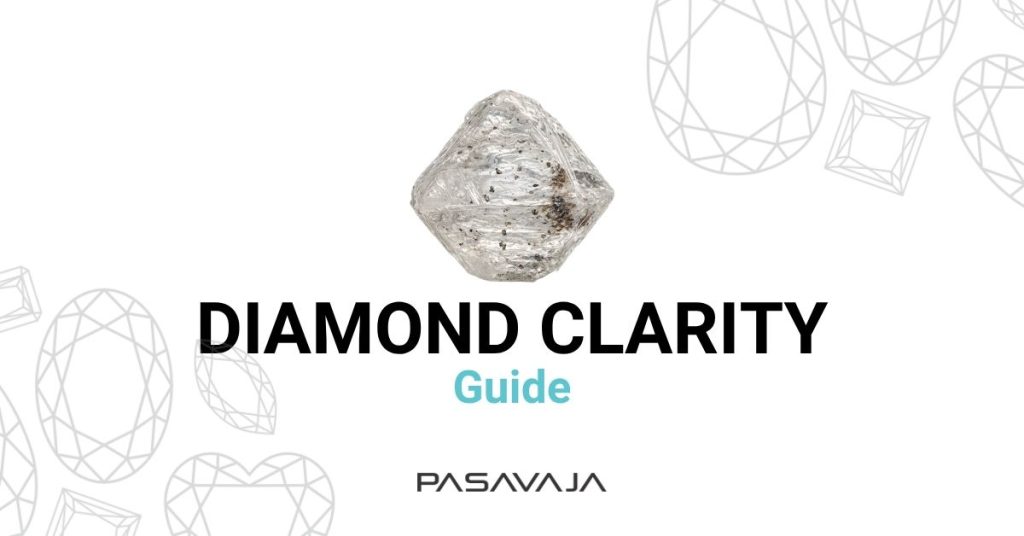

What Is Diamond Clarity?
Diamond clarity measures the presence and visibility of internal characteristics (inclusions) and surface irregularities (blemishes) in a natural diamond. GIA grades clarity under 10x magnification on an 11-point scale, from Flawless (FL) at the top to Included (I3) at the bottom. Clarity has no impact on sparkle in grades FL through SI1 for brilliant cuts.
Natural diamonds form deep in the earth under extreme heat and pressure. During that process, tiny crystals, feathers, needles, and other materials can become trapped inside the stone. These are inclusions. External marks from cutting and polishing are blemishes.
GIA’s clarity grading examines a polished diamond under 10x magnification, looking at the size, nature, number, relief, and position of any characteristics. That last factor matters a lot. An inclusion sitting under the table of the diamond, right in the center, is more visible and more impactful than one tucked near the girdle edge.
Want to understand how clarity fits alongside the other 4Cs? Start with our complete white diamond buying guide before diving into individual grades.
The GIA Clarity Scale, All 11 Grades Explained
GIA uses 11 clarity grades grouped into six categories: Flawless (FL), Internally Flawless (IF), Very Very Slightly Included (VVS1/VVS2), Very Slightly Included (VS1/VS2), Slightly Included (SI1/SI2), and Included (I1/I2/I3). Each grade reflects what a skilled grader can observe under standardised 10x magnification.
Here is how each grade is defined and what it means for a real buyer.
Flawless (FL)
No inclusions or blemishes are visible under 10x magnification by a skilled grader. Fewer than 1% of all diamonds ever graded receive this designation. FL diamonds are priced at a significant premium and are primarily of interest to collectors and investors rather than everyday buyers. Visually, a Flawless diamond is indistinguishable from a VS1 to the naked eye.
Internally Flawless (IF)
No inclusions visible under 10x. Minor surface blemishes only, which can sometimes be polished away. IF diamonds carry a substantial premium and offer no visible advantage over VS-grade stones in a finished ring. The grading is exceptionally strict and some stones can move between IF and VVS1 depending on the grader.
Very Very Slightly Included 1 and 2 (VVS1 / VVS2)
Inclusions are present but so minute they are extremely difficult to see even under 10x magnification. VVS1 has inclusions observable only from the pavilion side; VVS2 inclusions may be observable from the crown. Both grades are entirely invisible to the naked eye under any circumstances. These grades command a meaningful premium over VS grades with no visual return for most buyers.
Very Slightly Included 1 and 2 (VS1 / VS2)
Minor inclusions that are clearly observable under 10x but require effort to find. VS1 inclusions are typically smaller or positioned more favourably than VS2. Both grades are eye-clean in virtually every diamond shape at every carat weight, making them excellent choices for buyers who want a clean stone with a justifiable price.
Slightly Included 1 and 2 (SI1 / SI2)
Inclusions are noticeable under 10x magnification and may be visible to the naked eye depending on the stone and its shape. SI1 is frequently eye-clean in brilliant cuts like round, oval, and cushion, but should be evaluated stone-by-stone. SI2 inclusions are more likely to be visible without magnification and demand careful inspection before purchase.
Included 1, 2, and 3 (I1 / I2 / I3)
Inclusions are obvious under 10x and typically visible to the naked eye. I2 and I3 grades can also affect the structural integrity of the stone in severe cases. PASAVAJA does not carry I-grade diamonds in its primary collection. These grades are generally not recommended for fine jewelry.
GIA Clarity Grade Reference Table
Use this table as a practical reference when reading a GIA certificate or comparing diamonds.
| Grade | Category | Definition | Visible Naked Eye | Eye-Clean | Best For | Price Tier |
|---|---|---|---|---|---|---|
| FL | Flawless | No inclusions or blemishes at 10x | No | Yes | Collectors / Investors | Ultra-premium |
| IF | Internally Flawless | No inclusions; minor surface blemishes | No | Yes | Collectors / Investors | Ultra-premium |
| VVS1 | VVS | Extremely difficult to see at 10x | No | Yes | Investment / Premium buyers | Premium |
| VVS2 | VVS | Very difficult to see at 10x | No | Yes | Investment / Premium buyers | Premium |
| VS1 | VS | Clearly visible at 10x; hard to find | No | Yes | All buyers | Excellent value |
| VS2 | VS | Clearly visible at 10x; minor effort | Rarely | Yes | All buyers (sweet spot) | Best value |
| SI1 | SI | Noticeable at 10x | Sometimes | Often (brilliant cuts) | Budget-conscious buyers | Good value |
| SI2 | SI | Easily noticeable at 10x | Often | Rarely | Evaluate stone by stone | Lower value |
| I1 | Included | Obvious at 10x; may affect brilliance | Usually | No | Not recommended | Low |
| I2 | Included | Obvious; affects transparency | Always | No | Not recommended | Low |
| I3 | Included | Very obvious; may affect durability | Always | No | Avoid | Lowest |
The price jumps between FL/IF and VVS are substantial. The jump between VVS2 and VS2 is smaller yet the visual difference is essentially zero. That is where expert buyers consistently find genuine value.
What Is Eye-Clean and Why Does It Matter More Than Your GIA Grade?
Eye-clean means no inclusions are visible to the naked eye at a normal viewing distance of approximately 25 to 30 centimetres. It is not a GIA designation: it is a practical standard used by experienced buyers and dealers. A VS2 eye-clean diamond looks identical to a Flawless diamond once set in a ring.
The concept of eye-clean is arguably the most important thing you can understand as a diamond buyer. Here is why.
When you wear a diamond ring, you view it from a normal conversational distance. You are not looking at it through a loupe. Your dinner guests are not examining it under magnification. The question that actually matters in your daily life is whether the stone looks clean and beautiful to you and everyone around you.
A VS2 diamond with a well-placed inclusion that cannot be seen with the naked eye gives you exactly the same visual experience as a Flawless diamond. The difference is purely on paper. Paying for Flawless clarity when VS2 satisfies the eye-clean standard means you are paying for a certificate, not for beauty.
The key detail is that eye-clean status is stone-specific, not grade-specific. Two VS2 diamonds can have very different inclusion positions and natures. One may be completely invisible to the eye; another may have an inclusion positioned centrally under the table that is technically still VS2 but visually more prominent than expected. This is why viewing the actual stone, or getting expert guidance from someone who has seen it, matters enormously.
Flawless and IF Diamonds, Who Should Actually Buy These?
Flawless and Internally Flawless diamonds are bought almost exclusively by collectors and investors. They carry significant premiums over VS-grade stones with no visual difference to the naked eye. For everyday jewelry use, FL and IF are not necessary unless the buyer values them as investment-grade assets.
There is a genuine market for Flawless and IF diamonds, but it is a specific one. These stones are bought by collectors who care about owning the finest possible specimen, investors who are building a portfolio of high-value natural diamonds, and in some cases high-profile jewelry commissions where the certificate’s prestige matters to the client.
If your goal is a beautiful engagement ring that will be worn and loved every day, FL and IF clarity is money that would be better spent on cut quality or carat weight. Both of those factors have a direct, visible impact on how your diamond looks. Clarity in the FL and IF range does not.
There is one exception worth noting: large diamonds above five carats. At significant sizes, even minor inclusions can become more visually apparent, and the premium for higher clarity grades is sometimes more proportionally justified.
The Expert Sweet Spot, Where Experienced Buyers Actually Land
VS1 to VS2 is where most experienced buyers and trade professionals buy natural diamonds for fine jewelry. These grades are consistently eye-clean across virtually every diamond shape and carat weight, deliver exceptional visual beauty, and avoid the unnecessary premium associated with VVS and Flawless grades.
VS2 in particular is where PASAVAJA most consistently guides clients for white diamond purchases. Here is the logic.
- VS2 diamonds are eye-clean in every standard shape from under 1 carat to well above 3 carats
- The price difference between VS2 and VS1 is modest, and between VS2 and VVS2 it becomes meaningful
- The visual result is identical to FL in any real-world viewing scenario
- Budget saved on clarity can be redirected to cut quality, which has a direct visible impact
SI1 is also a legitimate option in brilliant cut shapes when the stone is evaluated individually. Many SI1 round brilliants are completely eye-clean, and they represent genuine value. The crucial word is ‘evaluated’, SI1 requires you to inspect the actual stone or work with an expert who has done so.
How Diamond Shape Changes the Clarity Grade You Need
Step-cut diamonds, emerald, Asscher, baguette, and portrait cuts, have broad flat facets that act like windows, making inclusions significantly easier to see than in brilliant cuts. Brilliant cuts scatter light in ways that naturally conceal inclusions. This means clarity requirements differ substantially between cut families, and shape should always be considered before settling on a clarity grade.
This is one of the most practically important things to understand about clarity, and it is consistently underemphasised in most diamond guides.
Brilliant Cuts, Round, Oval, Cushion, Pear, Marquise, Heart, Radiant
Brilliant cuts have multiple small facets that create a rapid, dynamic play of light and shadow. This sparkle pattern is very effective at breaking up and concealing inclusions. An SI1 brilliant-cut diamond can easily be eye-clean. VS2 is the reliable safe zone.
Step Cuts, Emerald, Asscher, Baguette, Tapered Baguette
Step cuts have fewer, larger facets arranged in parallel rows. Light moves through these stones in long, slow reflections rather than rapid scintillation. The result is a beautiful hall-of-mirrors effect, but it also means inclusions are far more visible. Harsh Shah puts it plainly: ‘In step cuts like emerald, clarity matters more than in any other shape. An SI1 emerald almost always has a visible inclusion. This is a category where buyers regularly overpay in the wrong direction.’
For emerald and Asscher cuts, VS2 is the minimum grade PASAVAJA recommends. VS1 is the preferred grade. Do not buy an SI1 step cut without physically examining the stone.
For more on how shape affects your buying decisions across all dimensions, see our diamond shapes guide which covers every cut from round brilliant to Old Mine Cut.
| Shape / Cut Family | Clarity Minimum | Recommended Grade | Reason |
|---|---|---|---|
| Round Brilliant | SI1 (stone by stone) | VS2 | Facets conceal inclusions effectively |
| Oval / Pear / Marquise | SI1 (stone by stone) | VS2 | Brilliant cut masks inclusions well |
| Cushion / Radiant | SI1 (stone by stone) | VS2 | Brilliant facets scatter light well |
| Heart Shape | VS2 | VS1 | Inclusion position critical near cleft |
| Emerald Cut | VS2 | VS1 | Open step facets reveal inclusions |
| Asscher Cut | VS2 | VS1 minimum | Concentric pattern exposes center |
| Baguette / Tapered Baguette | VS1 | VS1-VVS2 | Pure step cut, least forgiving |
| Old Mine / Rose Cut | Context-based | Evaluate individually | Heritage grading standards apply |
How GIA Actually Grades Diamond Clarity
GIA grades diamond clarity by examining a polished stone under 10x magnification using standardised conditions, specific lighting, magnification, and a trained grader. GIA grades the five inclusion factors: nature (type), number, size, relief (contrast against the diamond), and position. GIA graders are trained against reference masterstone sets and are tested for consistency.
The grading process matters because not all laboratory certificates are equivalent. GIA maintains the strictest and most consistent clarity grading standards in the industry. This is why GIA-certified diamonds are the global benchmark for natural diamond purchases.
GIA also provides a clarity plot on most of its reports, a diagram showing where inclusions are located inside the stone. Learning to read this plot tells you a great deal about whether an SI1, for example, has inclusions placed in a visible central position or tucked discreetly near the girdle edge. Our diamond certification guide explains how to read a GIA report section by section.
Included Grades (I1 to I3), When to Avoid Them
I1, I2, and I3 diamonds have inclusions that are obvious under 10x magnification and visible to the naked eye. At I2 and I3 grades, inclusions can significantly reduce brilliance by interrupting light paths through the stone. I3 inclusions can also compromise the structural integrity of the diamond. These grades are not recommended for fine jewelry.
There is a specific use case where I-grade diamonds appear on the market: very large stones where even an I1 clarity diamond represents significant value, or estate jewelry where the stone is antique and the grading standards are contextually different.
For any new purchase of fine jewelry, PASAVAJA does not recommend I1 through I3 diamonds. The visual compromise is too significant and the structural risk at I2 and I3 is real. The price savings do not compensate for what you give up.
Expert Buying Tips for Diamond Clarity
The most important clarity tips for buyers: always evaluate the actual stone when purchasing SI1; use VS2 as your default target grade for brilliant cuts; require VS1 for step cuts; ask to see the GIA clarity plot; and never prioritise clarity above cut quality. These five principles will prevent the most common clarity-related buying mistakes.
- Always ask to see the GIA clarity plot diagram, it shows you where inclusions are located, not just how many there are
- For brilliant cuts, VS2 is your default. Move to VS1 only if the price difference is modest and the stone quality justifies it
- For step cuts (emerald, Asscher), never buy below VS2. VS1 is the safer choice
- When evaluating an SI1, always view the stone under magnification and again without. Trust what you see, not just the grade
- Never sacrifice cut quality for a higher clarity grade. A Flawless diamond with a Poor cut will be outshone by a VS2 with an Excellent cut
- Ask your dealer specifically about the nature and position of inclusions, not just the GIA grade. At PASAVAJA, this is standard guidance we provide for every stone. Request a price quotation and we will walk you through these details personally.
PASAVAJA’s Clarity Standards and Approach
PASAVAJA sources natural GIA-certified diamonds with a primary focus on VS1 to SI1 clarity across all shapes, guided by eye-clean performance rather than grade-chasing. Every stone Harsh Shah evaluates is assessed for actual visual quality, inclusion position, and how the clarity grade translates to real-world appearance in its intended setting.
At PASAVAJA, we are a second-generation natural diamond house and every significant diamond sourcing decision goes through Harsh Shah personally. His GIA training, De Beers Institute credentials, and years of direct engagement with GIA gemologists on grading questions give him a level of clarity assessment expertise that is genuinely rare.
What does that mean for you as a buyer? It means when you work with PASAVAJA, you are not just getting a GIA number. You are getting expert context on what that number means for the specific stone you are considering. Whether it is a VS2 round brilliant or a VS1 emerald cut, Harsh reviews each stone’s clarity characteristics in full before it is presented to a client.
- Loose natural diamonds in all shapes, sourced and personally reviewed for clarity performance
- GIA-certified natural diamonds across all clarity grades VS1 to SI1 as standard
- Bespoke fine jewelry manufacturing with clarity selection tailored to your chosen cut
- Free worldwide shipping with full insurance on every delivery
- Personal buying guidance via WhatsApp or email, speak directly with the experts, not a sales team
Learn more about our approach and credentials at our about page, and connect with us to discuss any specific diamond you have in mind.
Real Buyer FAQs, Questions Buyers Actually Ask
Can you see the difference between FL and VS2 with the naked eye?
In virtually all cases, no. A Flawless and a VS2 diamond are visually indistinguishable without magnification. The difference exists purely on the GIA certificate and in the price. For buyers whose goal is a beautiful, wearable diamond, VS2 eye-clean is the practical equivalent of Flawless at a significantly lower cost.
What inclusions are worst for a diamond?
The most problematic inclusions are large dark crystals positioned centrally under the table, fractures or feathers that break the surface and are a structural concern, and knots (included crystals that reach the surface). In contrast, pinpoints, clouds that are not dense, and needle-like inclusions near the girdle edge are generally the least impactful on appearance and value.
Does diamond shape affect how visible inclusions are?
Yes, significantly. Brilliant cuts, round, oval, cushion, scatter light in ways that naturally disguise inclusions. Step cuts, emerald, Asscher, have large flat facets that act like windows into the stone, making inclusions much easier to spot. This is why clarity requirements are meaningfully higher for step-cut diamonds than for brilliant cuts at the same carat weight.
Can I get a Flawless diamond without spending a fortune?
Flawless diamonds at smaller carat weights, under 0.50 carats, are somewhat more accessible in price, but the FL premium still applies. For most buyers, redirecting that FL premium into a larger carat weight or higher cut grade produces a more visually impactful result. FL is a worthwhile goal if you are building a collector-grade investment portfolio, not if you simply want a beautiful ring.
Is SI1 a good clarity grade?
SI1 can be an excellent choice in brilliant cut shapes when the stone is evaluated individually. Many SI1 round brilliants, ovals, and cushions are completely eye-clean. The critical step is inspecting the actual stone rather than simply trusting the grade. SI1 in step cuts is a different matter, always avoid it in emerald and Asscher cuts without expert guidance.
What is the difference between an inclusion and a blemish?
Inclusions are internal characteristics within the diamond, crystals, feathers, clouds, needles, and similar features formed during the diamond’s creation. Blemishes are external surface features such as scratches, chips, or abrasions that occur during cutting, polishing, or wear. Both affect the GIA clarity grade, though inclusions are generally more significant than surface blemishes in determining overall value.
Conclusion, The Clarity Grade That Earns Your Money
Diamond clarity is one of the four pillars of quality in a natural diamond, but it is the one where the gap between what you pay for and what you see is widest. Flawless diamonds are extraordinary objects, but for most buyers, a VS2 or VS1 eye-clean natural diamond delivers every bit of the visual beauty at a fraction of the collector premium.
The practical rules are simple: use VS2 as your default for brilliant cuts, require VS1 for step cuts like emerald and Asscher, evaluate SI1 stones individually, and never chase a clarity grade at the expense of cut quality. Those four principles will serve you well in almost every diamond purchase.
If you are comparing GIA reports and want to understand exactly what the clarity details mean for a specific stone, we are here to help.
Ready to find your eye-clean natural diamond? Connect with Harsh and the PASAVAJA team directly:
WhatsApp: +91 887 9999 787 (fast reply guaranteed)
Email: info@pasavaja.com
We can help you with:
- Loose natural white diamonds, VS2 to VVS2, with eye-clean assessment on every stone
- Antique and specialty diamond shapes with appropriate clarity guidance
- Bespoke fine jewelry design with clarity selection tailored to your setting
- GIA-certified investment-grade natural diamonds
- Custom sourcing for specific clarity and quality requirements
Frequently Asked Questions
1. What is diamond clarity?
Diamond clarity refers to the absence of internal inclusions and external blemishes. GIA grades clarity on an 11-point scale from Flawless (FL) to Included (I3) using 10x magnification. Higher clarity grades mean fewer or smaller inclusions, which can affect both the visual appearance and, in extreme cases, the structural integrity of a diamond.
2. What does FL mean in diamond grading?
FL stands for Flawless, the highest GIA clarity grade. A Flawless diamond has no inclusions or blemishes visible under 10x magnification by a skilled grader. Fewer than 1% of all natural diamonds ever achieve this grade, making Flawless diamonds exceptionally rare and highly prized by collectors and investors.
3. What is an eye-clean diamond?
An eye-clean diamond is one where no inclusions are visible to the naked eye when viewed from a normal viewing distance of approximately 25 to 30 centimetres. Eye-clean is not a GIA grade: it is a practical buying concept. Most VS1, VS2, and well-selected SI1 diamonds are eye-clean.
4. Is VS1 or VS2 better for a diamond?
VS1 has slightly fewer or smaller inclusions than VS2, but both grades are excellent choices that appear identical to the naked eye. Most experienced buyers consider VS2 the sweet spot for white diamonds, you get a visually clean stone without paying the premium for VS1 or VVS grades.
5. What is the best clarity grade for an engagement ring?
For most engagement rings, VS1 to SI1 represents the best value range. These grades are eye-clean in brilliant cuts like round and oval. For step cuts such as emerald and Asscher, VS2 minimum is recommended as the open facets make inclusions more visible than in brilliant cuts.
6. Does diamond clarity affect sparkle?
In most practical clarity grades (FL through SI1), clarity has minimal impact on sparkle. Brilliance is primarily driven by cut quality, not clarity grade. Inclusions only begin to meaningfully affect light performance in I1 and lower grades, where large dark crystals or fractures can interrupt light paths through the stone.
7. How does diamond shape affect the clarity grade I need?
Step-cut diamonds, emerald, Asscher, baguette, have large flat facets that act like windows into the stone, making inclusions easier to see. These shapes require VS2 minimum, with VS1 preferred. Brilliant cuts, round, oval, cushion, radiant, scatter light in ways that naturally conceal inclusions, allowing SI1 to be eye-clean in many cases.
Every stone is photographed and graded before it is listed. Join the list to see them before they reach the shop.
New stones only, no more than once a month. Unsubscribe any time.
Tell us the grade, shape and range. We will only send stones that genuinely match.