Orange Color Diamond Explained
On this page
Natural orange diamonds are among the most misunderstood stones in the entire world of colored diamonds. Most people know that yellow diamonds get their color from nitrogen. What they don’t know is that orange diamonds come from nitrogen too, but in an entirely different atomic arrangement that makes them significantly rarer than yellow.
Harsh Shah, Director of PASAVAJA Gems and a specialist in fancy color grading, describes orange diamonds as “one of the most technically fascinating color origins in gemology.” Where his reading of a stone differs from the issued grade, he takes it back to GIA, and orange diamonds sit firmly within that level of scrutiny.
In this guide, we will walk you through everything you need to know about natural orange diamonds: what causes their color, how GIA grades them, what the best stones look like, how they compare to yellow diamonds, and what they cost in today’s market. If you already know what you are looking for, browse our natural orange diamonds for sale.

What Is an Orange Diamond?
A natural orange diamond is a fancy color diamond that displays an orange hue strong enough to exceed the GIA D-to-Z color scale. Like yellow diamonds, orange diamonds owe their color to nitrogen atoms within the crystal lattice. However, the specific configuration of those nitrogen atoms determines whether a diamond becomes yellow or orange, and the arrangement that produces orange color is far less common in nature.
GIA classifies orange as a distinct fancy color category with its own intensity grades, running from Fancy Light Orange through to Fancy Vivid Orange. Pure orange diamonds, stones where orange is the dominant hue with no significant secondary color, are considered among the rarest natural diamonds in existence.
To understand why, you need to look at the science.
Why Orange Diamonds Are Rarer Than Yellow Despite Coming From Nitrogen
This is the question that surprises almost every buyer who asks Harsh about orange diamonds. Same element. Vastly different rarity. The answer lies in the atomic structure.
In yellow diamonds, nitrogen atoms typically aggregate in groups of four, a structure scientists call N3 or N-V centers depending on the specific configuration. This produces the yellow color most people associate with nitrogen-rich diamonds and occurs frequently in the billions of years of crystallisation deep within the earth.
Orange color requires nitrogen in a different structural arrangement, often involving paired nitrogen atoms alongside structural vacancies in the crystal lattice. This configuration is far less stable and far less likely to form during the natural diamond growth process. That is why you can find thousands of fine yellow diamonds for every single true orange stone.
When you add the requirement for no significant secondary hue, a pure orange with no brown, no yellow, and no red, the stones become rarer still. The vast majority of diamonds described as “orange” in the market have a brownish or yellowish secondary hue. Pure orange is genuinely exceptional.
If you want to understand how fancy color grading works at a foundational level, our colored diamonds guide explains the full GIA grading system and the rarity spectrum across all color categories.
Shades of Orange: What You Will Actually See
Natural orange diamonds exist on a spectrum, and the secondary hue plays a significant role in both the visual character of the stone and its value.
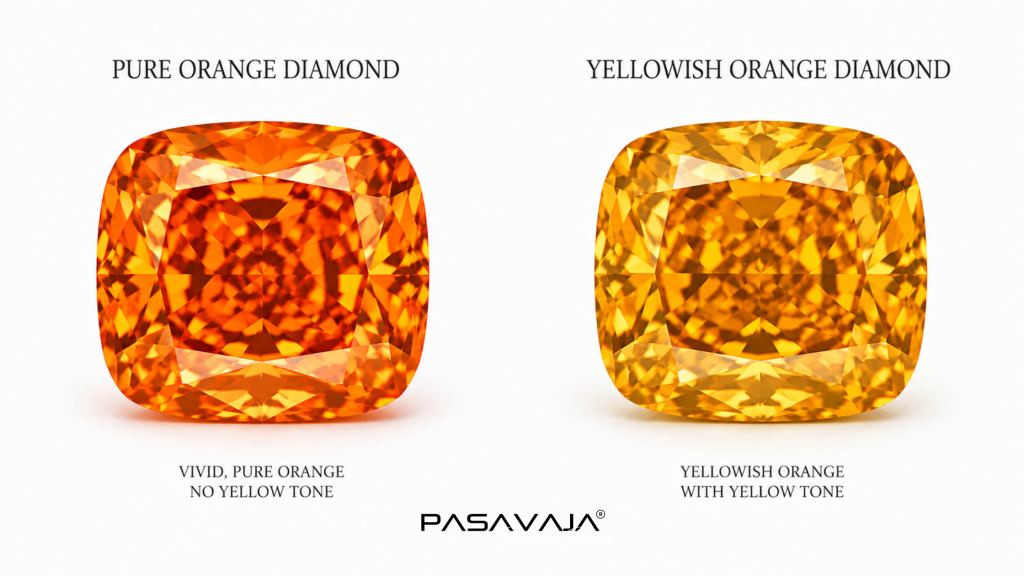
Pure Orange is the rarest and most desirable category. No detectable secondary hue. GIA would describe this as Fancy Orange, Fancy Intense Orange, or Fancy Vivid Orange depending on saturation. Pure orange stones at Fancy Vivid intensity are exceptionally rare.
Brownish Orange diamonds have a warm, earthy character. The brown modifier softens the orange and reduces the stone’s rarity and value relative to pure orange, though some buyers actively prefer the warmer tone.
Yellowish Orange stones sit between yellow and orange. The yellow secondary color makes them more available than pure orange and positions them closer to the yellow diamond market in terms of pricing and supply.
Orangy Yellow is technically a yellow diamond with an orange secondary hue. Graded within the yellow category, these are more common than true orange diamonds and often more affordable.
Understanding the difference between these categories is essential when evaluating an orange diamond. The GIA certificate will tell you the exact hue description, always read it carefully before making any assessment of rarity or value.
How GIA Grades Orange Diamonds
GIA grades orange diamonds using the same intensity scale applied to all fancy color diamonds. The grading process evaluates three components: hue (the dominant color), tone (lightness or darkness), and saturation (strength of color).
For orange, as for every hue except pink, brown and grey, the fancy scale begins at Fancy Light. The grades from lightest to strongest are:
- Fancy Light Orange
- Fancy Orange
- Fancy Intense Orange
- Fancy Deep Orange
- Fancy Vivid Orange
For investment-grade orange diamonds, the most desirable grades are Fancy Intense Orange, Fancy Deep Orange, and Fancy Vivid Orange. These are the grades where the color is saturated enough to be immediately striking, and where secondary hues have the greatest impact on value.
GIA’s grading process for orange diamonds is conducted face-up under controlled lighting conditions. Unlike white diamond color grading, which assesses the absence of color, fancy color grading is entirely about the presence and intensity of color as it appears to the observer.
Harsh evaluates orange diamonds beyond the certificate, assessing how the stone looks in natural daylight, how it responds to different lighting environments, and whether the color is evenly distributed throughout the stone. Certificates are essential, but an expert eye adds a layer of evaluation that no document can replace.
For a deeper understanding of how GIA approaches all fancy color grading, the GIA website provides authoritative reference material on the grading methodology.
The Pumpkin Diamond: The Most Famous Orange in the World
No article on orange diamonds would be complete without mentioning the Pumpkin Diamond, the stone that put orange diamonds on the global map.
The Pumpkin Diamond is a 5.54 carat Fancy Vivid Orange cushion cut diamond, named for the date of its purchase: the day before Halloween in 1997. Acquired for $1.3 million at the time, it has been seen on the wrist of Halle Berry at the Academy Awards and remains one of the most recognized colored diamonds in the world.
It is the most famous example of what a truly exceptional orange diamond looks like: pure hue, high saturation, no significant secondary color, and a size that allows the color to express itself fully.
Stones at this level are extraordinarily rare. But smaller orange diamonds in the Fancy and Fancy Intense range, while still genuinely scarce, are available to informed buyers working with the right specialists.

Orange vs Yellow Diamond: A Direct Comparison
Buyers often encounter the choice between an orange and a yellow diamond, particularly because the two are related in origin. Understanding the differences helps you make the right decision for your goals.
| Characteristic | Natural Orange Diamond | Natural Yellow Diamond |
|---|---|---|
| Color Cause | Nitrogen, specific paired configuration | Nitrogen, N3 or aggregated groups |
| Rarity | Significantly rarer | More readily available |
| GIA Intensity Range | Faint through Fancy Vivid | Faint through Fancy Vivid |
| Most Common Grade Available | Fancy / Fancy Intense (with secondary hue) | Fancy Intense / Fancy Vivid |
| Price Per Carat | Higher for equivalent intensity | Lower for equivalent intensity |
| Best Metal Setting | Yellow gold, rose gold | Yellow gold |
| Investment Appeal | Very high, supply extremely limited | High, established collector market |
| Secondary Hue Impact on Value | Very significant | Significant |
The key takeaway: if pure orange is your goal, you are looking at a genuinely rare stone with prices that reflect its scarcity. If your budget works better with a yellowish orange or orangy yellow stone, you can access the visual warmth of the orange family at a more accessible price point.
Our yellow diamond guide covers yellow diamonds in detail if you want to compare the two categories directly.
Orange Diamond Price Guide
Natural orange diamonds vary significantly in price depending on intensity grade, purity of hue, carat weight, and the presence of secondary colors. The following ranges are general market references for GIA-certified natural orange diamonds in typical commercial sizes of 0.5 to 2 carats.
| GIA Grade | Hue Purity | Approx. Price Per Carat (USD) | Investment Appeal |
|---|---|---|---|
| Fancy Light Orange | Often with secondary hue | $8,000, $18,000 | Moderate |
| Fancy Orange | With secondary hue | $20,000, $50,000 | Good |
| Fancy Orange | Pure orange (no secondary) | $50,000, $120,000 | Strong |
| Fancy Intense Orange | With secondary hue | $40,000, $80,000 | Strong |
| Fancy Intense Orange | Pure orange | $100,000, $250,000 | Very Strong |
| Fancy Vivid Orange | With or without secondary | $200,000+ | Exceptional |
Prices at the top end of each grade, for large, eye-clean, pure orange stones, can exceed these ranges significantly, particularly at auction where collector demand drives premiums. Orange diamonds at Fancy Vivid grade in truly pure hue are among the most valuable diamonds per carat anywhere in the natural diamond world.
For an accurate quotation on any specific orange diamond, the most reliable approach is to work directly with a specialist. You can request a quotation from PASAVAJA and Harsh will personally provide market-accurate pricing based on current conditions.
Expert Buying Tips for Orange Diamonds
Orange diamonds require more expertise to evaluate than almost any other colored diamond category. Here is what Harsh looks for when sourcing orange diamonds for clients.
Prioritise the GIA certificate above all else. Orange diamonds must be GIA certified. The certificate will tell you the exact hue, tone, and saturation, and crucially, whether any secondary hue is present and how significant it is. Never buy an orange diamond without a GIA report.
Understand the secondary hue before you commit. A brownish orange and a pure orange at the same intensity grade can have a price difference of two to three times. Know exactly what the hue description on the certificate says. Ask your dealer to walk you through what that description means visually.
View the stone in multiple lighting environments. Orange diamonds, like all fancy color stones, can shift in appearance between daylight, incandescent light, and LED lighting. Viewing under a single light source gives you an incomplete picture.
Rarity compounds with size. Finding a pure orange diamond above one carat is significantly harder than finding one under a carat. If your budget allows for a larger stone, expect the price per carat to escalate more steeply than in almost any other color category.
Ask about the color’s origin. Occasionally, orange color in diamonds can be the result of treatment. A GIA certificate will disclose any known treatments, but working with a specialist who understands how to identify treated versus natural color adds a layer of security. Harsh evaluates this as part of every sourcing decision.
Think about secondary hue as an opportunity. For buyers whose goal is beauty over investment purity, a brownish orange or orangy yellow stone at Fancy Intense grade can deliver extraordinary visual warmth at a meaningfully lower price point than a pure orange equivalent.

Best Settings for Orange Diamonds
The right setting amplifies the color of an orange diamond. The wrong one can make it look flat or dull.
Yellow gold and rose gold are the natural partners for orange diamonds. Warm metals reflect warmth back into the stone and enhance the orange hue, particularly for stones with brownish or yellowish secondary colors. Harsh and his team consistently recommend 18K yellow gold or rose gold for orange diamond jewelry.
Platinum and white gold can work for pure orange stones at high intensity grades, the contrast can actually make a vivid orange pop against a cool metal background. For lighter grades or stones with significant secondary color, however, white metals can mute the warmth.
Radiant and cushion cuts are the most popular shapes for orange diamonds. Their brilliant facet structure distributes color evenly throughout the stone, maximising the visual impact of the orange hue. Step cuts like emerald and Asscher can work for very high saturation stones, but the open facets can reveal color concentration issues in lighter grades.
For orange diamonds used in rings, the halo setting is a popular choice: a frame of smaller white diamonds around the orange center creates a striking contrast and makes the orange appear richer. A solitaire in yellow gold lets a vivid stone speak entirely for itself.
If you are thinking about a bespoke setting for an orange diamond, our team at PASAVAJA can guide you through the design process from stone selection to finished piece. The contact page is the best starting point for a conversation.
PASAVAJA’s Expertise in Fancy Orange Diamonds
PASAVAJA is a second-generation natural diamond house with a specific focus on fancy color diamonds. Orange diamonds sit right at the heart of what we do, rare, technically complex, and requiring a level of grading expertise that most general diamond dealers simply do not have.
Harsh Shah personally sources and evaluates every orange diamond that passes through PASAVAJA. His direct engagement with GIA gemologists on color grading discussions, including contributions to certificate revisions, is a level of expertise that is genuinely uncommon anywhere in the diamond world.
What PASAVAJA offers for orange diamond buyers:
- Direct loose orange diamond sourcing from the international market
- Personal evaluation by Harsh Shah for every stone
- GIA certified natural orange diamonds across all intensity grades
- Transparent expert guidance on hue, secondary color, and value
- Bespoke fine jewelry manufacturing in platinum and 18K gold options
- Free worldwide shipping
- Fully insured delivery
- Personalized buying assistance via WhatsApp or email
Whether you are buying your first colored diamond or adding a rare orange stone to an established collection, PASAVAJA brings the combination of source relationships, grading expertise, and honest education that this category requires.
Conclusion
Orange diamonds are one of the most scientifically fascinating and genuinely rare color categories in the natural diamond world. The fact that they share their color origin with yellow diamonds, but require such a specific and uncommon atomic arrangement, is what makes them so remarkable. Same element, completely different rarity story.
For buyers and collectors, the key points to carry forward are these: always require a GIA certificate, understand the secondary hue and what it means for both value and visual character, and work with a specialist who has the expertise to evaluate color beyond what a certificate can capture.
If you are drawn to orange diamonds, whether for a bespoke jewelry piece or as part of a serious color diamond collection, PASAVAJA is one of the very few sources where that expertise genuinely exists.
Thinking about an orange diamond or another rare natural stone? We would love to help.
Connect with Harsh and the PASAVAJA team directly:
WhatsApp: +91 887 9999 787 (fast reply guaranteed) Email: info@pasavaja.com
We can help you with:
- Loose natural orange and fancy color diamonds
- Antique and rare diamond shapes
- Bespoke fine jewelry in platinum and 18K gold
- GIA-certified investment-grade diamonds
- Custom sourcing for rare and one-of-a-kind stones
Ask About Orange Diamond Availability
FAQ
1. What causes orange color in natural diamonds?
Orange color in natural diamonds comes from nitrogen atoms arranged in a specific structural configuration within the crystal lattice. This arrangement differs from the nitrogen groupings that produce yellow color and forms far less frequently, making pure orange diamonds significantly rarer than yellow diamonds despite sharing the same elemental cause.
2. Why are orange diamonds rarer than yellow diamonds if both come from nitrogen?
Yellow color forms from common nitrogen groupings that occur regularly during crystallisation. Orange color requires a different, less stable nitrogen configuration involving paired atoms and structural vacancies. This arrangement rarely forms over billions of years of diamond growth, making pure orange diamonds a fraction of yellow diamond supply.
3. What is the most famous natural orange diamond?
The Pumpkin Diamond is the most famous orange diamond, a 5.54 carat Fancy Vivid Orange cushion cut purchased in 1997 and worn by Halle Berry at the Academy Awards. It is the most iconic example of a pure, highly saturated natural orange diamond and one of the most recognized colored diamonds in existence.
4. Is an orange diamond more expensive than a yellow diamond?
Yes, in most cases. Pure orange diamonds at equivalent intensity grades command significantly higher prices than yellow diamonds due to their greater rarity. A Fancy Intense Yellow might cost $15,000 to $30,000 per carat, while a Fancy Intense Orange in pure hue can reach $100,000 per carat or more.
5. What is the best metal setting for an orange diamond?
Yellow gold and rose gold are the best choices for most orange diamonds. Warm metals enhance the orange hue and create visual harmony. Pure orange stones at high saturation can work in platinum for dramatic contrast. Avoid white metals for lighter or brownish orange stones, warm metals will always complement those grades better.
6. Are pure orange diamonds common?
No. Pure orange diamonds with no significant secondary hue are among the rarest natural diamonds in existence. Most stones marketed as orange have brownish or yellowish secondary hues. True Fancy Vivid Orange in pure hue is extraordinarily rare, particularly above one carat. Even Fancy Intense Orange in pure hue requires significant effort to source.
7. Can orange diamonds be treated to enhance their color?
Yes, color treatment can be applied to diamonds to create or enhance orange color. GIA certification is non-negotiable for orange diamonds, a GIA report discloses known treatments and verifies that the color is natural. Always confirm the color origin statement on the certificate before buying any orange diamond.
Every stone is photographed and graded before it is listed. Join the list to see them before they reach the shop.
New stones only, no more than once a month. Unsubscribe any time.
Tell us the grade, shape and range. We will only send stones that genuinely match.