Radiant Cut Diamond Guide
On this page
The radiant cut diamond is one of the most versatile and underappreciated shapes in the entire diamond world. If you have been shopping for a square or rectangular diamond with serious sparkle, and especially if colored diamonds are on your radar, understanding the radiant cut diamond should be your first step.
Harsh Shah, who leads diamond sourcing at PASAVAJA and whose expertise in fancy color diamond grading has directly contributed to GIA certificate revisions, considers the radiant cut one of his most recommended shapes for buyers who want maximum visual impact from a colored stone. His experience working with Fancy Vivid yellows, pinks, and oranges in radiant cuts gives him a perspective that goes well beyond what you will read on most diamond sites.
This guide covers everything you need to know: what the radiant cut actually is, why it dominates the colored diamond world, how to choose between square and rectangular, how it stacks up against cushion, and which settings work best.
What Is a Radiant Cut Diamond?
A radiant cut diamond is a rectangular or square diamond with trimmed corners and a brilliant-cut facet pattern. It combines the elegant outline of a step cut with the light-scattering facets of a brilliant cut, delivering excellent sparkle in a shape that works beautifully for both colorless and fancy colored stones. Radiant cuts typically have 70 facets.
The radiant cut was developed in 1977 by Henry Grossbard, making it one of the newer diamond shapes in the modern cutting tradition. Grossbard’s goal was to bring the light performance of a round brilliant into a rectangular shape, and he succeeded.
The defining visual feature is the trimmed corners. Unlike a princess cut with its sharp 90-degree corners, the radiant’s cropped corners make it significantly more durable and easier to set. That practical advantage is one reason jewelers and buyers alike continue to choose it.
If you want to explore how radiant compares to other shapes in the broader context, the complete diamond shapes guide is a great starting point.

Why the Radiant Cut Is the Top Choice for Colored Diamonds
The radiant cut is the preferred shape for fancy colored diamonds because its brilliant facet pattern distributes color more evenly across the face-up surface than step cuts. In a step cut like emerald or Asscher, you can see patches of lighter and darker color. In a radiant, the color saturates the whole stone evenly, making the hue look richer and more consistent from every angle.
This is not a minor distinction. It is the reason why if you look at GIA reports for Fancy Vivid yellow or Fancy Intense pink diamonds, you will find a disproportionate number of them in radiant and cushion cuts. The cutting houses that specialize in colored stones choose these shapes deliberately.
Harsh Shah explains it this way: the facet structure of a radiant cut acts almost like a mixing bowl for color. The brilliants reflect colored light back through each other, intensifying the hue rather than concentrating it in zones the way a step cut does. For anyone considering a yellow, pink, orange, or any other fancy colored diamond, the radiant cut deserves serious consideration before any other shape.
For a deeper understanding of how GIA grades colored diamonds and why cut choices matter so much for color presentation, the fancy colored diamonds education guide at PASAVAJA covers the topic in full.
Square vs Rectangular Radiant, Which Should You Choose?
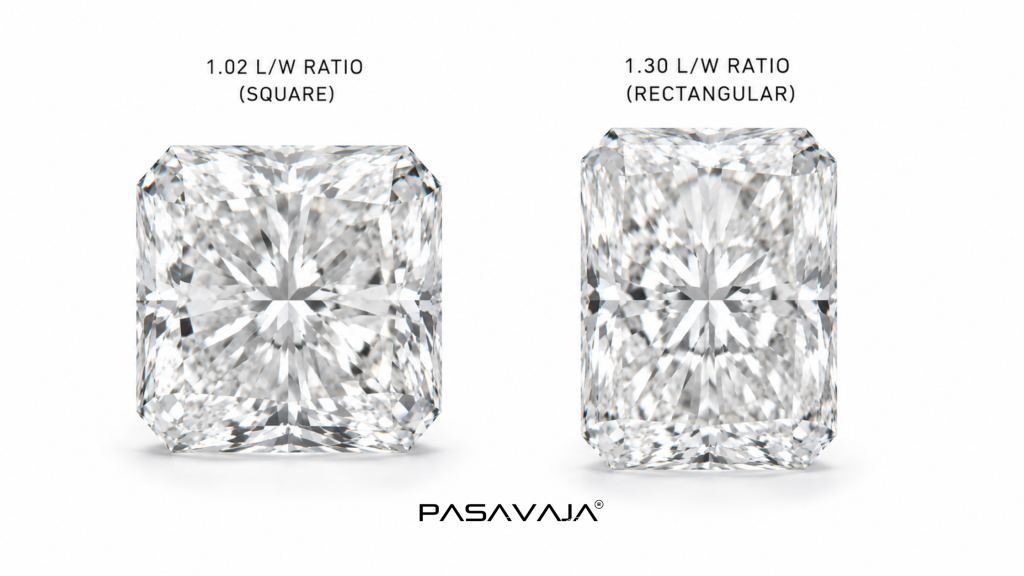
The square radiant has a length-to-width ratio between 1.00 and 1.05. The rectangular radiant typically falls between 1.20 and 1.35. Both are radiants, but they read very differently on the finger and in a setting.
| L/W Ratio | Visual Character | Best Setting | Who It Suits |
|---|---|---|---|
| 1.00 to 1.05 | Square, bold, substantial | Four-prong or halo | Buyers who want a modern square look without princess cut corners |
| 1.10 to 1.19 | Transitional, slightly elongated | Solitaire or east-west halo | Buyers who want versatility |
| 1.20 to 1.35 | Rectangular, elongating | Prong solitaire or three-stone | Buyers who want the finger-elongating effect |
| 1.35 and above | Strongly elongated | Vintage-inspired settings | Buyers with a preference for marquise-like visual length |
Most buyers end up choosing somewhere in the 1.20 to 1.35 range, which gives a satisfying rectangular shape without looking stretched. The square radiant is a bolder, more contemporary choice and is growing in popularity for buyers who want a princess cut look with better durability.
One practical tip: always view radiant cuts face-up in the actual ratio you are considering. The mm dimensions on a GIA certificate give you an exact size reference, but the proportions read differently in person depending on your hand size and the setting style you prefer.
Radiant Cut vs Cushion Cut, What Is the Real Difference?
| Characteristic | Radiant Cut | Cushion Cut |
|---|---|---|
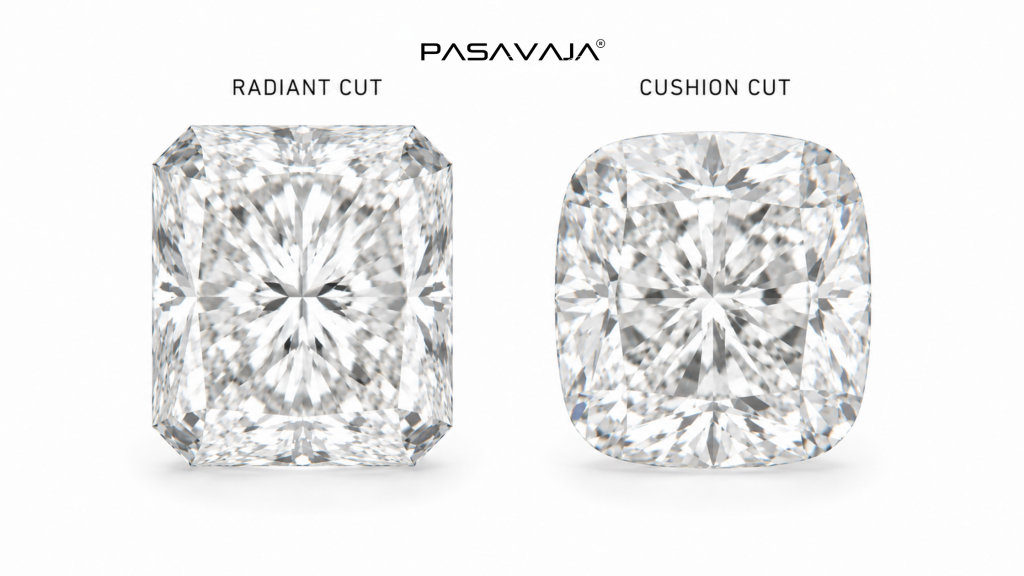
| Corner shape | Trimmed, angular | Soft, rounded |
| Facet pattern | Uniform brilliant | Standard chunky or modified crushed ice |
| Color distribution | Very even | Even (standard), slightly more scattered (modified) |
| Visual character | Sharper, more geometric | Softer, more romantic |
| Depth typical range | 61% to 67% | 60% to 68% |
| Price vs round | 15 to 25% less | 20 to 30% less |
| Best for colored diamonds | Excellent | Excellent |
| Era association | Contemporary (1977+) | Classic and antique revival |
Both radiant and cushion cuts are outstanding for colored diamonds. The choice between them is largely aesthetic. A radiant gives a slightly more modern, architectural look. A cushion leans romantic and vintage-inspired.
Buyers who love the idea of a radiant but want softer outlines often end up with cushion. Buyers who love cushion but want crisper geometry tend to land on radiant. If you want to explore the cushion cut in detail, the cushion cut diamond guide covers standard vs modified and the crushed ice phenomenon in full.
Radiant Cut Diamond Proportions, What to Look For
The radiant cut does not have an official GIA cut grade the way round brilliants do. That means you need to evaluate proportions yourself from the GIA certificate. Here is what to look for:
Depth percentage: Aim for 61% to 67%. A radiant deeper than 68% starts to look smaller face-up than its carat weight suggests.
Table percentage: 61% to 69% is a good range. A very large table (above 72%) can flatten the stone’s light return. A very small table can reduce brilliance.
Length-to-width ratio: Choose based on your personal preference for square vs rectangular (see the section above).
Polish and symmetry: Always look for Very Good or Excellent on both. This is the one area where the GIA report guides you directly, even without a formal cut grade.
The absence of an official GIA cut grade for radiants is one reason why having an expert review your stone matters. Harsh Shah evaluates radiant cuts by reviewing GIA proportions data alongside video and imaging, the report alone does not tell the full story.

Expert Buying Tips for Radiant Cut Diamonds
The radiant cut rewards informed buyers. Here are the most important things to know before you buy:
Always check depth. A deep radiant can carry significant weight in the pavilion, which means a 1.00-carat stone may look smaller face-up than expected. Compare the mm face-up dimensions, not just the carat weight.
For colorless radiant cuts, VS2 to VS1 clarity is typically eye-clean. The brilliant facet pattern does an excellent job of masking minor inclusions: this is one area where radiant has an advantage over emerald and Asscher cuts, which are far more transparent.
For colored diamonds in radiant cut, clarity standards are more flexible. A Fancy Vivid yellow radiant with SI1 clarity may be entirely eye-clean and spectacular. GIA certification is non-negotiable for any colored diamond regardless of cut.
Color grade matters differently in radiant vs round. Because radiant cuts display color so richly, a Fancy Intense yellow in radiant can look as saturated as a Fancy Vivid in round. This is a genuine buying opportunity for educated buyers.
Always ask to see video. Radiant cuts in particular need to be viewed in motion to appreciate their light performance. A static image does not capture the way a radiant catches light from different angles.
Best Settings for Radiant Cut Diamonds
Four-prong solitaire is the cleanest choice and maximizes the diamond’s face-up area. Works for both square and rectangular radiants. Platinum or 18K white gold shows off a colorless stone at its best.
Halo setting adds significant visual size and works particularly well for square radiants where the halo creates a cushion-like silhouette from a distance. Yellow or rose gold halos pair beautifully with fancy yellow or pink radiant centers.
Three-stone setting with tapered baguettes or half-moon side stones is a classic choice for rectangular radiants. The elongated center and flanking side stones create a balanced, architectural look.
Yellow gold is the ideal metal for fancy yellow and orange radiant cut diamonds. The warm metal complements and intensifies the color of the center stone. For colorless radiants, platinum or white gold remains the standard.
For guidance on settings and metals more broadly, the diamond ring settings guide covers every major style with expert recommendations from PASAVAJA’s jewelry team.
PASAVAJA’s Expertise in Radiant Cut Diamonds
At PASAVAJA, radiant cut diamonds are one of our most requested shapes, particularly for colored diamond commissions. Harsh Shah sources radiant cuts across the full range of GIA-certified fancy colors, from Fancy Light yellows to Fancy Vivid pinks and oranges.
What makes PASAVAJA’s sourcing different is the direct connection between colored diamond grading expertise and shape selection. Harsh evaluates every colored radiant for color distribution, face-up brilliance, and proportion quality, not just the GIA certificate grades. His ability to spot how a specific stone’s facet pattern interacts with its color saturation is the kind of assessment that saves buyers from expensive mistakes.
Heer Shah, who leads PASAVAJA’s jewelry design and bespoke manufacturing, works alongside Harsh on the setting side of every colored radiant commission, ensuring the metal choice, setting style, and prong design are optimized for each individual stone.
Everything we offer at PASAVAJA is:
- GIA-certified natural diamonds only
- Personally sourced and reviewed by Harsh or Heer Shah
- Available for loose diamond purchase or bespoke jewelry commission
- Delivered worldwide with full insurance
You can request a price quotation for a radiant cut diamond or reach us directly on WhatsApp or email. We will respond quickly.
Conclusion, Is a Radiant Cut Diamond Right for You?
The radiant cut diamond is genuinely one of the best all-around choices in the market today. It delivers brilliant-cut sparkle in a versatile rectangular or square format, handles colored diamonds better than almost any other shape, and comes with the durability advantage of trimmed corners over princess cut.
If you are drawn to fancy colored diamonds, the radiant cut is the shape Harsh Shah reaches for first. Its even color distribution, strong face-up brilliance, and wide range of available ratios make it the most flexible shape in the colored diamond world.
If you are choosing a colorless radiant, the value proposition is compelling too. You get round-brilliant light performance in a shape that costs 15 to 25% less per carat, with a contemporary look that ages beautifully.
Thinking about a radiant cut diamond, colorless or fancy colored? We would love to help you find the right stone.
Connect with Harsh and the PASAVAJA team directly:
WhatsApp: +91 887 9999 787 (fast reply guaranteed) Email: info@pasavaja.com
We can help you with:
- Loose fancy color natural radiant cut diamonds
- Colorless GIA-certified radiant cuts
- Bespoke fine jewelry in any setting style
- Custom sourcing for specific ratios and grades
- Investment-grade fancy color diamonds in radiant cut
Find Your Radiant Cut Diamond, Request a Quote
Frequently Asked Questions
Q: What is a radiant cut diamond?
A: A radiant cut diamond is a rectangular or square diamond with trimmed corners and a brilliant facet pattern. It was developed in 1977 and typically has 70 facets. The combination of step-cut outline and brilliant-cut facets gives it strong sparkle and excellent color distribution, making it one of the most versatile shapes available.
Q: Why is radiant cut so good for colored diamonds?
A: The radiant cut’s brilliant facet pattern distributes color evenly across the entire face-up surface, preventing the patchy color zones you can see in step cuts like emerald and Asscher. This is why most Fancy Vivid colored diamonds are cut in radiant or cushion, the shape intensifies and evens out the hue, making the color appear richer.
Q: What is the difference between radiant cut and cushion cut?
A: Radiant cut has trimmed angular corners and a more geometric outline. Cushion cut has soft rounded corners and a more romantic, pillow-like shape. Both are excellent for colored diamonds. Radiant reads more contemporary and architectural; cushion reads softer and vintage-inspired. The light performance of both is comparable.
Q: What length-to-width ratio is best for a radiant cut diamond?
A: There is no universally best ratio, it depends on your preference for square or rectangular. A 1.00 to 1.05 ratio gives a square appearance. A 1.20 to 1.35 ratio gives a classic rectangular look that elongates the finger. Most buyers land in the 1.20 to 1.30 range. Always view the stone face-up before deciding.
Q: Does radiant cut have a GIA cut grade?
A: No. GIA does not assign an official cut grade to fancy shapes including radiant cut. You need to evaluate depth percentage, table percentage, polish, and symmetry directly from the GIA certificate. Depth between 61% and 67% and table between 61% and 69% are reliable starting ranges. Working with an expert helps significantly here.
Q: Is radiant cut cheaper than round brilliant?
A: Yes, typically 15 to 25% less per carat for colorless diamonds of comparable quality. Fancy colored radiants are priced based on color intensity and rarity, not shape premium. The lower price for colorless radiants versus round is a genuine value opportunity, you get comparable light performance at a lower price per carat.
Q: When was the radiant cut invented?
A: The radiant cut was invented by Henry Grossbard in 1977. It was the first rectangular or square diamond shape specifically designed to combine the elegant outline of a step cut with the light-scattering brilliance of a round brilliant cut. It remains one of the most successful modern shape innovations in the diamond industry.
Every stone is photographed and graded before it is listed. Join the list to see them before they reach the shop.
New stones only, no more than once a month. Unsubscribe any time.
Tell us the grade, shape and range. We will only send stones that genuinely match.