Round Cut Diamond Guide
On this page
There is a reason the round cut diamond has been the top choice for buyers around the world for over a century. It is not tradition for its own sake: it is mathematics meeting beauty in a way no other shape has managed to replicate. Harsh Shah, Director of PASAVAJA, Graduate Diamonds (GIA), with deep expertise in diamond sourcing and evaluation, puts it plainly: the round brilliant is not the most popular diamond by accident. Marcel Tolkowsky’s mathematical model from 1919 remains the most rigorously optimised formula for light performance ever developed for a gemstone, and that precision still sets the standard today.
If you are choosing your first diamond, comparing a round to an oval or cushion, or trying to understand why round diamonds command a price premium, this guide covers everything you need to know before you buy.

What Is a Round Cut Diamond?
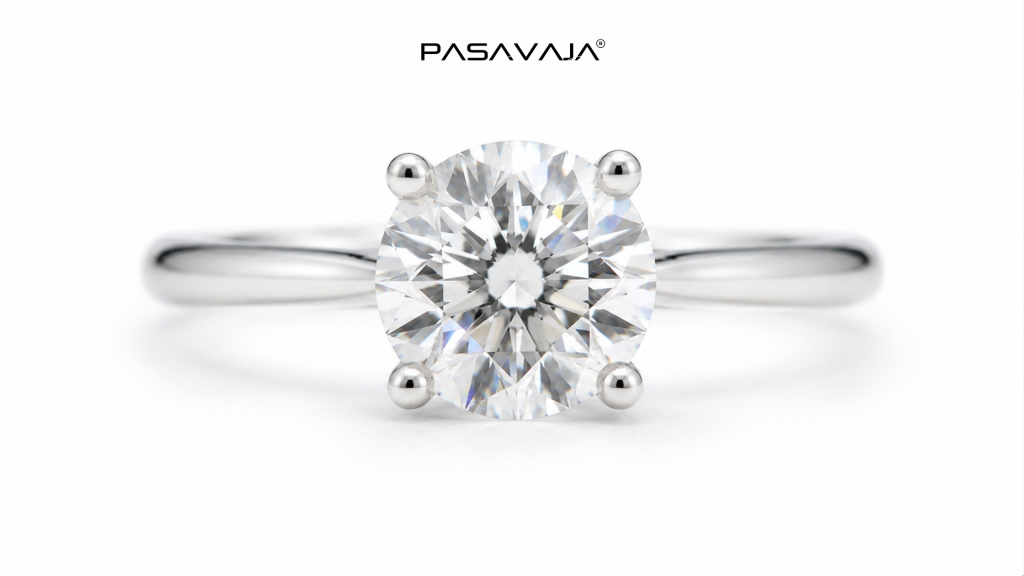
A round cut diamond, also known as the round brilliant, is a circular diamond with 57 or 58 facets arranged across the crown, girdle, and pavilion to maximize the return of light to the eye. First mathematically defined by Marcel Tolkowsky in 1919, it remains the single most purchased diamond shape globally, prized for its unmatched brilliance, fire, and scintillation across all lighting conditions.
The round brilliant is not simply a popular preference. It is an engineered masterpiece. Tolkowsky calculated the precise angles and proportions that would produce the optimal balance of brilliance (white light return), fire (colored light dispersion), and scintillation (the flash of light as the stone or viewer moves). That formula, with refinements from GIA research over decades, is what defines the round cut today.
The 57-facet version is standard when the diamond has no culet facet. When a small culet facet is included, the total becomes 58 facets. Either is correct and neither indicates higher quality.
Why the Round Brilliant Remains the Most Popular Diamond Shape
The round cut diamond has held the top position in global diamond sales for decades, and its dominance is not slowing down. It accounts for roughly 50 to 60 percent of all diamond purchases worldwide.
Several factors explain this sustained popularity.
Light performance is unbeatable. No other diamond shape returns as much light as efficiently as a well-cut round brilliant. The symmetrical 360-degree facet structure ensures light enters, reflects internally, and exits back through the top of the stone from almost any angle. Step cuts and elongated shapes cannot achieve this symmetry.
GIA cut grading exists for rounds. This is significant. GIA’s formal cut grade, Excellent, Very Good, Good, Fair, Poor, applies only to round brilliant diamonds. Every other shape is a “fancy shape” and does not receive a GIA cut grade on the certificate. For buyers who want objective verification of cutting quality, the round brilliant is the only shape with that guarantee from GIA.
Versatility. The round brilliant works in every setting style, every metal, and every ring design. It suits solitaires, halos, three-stone rings, and everything in between. No other shape matches this flexibility.
Resale value. Round diamonds consistently hold their value better than fancy shapes in secondary markets. Their universal desirability makes them easier to resell when needed.
If you want to understand more about how GIA cut grades work for round brilliants, the complete GIA diamond cut guide at pasavaja.com/education/white-diamonds/cut/ explains the grading system in detail.
How to Evaluate a Round Cut Diamond, Proportions and GIA Cut Grade
When buying a round cut diamond, the GIA cut grade is the single most important number on the certificate. A round brilliant with a GIA Excellent cut grade, combined with Excellent polish and Excellent symmetry, is the standard PASAVAJA recommends for any buyer prioritising optical performance.
Here is what each proportion measurement means and why it matters.
Table percentage is the width of the flat top facet as a percentage of the diamond’s total diameter. Ideal range: 54 to 57 percent. Above 60 percent and the crown angles compress, reducing fire.
Depth percentage is the total depth of the diamond as a percentage of its diameter. Ideal range: 59 to 62.5 percent. Too shallow and light leaks through the bottom. Too deep and it leaks through the sides.
Crown angle is the angle between the girdle plane and the bezel facets. Ideal range: 34 to 35 degrees. This directly controls fire, the dispersion of colored light.
Pavilion angle is the angle between the girdle plane and the pavilion main facets. Ideal range: 40.6 to 41 degrees. This controls brilliance, the return of white light.
Girdle thickness should be Thin to Slightly Thick. Very Thin girdles are fragile. Very Thick girdles add weight without adding visible size.
Round Brilliant Ideal Proportions
| Measurement | Ideal Range | Acceptable Range | Avoid |
|---|---|---|---|
| Table % | 54 – 57% | 52 – 60% | Below 50% or above 63% |
| Depth % | 59 – 62.5% | 58 – 64% | Below 56% or above 66% |
| Crown Angle | 34° – 35° | 32° – 36° | Below 30° or above 38° |
| Pavilion Angle | 40.6° – 41° | 40° – 41.5° | Below 39° or above 42.5° |
| Girdle | Thin to Slightly Thick | Very Thin to Thick | Extremely Thin or Extremely Thick |
| Culet | None or Very Small | Small | Medium or larger |
| Polish | Excellent | Very Good | Good or below |
| Symmetry | Excellent | Very Good | Good or below |
The GIA cut scale runs from Excellent to Very Good, Good, Fair, and Poor. For a round brilliant you want Excellent or Very Good at minimum, anything below is a meaningful compromise in light performance.
One important note: a GIA Excellent cut grade does not guarantee a hearts and arrows pattern. Hearts and arrows require additional cutting precision beyond GIA’s Excellent threshold. If that optical phenomenon matters to you, there is more detail at our guide to hearts and arrows.

Round Cut Diamond vs Fancy Shapes, What You Gain and What You Give Up
Choosing between a round brilliant and a fancy shape (oval, cushion, pear, emerald, and others) is one of the most common decisions buyers face. There is no objectively correct answer, but there are real trade-offs to understand.
What you gain with round:
- Maximum light performance verified by GIA cut grade
- Universal setting compatibility
- Stronger resale demand
- No bow-tie effect (a dark zone that appears in elongated shapes)
What you give up with round:
- Face-up size relative to carat weight, ovals and marquise shapes appear larger face-up at the same carat weight
- Lower price-per-carat, round diamonds typically cost 20 to 30 percent more than equivalent fancy shapes at the same quality level, because they waste more rough during cutting
- Uniqueness, fancy shapes are less common and can feel more personal
If face-up size is a priority within a fixed budget, an oval cut can appear 10 to 15 percent larger than a round at the same carat weight. You can explore that trade-off in detail at our oval cut guide.
| Characteristic | Round Brilliant | Oval Cut | Cushion Cut | Emerald Cut |
|---|---|---|---|---|
| GIA Cut Grade | Yes (Excellent to Poor) | No | No | No |
| Light Performance | Highest | High | High | Moderate (step cut) |
| Face-Up Size vs Round | Baseline | 10–15% larger | Similar | Smaller feel |
| Bow-Tie Effect | None | Possible | Rare | None |
| Price vs Round | Baseline (premium) | 15–25% less | 15–20% less | 20–30% less |
| Best For | All-round performance | Size maximisation | Colored diamonds | Understated elegance |
| Clarity Required | VS2 minimum recommended | VS2 minimum | VS2 minimum | VS1 minimum (step cut) |
The price premium for round diamonds exists because of cutting yield. A round brilliant requires removing more of the rough diamond to achieve its shape than a cushion or pear, that wasted material is priced into the finished stone. Understanding this makes the premium feel logical rather than arbitrary.
How Much Does a Round Cut Diamond Cost?
A GIA-certified natural round cut diamond typically starts at around $2,500 to $4,500 USD per carat for an H-VS2 Excellent cut stone. The price rises significantly with color and clarity. D-IF (Flawless) Excellent cut round brilliants can reach $15,000 to $25,000 USD per carat or higher depending on the specific stone and market conditions.
Price is driven by four variables: cut quality, color grade, clarity grade, and carat weight. Of these, cut quality delivers the most visible return, an Excellent cut H color diamond will outperform a D color Fair cut diamond in every lighting environment.
Price ranges for GIA-certified natural round brilliants (approximate USD per carat, 2025 market):
| Color | Clarity | Cut | Approx. Price Per Carat |
|---|---|---|---|
| D–F | IF–VVS2 | Excellent | $12,000 – $25,000+ |
| D–F | VS1–VS2 | Excellent | $8,000 – $15,000 |
| G–H | VS1–VS2 | Excellent | $4,500 – $8,000 |
| G–H | SI1–SI2 | Very Good / Excellent | $2,500 – $5,000 |
| I–J | VS2–SI1 | Excellent | $2,000 – $4,000 |
These are per-carat figures. A 1-carat stone at $6,000 per carat costs $6,000. A 2-carat stone at $10,000 per carat costs $20,000, because price per carat rises exponentially at larger sizes due to rarity.
One practical strategy is avoiding round-number carat weights. A 0.95-carat stone looks nearly identical to a 1.00-carat stone face-up, but can cost 10 to 15 percent less because it falls below the psychological threshold buyers, and therefore sellers, price to.
PASAVAJA works directly in the diamond trade and sources round brilliants across all quality levels. For a personalized price indication based on your specific requirements, request a quotation at pasavaja.com/price-quotation/.

Expert Buying Tips for Round Cut Diamonds
Buying a round brilliant well requires a few key decisions. Here is what Harsh Shah and the PASAVAJA team recommend based on years of diamond sourcing.
Prioritise cut before everything else. Harsh Shah evaluates cut quality first when selecting a white diamond for any client, before color, before clarity, before carat. An Excellent cut round brilliant in G-H color with VS2 clarity will be more beautiful in real life than a D-IF stone with a Good cut grade. The physics of light do not negotiate.
Do not overpay for color you cannot see. G and H color round brilliants are visually indistinguishable from D, E, and F stones once set in white gold or platinum. The color difference is detectable only when comparing loose stones side by side against GIA masterstones in controlled lighting. In a ring, on a finger, in natural light, the difference disappears. You can understand the full color grading system at our guide to diamond color.
Do not over-clarify either. A GIA-certified VS2 round brilliant is eye-clean, meaning no inclusion is visible to the naked eye, in the vast majority of cases. Paying for VVS or Flawless clarity is paying for a laboratory grade, not visual beauty. SI1 can also be eye-clean in rounds, but this requires case-by-case evaluation rather than relying on the grade alone.
Check the light performance in video. Certificate numbers are a starting point, not a finishing line. A round brilliant should be evaluated in video or in person, look for even brilliance across the face of the stone, no dark zones, and crisp scintillation under point light. A certified Excellent cut stone with good proportions should pass this test easily.
GIA certification is non-negotiable. For a round brilliant, there is simply no reason to accept any other grading laboratory. GIA’s cut grade is the most reliable independent assessment in the industry. For more on understanding diamond certification, our guide to diamond certification covers the full comparison of grading labs.
Use magic sizes strategically. 0.90ct, 0.95ct, 1.45ct, 1.90ct, these just-below-threshold sizes can deliver significant savings with no visible difference in the ring. This is one of the most consistently reliable strategies in diamond buying.
Popular Settings for Round Cut Diamonds
The round brilliant’s symmetry makes it the most versatile diamond shape for ring settings. It works beautifully in almost every configuration.
Prong (claw) solitaire, the classic four or six-prong setting. Four prongs expose more of the diamond to light. Six prongs offer greater security. Both are correct choices depending on lifestyle and aesthetic preference.
Halo setting, a frame of smaller diamonds surrounds the center round brilliant, increasing apparent visual size and adding sparkle. A halo on a 0.75ct round can make it appear as large as a 1.00ct stone face-up.
Bezel setting, the diamond is encircled by a band of metal. Highly protective and modern. Reduces light entry slightly compared to prong settings, but the durability advantage suits active lifestyles.
Pave band, the ring band is set with small diamonds, extending sparkle from center stone to finger. Works beautifully with round centers because the curved band follows the stone’s round outline.
Three-stone setting, a round brilliant center flanked by two side stones (rounds, ovals, or crescents). Symbolic and visually balanced.
Metal recommendations for round brilliants:
- D–F color stones: Platinum or 18K white gold, avoid anything that adds warmth to a colorless stone
- G–H color stones: Platinum, 18K white gold, or 18K yellow gold, yellow gold masks any subtle warmth and works beautifully
- I–J color stones: 18K yellow gold or rose gold, the warm metal hides the slight body color and creates a harmonious look
For detailed guidance on metal selection across all diamond colors, the metals guide at pasavaja.com/education/jewelry/metals/ covers every option with expert recommendations from Heer Shah.
PASAVAJA’s Expertise in Round Cut Diamonds
At PASAVAJA, every round brilliant we source is personally reviewed for cut quality, proportion data, and light performance, not simply for the GIA certificate number.
Harsh Shah applies the same evaluative discipline to white diamonds that he brings to his work in fancy color and rare stones. A certificate is a starting point. The actual stone, examined against proportion data and in video, is what determines whether a diamond earns its place in our sourced selection.
PASAVAJA offers:
- Directly sourced GIA-certified natural round brilliants across D–J color and IF to VS2 clarity
- Personal buying guidance from Harsh Shah and Heer Shah via WhatsApp and email
- Bespoke fine jewelry manufacturing in platinum and 18K gold, Heer Shah oversees every setting commission
- Free worldwide shipping on all diamonds and jewelry
- Fully insured delivery on every order
- No automated estimates, every quotation is personally reviewed by Harsh or Heer
PASAVAJA is a second-generation diamond family business. When you connect with us, you reach the people who sourced your stone, not a sales representative.
Conclusion
The round cut diamond has held its position as the world’s most purchased diamond shape for over a century because it genuinely earns that status. Tolkowsky’s 1919 mathematical model, refined over decades by GIA research, produces a stone optimised for one thing: returning the maximum amount of light to the eye in the most beautiful way possible.
For buyers choosing a round brilliant, the priorities are clear. Prioritise GIA Excellent cut. Choose G or H color for the best value in white metal settings. Select VS2 or SI1 clarity if the stone is eye-clean. And use magic sizes if budget efficiency matters.
The round cut diamond is not a conservative choice. It is a confident one, backed by science and proven by more buyers than any other shape in the world.
Thinking about a round cut diamond for an engagement ring or collection? We would love to help you find the right stone.
Connect with Harsh and the PASAVAJA team directly:
WhatsApp: +91 887 9999 787 (fast reply guaranteed) Email: info@pasavaja.com
We can help you with:
- GIA-certified natural round cut diamonds
- Ideal proportion matching and light performance evaluation
- Bespoke solitaire and halo ring manufacturing
- Fancy color diamonds in round brilliant cut
- Magic size strategy and budget optimisation
Find Your Round Cut Diamond at pasavaja.com/price-quotation/
FAQ
1. What is a round cut diamond?
A round cut diamond is a circular brilliant-cut diamond with 57 or 58 facets, mathematically designed by Marcel Tolkowsky in 1919 to maximize light return. It is the world’s most popular diamond shape, accounting for roughly 50 to 60 percent of all diamond purchases globally, and the only shape to receive a formal GIA cut grade.
2. How many facets does a round cut diamond have?
A standard round cut diamond has 57 or 58 facets. 57 facets is standard when there is no culet facet. When a small culet facet is added, the total becomes 58. Both are correct, the presence or absence of a culet does not affect cut quality or grade.
3. What are the ideal proportions for a round brilliant cut diamond?
Ideal round brilliant proportions are: table 54 to 57 percent, depth 59 to 62.5 percent, crown angle 34 to 35 degrees, pavilion angle 40.6 to 41 degrees, thin to slightly thick girdle, and no culet. GIA Excellent cut grade with Excellent polish and symmetry confirms the highest performance range.
4. Why are round cut diamonds more expensive than other shapes?
Round cut diamonds cost 20 to 30 percent more than equivalent fancy shapes because cutting a round brilliant removes more of the original rough diamond than almost any other shape. This cutting waste is priced into the finished stone, reflecting both material loss and the engineering precision required.
5. Is round brilliant the same as round cut diamond?
Yes. Round brilliant and round cut refer to the same diamond. The term round brilliant describes the specific 57 or 58 brilliant-cut facet arrangement designed for maximum light return. Round cut is the common shorthand. A transitional cut round is a historical precursor with slightly different proportions.
6. Can round cut diamonds be used for fancy color diamonds?
Yes. Round brilliants work for fancy color diamonds, particularly yellow and orange stones, because the facet pattern distributes body color evenly. However, cushion and radiant cuts are often preferred as their larger facets concentrate and intensify the hue more effectively.
7. What is a transitional cut round diamond?
A transitional cut round is a historical diamond cut made between approximately 1920 and 1950, bridging the Old European Cut and the modern round brilliant. It has a rounder outline than the OEC but slightly different proportions than a modern brilliant, including a smaller table and larger culet. GIA classifies these as antique cuts.
Every stone is photographed and graded before it is listed. Join the list to see them before they reach the shop.
New stones only, no more than once a month. Unsubscribe any time.
Tell us the grade, shape and range. We will only send stones that genuinely match.