Trillion Cut Diamond Guide
On this page
If you have spent any time exploring diamond shapes, you have probably focused on the big names, round brilliants, ovals, cushions. But the trillion cut diamond deserves your attention, especially if you are designing a three-stone ring or looking for a bold, geometric center stone that genuinely stands out.
Harsh Shah, Director at PASAVAJA Gems LLP and Graduate Diamonds (GIA), judges a trillion on how evenly it carries light to its three corners. A shallow trillion faces up large and looks impressive in a photograph, then reads glassy and lifeless in the hand, which is why weight alone is a poor guide to this shape.
In this guide, we will walk you through everything you need to know about the trillion cut, what it is, how it is graded, how much it costs, and how to buy one with confidence.
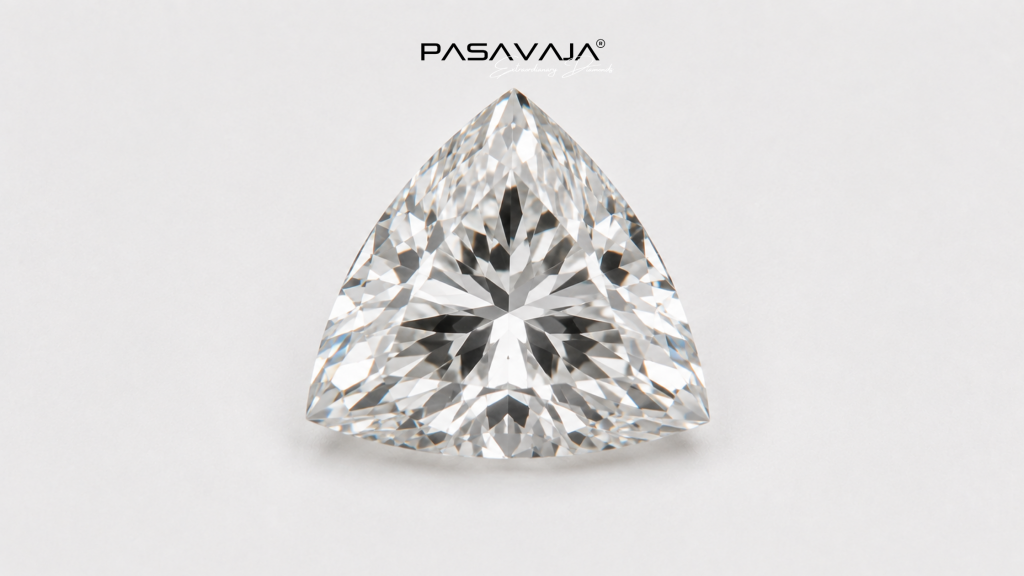
What Is a Trillion Cut Diamond?
A trillion cut diamond is a triangular brilliant-cut diamond with three equal sides and a flat or slightly domed face. It typically features either straight or curved sides and a brilliant-style facet arrangement that creates strong light return across its wide face. Trillion cuts are used both as striking center stones and as side stones in three-stone ring designs.
The trillion cut is also sometimes called the trilliant diamond or triangular diamond, though these terms are used interchangeably in the trade. The shape itself emerged in the latter half of the twentieth century and was refined over time into the bright, face-up-heavy stone we see today.
What makes the trillion unique is its geometry. The triangular outline gives it a face-up footprint that often looks significantly larger than its carat weight suggests. A 0.50 carat trillion, for example, can appear visually larger than a 0.50 carat round brilliant of similar quality, which is one of the reasons this shape has developed a loyal following among buyers who want maximum visual impact.
There are two main styles of trillion cut diamonds you will encounter. The first has curved, slightly bowed sides, which softens the overall look and tends to maximize light performance. The second has straight sides, creating a more angular, geometric appearance that suits contemporary and Art Deco-inspired jewelry designs. Neither is objectively better, the choice comes down to the setting style and the buyer’s aesthetic.
When shopping for a trillion cut diamond, you will notice that fancy shape diamonds like trilliants are graded differently from round brilliants. GIA does not assign a cut grade to trillion cuts the way it does for rounds, so visual evaluation becomes more important than ever.
Trillion Cut Characteristics, Shape, Facets, and Face-Up Size
A trillion cut diamond typically features between 31 and 50 facets, arranged in a brilliant pattern across the crown and pavilion. The exact facet count varies by cutter and style, but the goal is always the same: to maximize the light that enters the stone and reflect it back to the eye across that wide triangular face.
The face-up size advantage of the trillion is worth understanding. Because the shape is designed to spread weight across a flat, shallow profile, the trillion delivers more surface area per carat than most other shapes. This is particularly important for side stones, where the goal is often to flank a center diamond without adding excessive bulk or depth to the ring profile.
Here are the key characteristics to evaluate when looking at a trillion cut diamond:
- Symmetry: All three sides should be equal in length. Uneven sides will create an imbalanced look in the setting, which is particularly noticeable in matched pairs.
- Tip condition: Each corner of a trillion cut is a structural vulnerability point. Well-cut trilliants have gently rounded or slightly protected tips, which reduces the risk of chipping during setting and daily wear.
- Curved vs straight sides: Curved side trilliants tend to sparkle more; straight-sided trilliants offer a sharper, more graphic silhouette.
- Depth percentage: Trillion cuts are typically shallow relative to their face-up size. Very shallow stones can lack brilliance; extremely deep stones lose the face-up size advantage. A depth between 30% and 48% is generally considered optimal.
- Color saturation: Because trilliants sit face-up and expose a large surface, color can be more apparent than in deeper shapes. This is worth factoring into your color grade selection.
For buyers interested in all diamond shapes and how they compare, the trillion occupies a unique position: it is at once a practical side stone workhorse and a bold architectural center stone option.

Trillion Cut Diamond Price Guide
Trillion cut diamonds are generally priced below round brilliants of equivalent quality, which makes them an attractive option for buyers seeking value without sacrificing presence. As with all diamond shapes, price is driven by the four Cs, but the trillion has its own pricing dynamics worth understanding.
For natural, GIA-certified trillion cut diamonds, here are approximate price ranges based on current market conditions:
| Carat Weight | Color | Clarity | Approximate Price (USD) | Best Use |
|---|---|---|---|---|
| 0.25 ct | G–H | VS1–VS2 | $400 – $700 per stone | Side stones, matched pairs |
| 0.50 ct | F–H | VS1–VS2 | $900 – $1,800 | Side stones, small center stones |
| 0.75 ct | E–H | VS1–VS2 | $1,800 – $3,200 | Side stones, center stone |
| 1.00 ct | D–H | IF–VS2 | $3,500 – $7,500 | Center stone, statement jewelry |
| 1.50 ct+ | D–F | IF–VS1 | $8,000 – $18,000+ | Collector, investment-grade |
Prices above are for illustrative guidance and will vary based on exact proportions, polish, fluorescence, and market timing. Always request a current quotation for the specific stone you are considering.
Several factors push trillion diamond prices up or down meaningfully:
Matched pairs command a significant premium. When two trillion cuts are purchased to flank a center stone, they need to match closely in dimensions, color, clarity, and brilliance. Sourcing a well-matched pair requires time and expertise, and that sourcing effort is reflected in the price.
Color grade matters more in trilliants. Because of the large face-up surface, color differences between grades can be more visible in a trillion than in a round brilliant. Buyers who want a truly colorless look should prioritise D–F color grades, particularly for center stones.
Natural vs treated stones: All PASAVAJA trilliants are natural, untreated diamonds. Natural trillion cuts are rarer in supply than many buyers expect, particularly in matched pairs above 0.50 carats.
For a current price quote on a trillion cut diamond or matched pair, you can request a quotation directly here.
Trillion Cut as a Side Stone, What You Need to Know
The trillion cut diamond is most commonly encountered as a side stone in three-stone ring designs, where it flanks a round brilliant, oval, cushion, or emerald cut center diamond. When used this way, the trillion adds visual weight and geometric character without competing with the center stone.
Heer Shah, who leads PASAVAJA’s bespoke jewelry design commissions, works with trillion side stones regularly. His approach is always to pair the trillion’s curved or straight sides with a center stone style that creates visual harmony rather than conflict. For example, curved side trilliants tend to complement softer center shapes like ovals and cushions beautifully. Straight-sided trilliants work particularly well alongside emerald cuts and other geometric, angular center stones.
Here are the most important things to know when selecting trillion cut side stones:
- Dimensional matching: The height of the trillion (measured from the base to the apex) should align with the shoulder width of the center stone setting. Your jeweler will advise on the specific millimetre dimensions required.
- Orientation: Trillion side stones are typically set with one point facing toward the center stone and the flat side facing outward. This orientation creates a smooth, continuous shoulder line and protects the inward-facing tip within the setting.
- Color matching: Side stones should be color-matched to the center stone or within one to two grades. Because trilliants show color more readily than rounds, this is worth paying attention to.
- Protected tips: All three tips of a trillion are vulnerable to chipping. In side stone settings, the tip that faces the center stone is particularly exposed during the setting process. A quality jeweler will handle this carefully and may use a protective bezel element or prong at that point.
For buyers designing a three-stone ring with trillion side stones, Heer is available to discuss the design specifics directly. You can also explore half moon diamonds as an alternative side stone option that offers a different silhouette profile.

Trillion Cut as a Center Stone
While the trillion is best known as a side stone, it works beautifully as a center stone for buyers who want something genuinely distinctive. A trillion solitaire or trillion halo ring commands attention in a way that few other shapes can match.
As a center stone, the trillion cut works best in settings that protect all three tips. Bezel settings are ideal for active wearers, as the full metal surround eliminates chip risk entirely. Three-prong settings, with a prong at each tip, are the traditional choice and allow more light into the stone but require a skilled setter.
The trillion also works well as the primary stone in pendants and earrings, where it sits flat against the skin and the wide, geometric face can be fully appreciated without the structural concerns of a ring setting.
One thing to keep in mind: trillion cut diamonds above 1.00 carat are not especially common in the natural diamond market, particularly in matched pairs. If you need a specific size or have unusual proportional requirements, PASAVAJA can source to specification through our direct trade relationships.
Expert Buying Tips for Trillion Cut Diamonds
When buying a trillion cut diamond, there are several things that an experienced buyer pays attention to that a first-time buyer often misses.
First, always evaluate the stone face-up, not just from the certificate. GIA does not assign a cut grade to trillion cuts, so the visual assessment is your primary quality tool. A well-cut trillion should show even, consistent brilliance across all three sections of the face, with no dark or shadowy areas in the corners.
Second, check the tips carefully. Even a small chip or abrasion at a tip can significantly affect the value and setting viability of a trillion cut. Request a high-resolution image or loupe inspection if you are buying remotely.
Third, for matched pairs, confirm the millimetre dimensions precisely. Two trilliants at 0.40 carats each are not guaranteed to match dimensionally, cutters make different decisions about depth and spread that can result in visible size differences. PASAVAJA measures and visually confirms all matched pairs before recommending them.
Fourth, clarity matters differently in trilliants. Because the trillion tends to sit face-up with a large, open table, inclusions near the center of the stone can be more visible than they would be in a deeper brilliant. VS2 is generally a safe minimum for face-up cleanliness, but always ask for a visual assessment rather than relying on the grade alone.
Finally, ask about the stone’s fluorescence. For G–J color trillion side stones, medium blue fluorescence can make the stone appear brighter and more colorless in daylight, a genuine value advantage. You can learn more about diamond fluorescence and how it affects appearance on our education hub.
Settings and Jewelry Styles for Trillion Cut Diamonds
At PASAVAJA, our Director Heer Shah works closely with clients on bespoke commissions, and he will tell you that trillion cuts are one of the most versatile shapes a designer can work with. When paired well, they can elevate a ring from beautiful to extraordinary.
The trillion cut is a remarkably flexible shape from a design perspective, which is one of the reasons Heer Shah enjoys working with it in bespoke commissions.
Three-stone rings are the most common context for trilliants, and they work beautifully in this role regardless of the center stone choice. Yellow gold, white gold, and platinum all suit the trillion well. If the center stone is a colored diamond or a colored gemstone, yellow gold can enhance warm-toned trilliants particularly effectively.
Solitaire settings for center-stone trilliants should always include either a full bezel or prongs at every tip. A three-prong setting with one prong at each tip is traditional and visually clean. A bezel setting is more protective and suits a modern, architectural jewelry aesthetic.
Pendants and necklaces are an underappreciated context for trillion cut diamonds. A trillion pendant allows the full geometric beauty of the shape to be displayed without any of the setting-related tip-protection concerns that arise in a ring. It is a wonderful choice for a colored diamond trillion, where the broad face-up surface showcases the hue beautifully.
Earrings in trillion cuts, whether studs or drops, offer a bold, geometric look that is far less common than the standard round or oval earring. Matched trillion stud earrings are one of Heer’s favorite commission types because the shape is genuinely striking at the ear.
If you are considering a platinum setting, know that platinum is the most secure choice for trillion tips because the metal grips well and is highly durable. 18k white gold is a close second, with yellow gold reserved for designs where the warm tone adds something meaningful to the overall look.

PASAVAJA’s Expertise in Trillion Cut Diamond Sourcing
At PASAVAJA, we are a second-generation natural diamond family business with deep roots in the trade. Heer Shah personally oversees loose diamond sourcing and bespoke jewelry manufacturing for our clients, and he brings exceptional precision to trillion cut selection, particularly when it comes to matched pairs for three-stone ring commissions.
What sets PASAVAJA apart in this area is the combination of sourcing expertise and jewelry design knowledge. When Heer evaluates a trillion cut for a client commission, he is not just looking at the stone in isolation. He is assessing how it will behave once set, how the tips will be handled, how the color will read against the intended metal, and how the dimensions will interact with the center stone.
Everything PASAVAJA sources is a natural, GIA-certified diamond. We do not work with treated stones or lab-grown alternatives. Our clients come to us for rarity, authenticity, and expert guidance, and that is what every commission delivers.
Our services for trillion cut diamond buyers include:
- Loose trillion cut natural diamonds, single stones and matched pairs
- Bespoke three-stone ring commissions with trillion side stones
- Center stone trillion cut sourcing in round-corner and straight-edge styles
- Trilogy ring design with Heer’s personal involvement from stone selection through to setting
- Trillion cut pendants and earring commissions
- Free worldwide shipping on all orders
- Fully insured delivery
All settings are available in platinum and 18k gold in white, yellow, and rose.
Conclusion: Is a Trillion Cut Diamond Right for You?
The trillion cut diamond is not for everyone, and that is part of its appeal. It is a shape that rewards buyers who know what they want, geometric precision, bold visual presence, and genuine versatility across ring, pendant, and earring designs.
Whether you are designing a classic three-stone engagement ring with trillion side stones, or looking for a striking and unconventional center stone that will turn heads, the trillion cut is worth serious consideration. Natural trillion cut diamonds in well-matched pairs are genuinely harder to source than most buyers expect, which is why working with an expert who understands both the stone and the setting is so important.
Thinking about a trillion cut diamond for a bespoke commission or three-stone ring? We would love to help.
Connect with the PASAVAJA team directly:
WhatsApp: +91 887 9999 787 (fast reply guaranteed) Email: info@pasavaja.com
We can help you with:
- Loose natural trillion cut diamonds, single stones and matched pairs
- Three-stone ring design and bespoke commissions
- Trillion pendants, earrings, and jewelry design
- GIA-certified natural diamonds across all shapes and categories
- Custom sourcing for rare and hard-to-find stones
Ask About Trillion Cut Diamonds
Frequently Asked Questions
Q: What is the difference between a trillion and a trilliant diamond?
A: Trillion and trilliant are two names for the same triangular diamond shape. “Trilliant” is the older trade term, while “trillion” is more commonly used today. Both refer to a three-sided brilliant-cut diamond with equal sides. The shape may have curved or straight sides depending on the cutter’s style.
Q: Are trillion cut diamonds good for engagement rings?
A: Yes, trillion cut diamonds work well in engagement rings, particularly as side stones in three-stone designs where they flank a round, oval, or cushion center stone. As a center stone, the trillion is bold and distinctive. However, the pointed tips need to be well protected in any ring setting, as they are structurally vulnerable to chipping.
Q: Do trillion cut diamonds look bigger than round brilliants of the same carat?
A: Yes, in most cases. Trillion cuts are cut shallow with a wide face-up profile, which means they spread more surface area per carat than a round brilliant. A 0.50 carat trillion will typically appear larger face-up than a 0.50 carat round, though it may lack the depth and fire of a rounder brilliant-cut stone.
Q: How should trillion diamond tips be protected in a ring?
A: Each of the three tips of a trillion cut is a potential chip point. A bezel setting provides full protection and is ideal for active wearers. A three-prong setting with one prong at each tip is the traditional option and allows more light into the stone. Avoid any setting that leaves a tip exposed without contact support.
Q: What is the best color grade for a trillion cut side stone?
A: For platinum or white gold settings, G or H color is a practical and visually excellent choice for trillion side stones. Because the trillion sits face-up with a large open surface, color can be slightly more visible than in a round brilliant, so staying within two grades of your center stone is advisable. For yellow gold settings, I or J color is acceptable.
Q: Does GIA grade trillion cut diamonds?
A: GIA certifies trillion cut diamonds for color and clarity, but does not assign a cut grade the way it does for round brilliants. For fancy shapes like the trillion, your visual assessment of the stone face-up is the most important tool for evaluating cut quality. Always request high-resolution images or a physical inspection when buying.
Q: How much does a trillion cut diamond cost?
A: Natural GIA-certified trillion cut side stones in the 0.25 to 0.50 carat range typically cost between $400 and $1,800 per stone depending on color and clarity. Center-stone trilliants at 1.00 carat in D–H color and VS clarity range from approximately $3,500 to $7,500. Matched pairs command a premium due to the difficulty of sourcing dimensionally compatible stones.
Every stone is photographed and graded before it is listed. Join the list to see them before they reach the shop.
New stones only, no more than once a month. Unsubscribe any time.
Tell us the grade, shape and range. We will only send stones that genuinely match.