Rose Cut Diamond Guide
On this page
Rose cut diamonds are having a genuine moment right now. If you have been drawn to their soft, glowing look and wondered what makes them so different from a modern brilliant, you are asking exactly the right question. At PASAVAJA, Harsh Shah has sourced and evaluated rose cut diamonds for years and understands their distinctive character in a way that is rare in today’s market, including the fascinating Indian and Dutch trade history that gave this cut its start centuries ago.
This guide covers everything you need to know about rose cut diamonds: what they are, how they sparkle, what they cost, how to buy one, and why they have captured the attention of a whole new generation of jewelry lovers.
What Is a Rose Cut Diamond?
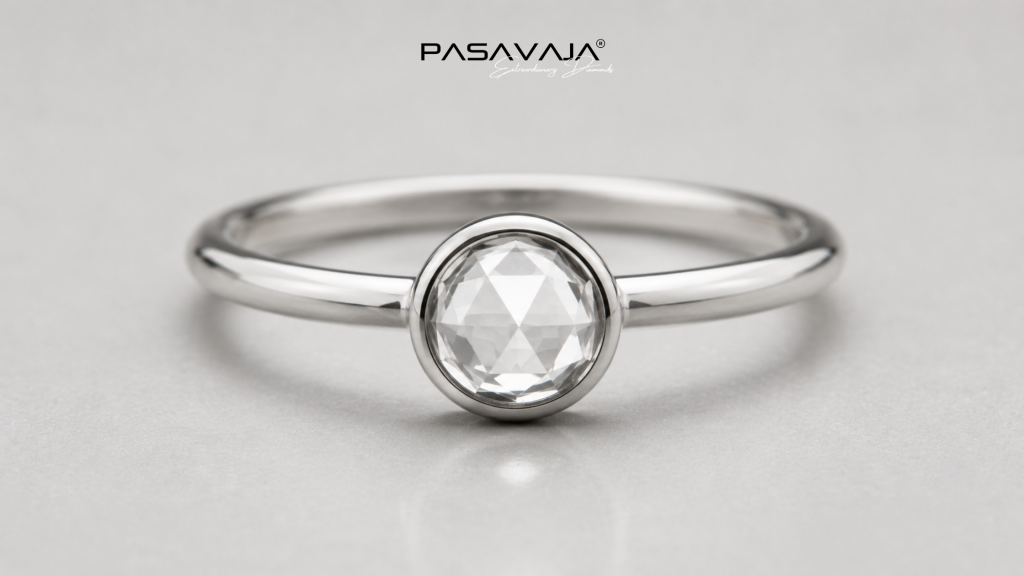
A rose cut diamond has three defining features: a flat base with no pavilion, a domed crown, and large triangular facets that converge at a single point at the top. There are typically between 3 and 24 facets, arranged in a pattern that resembles the petals of an unfurling rose, which is exactly where the name comes from.
The architecture is fundamentally different from a modern round brilliant. A round brilliant has a deep pavilion beneath the girdle that reflects light down and back up through the table. A rose cut has none of that. What you get instead is a wide, open, low-profile stone that sits close to the skin and produces a soft, candlelit glow rather than sharp electric sparkle.
This is not a flaw. It is a completely different philosophy of how a diamond can be beautiful.

The History of Rose Cut Diamonds
Rose cut diamonds have their origins in the Indian-Dutch diamond trade, making them one of the earliest refined cuts in the history of the gem. India, specifically the mines of Golconda, supplied rough diamonds to European traders from the 1500s onward, and the Dutch lapidaries of Amsterdam were among the first to develop the rose cut as a way to make the most of flat, irregular rough crystals that could not easily yield a deep pavilion.
By the 1600s, the rose cut was the dominant diamond cut in European jewelry. It appeared throughout the Georgian and Victorian eras, set into mourning jewelry, portrait lockets, brooches, tiaras, and sentimental rings. Because diamonds were cut and polished by hand, every rose cut from that period is slightly different. That individuality is a large part of their appeal today.
The brilliant cut gradually displaced the rose cut through the 18th and 19th centuries as cutting technology improved. By the early 20th century, the rose cut had largely disappeared from mainstream jewelry production.
What we are seeing now is a genuine revival, driven partly by a desire for something different from the modern brilliant, and partly by a growing appreciation for the craftsmanship and history embedded in these stones. For more on how cutting styles evolved, the GIA’s diamond history resources provide excellent context.
Rose Cut vs Round Brilliant: A Fundamentally Different Architecture
This comparison matters because buyers often assume that “less facets equals less quality.” That is not what is happening here. The rose cut and the round brilliant are designed to do completely different things.
| Characteristic | Rose Cut | Round Brilliant |
|---|---|---|
| Base | Flat, no pavilion | Deep curved pavilion |
| Crown | Domed with triangular facets | Lower crown with multiple facet tiers |
| Typical Facet Count | 3 to 24 | 57 to 58 |
| Profile / Depth | Very low | Deep |
| Sparkle Character | Soft, intimate, glowing | Intense, electric, scintillating |
| Face-Up Size vs Carat | Larger, flat base means more spread | Smaller face-up for same carat weight |
| Ideal Lighting | Soft, diffused, candlelight | Any light; performs best in bright light |
| Setting Style | Bezel, rub-over, low profile | Prong, claw, halo |
Because the rose cut has no pavilion, it sits much lower on the finger than a brilliant cut. A 1-carat rose cut will typically measure around 7.5mm to 8mm in diameter, close to what a 1.20-carat round brilliant produces. That is a significant size advantage for buyers who want visual impact without the weight.
The trade-off is sparkle intensity. In bright overhead light, a brilliant cut will outperform a rose cut on sheer fire and scintillation. But in soft indoor lighting, candlelight, or the warm glow of sunset, a rose cut comes alive in a way that a brilliant cut does not always match.
Neither is objectively better. They are different experiences of the same material.
The Sustainability Advantage of Rose Cut Diamonds
One practical reason rose cuts are attracting attention among informed buyers is the way they interact with rough diamonds. A brilliant cut requires a deep, well-formed octahedral rough crystal. A significant amount of that rough is lost in the cutting process, sometimes 50% or more.
Rose cuts, by contrast, can be cut from flatter, more irregular rough material that would otherwise be difficult to use efficiently. Less rough is wasted. More of the original crystal ends up in the finished gem.
This does not make rose cuts inherently “sustainable” in a strict environmental certification sense. But for buyers who care about the efficient use of natural resources, the rose cut represents a genuine difference from the standard brilliant-cut manufacturing model.
This is also why rose cut diamonds in natural fancy colors are exciting: color diamonds are already rare in rough form, and the ability to use a wider range of crystal shapes makes it possible to preserve color that might otherwise be lost in cutting.
For a deeper look at natural diamond color, PASAVAJA’s colored diamond education guide covers the full spectrum.
Why Rose Cut Diamonds Are Having a Revival
The revival of the rose cut is not a single-cause phenomenon. Several things are converging at once.
Jewelry designers have rediscovered the aesthetic. Minimalist settings, thin bands, bezel mounts, rub-over settings, have become dominant in high design, and the flat, low-profile rose cut suits these settings perfectly. A modern rose cut in a fine platinum bezel looks nothing like Victorian mourning jewelry. It looks sharp, architectural, and completely contemporary.
Buyers are also seeking alternatives to the standard round brilliant. After decades in which the round brilliant was essentially the only serious option for engagement rings, many buyers are now actively looking for something with a different visual character and a connection to history that a modern cut cannot offer.
The antique market has also driven awareness. Collectors and auction buyers encountering Georgian and Victorian rose cut jewelry have developed a genuine appreciation for the cut’s unique quality, and that appreciation has filtered into the bespoke and custom jewelry market.
How to Buy a Rose Cut Diamond: Expert Guidance
Rose cuts are evaluated differently from modern brilliant cuts. Here is what to focus on when you are buying one.
Understand that GIA does not assign a cut grade to rose cuts. The Excellent / Very Good / Good / Fair / Poor scale applies only to round brilliants. For rose cuts, you evaluate the craftsmanship of the facet execution, the symmetry of the dome, the quality of the polish, and the overall proportion of the stone directly. GIA does certify rose cut diamonds, the report will describe the shape and cutting style, color, clarity, and carat weight, but will not include a cut grade.
Symmetry matters enormously. A rose cut with uneven facets or an asymmetric dome will look noticeably off. Insist on seeing the stone face-up before buying, ideally in person, or via high-quality video from the seller.
Face-up color reads differently. Because a rose cut has no pavilion to reflect and amplify color, a faint warmth in a rose cut may be less visible than in a round brilliant. Buyers sometimes find that they can comfortably choose a slightly warmer color grade in a rose cut without any visible compromise. This is worth discussing with an expert before you decide on a grade.
Clarity is more visible than in brilliant cuts. The large, open facets of a rose cut do not hide inclusions the way a brilliant cut’s many small facets do. Inclusions that would be invisible in a round brilliant can be visible in a rose cut. Aim for VS2 or better, and always check eye-cleanliness directly.
Antique vs modern rose cuts are genuinely different. Original Georgian and Victorian rose cuts have a character that modern reproductions often do not fully capture, the handwork, the slight irregularities, the sense of age. Modern rose cuts can be beautiful, but they are a different experience. Know which one you are buying.
If you are navigating this decision, PASAVAJA’s diamond education section provides grounding in the fundamentals that apply across all diamond types.

Rose Cut Diamond Price Guide
Rose cut diamonds sit in an interesting position in the market. They are generally priced below comparable round brilliants in terms of cost per carat because they do not require the same quality of rough to produce, and because the market for them, though growing, is more specialist than the mainstream brilliant cut market.
Antique rose cuts from the Georgian and Victorian periods, however, can carry significant premiums based on provenance, age, setting quality, and the appeal of the historical piece as a whole.
| Type | Carat Range | Clarity | Approximate Price Range (USD) | Notes |
|---|---|---|---|---|
| Modern rose cut, colorless | 0.50 ct | VS2 to VS1 | $1,000 to $2,500 | Budget-friendly entry point |
| Modern rose cut, colorless | 1.00 ct | VS2 to VS1 | $2,500 to $5,500 | Sweet spot for engagement rings |
| Modern rose cut, colorless | 2.00 ct | VS2 to VVS2 | $7,000 to $15,000+ | Size and quality drive premium |
| Antique rose cut (Georgian / Victorian) | 0.50 to 1.50 ct | VVS to VS | $3,000 to $12,000+ | Historical premium applies |
| Natural color rose cut | Varies | Varies by color | Significant premium | Rarity and color intensity drive value |
These are indicative ranges based on current market knowledge. Actual pricing depends on color, clarity, source, and whether the stone is accompanied by a GIA certificate. Always request GIA documentation for any rose cut purchase above a modest value. For a personal quote, connect with PASAVAJA directly through the price quotation page.

Best Settings for Rose Cut Diamonds
Because the rose cut has a flat base, it requires different setting approaches than a brilliant cut.
Bezel and rub-over settings are the most natural choice. A full bezel surrounds the girdle of the stone with metal, holding it securely in place while complementing its low profile. This setting also protects the edge of the stone, important because rose cuts can occasionally be more vulnerable at the girdle than deep-pavilion stones.
Collet settings, a simple tube of metal that the stone drops into, are historically appropriate for Georgian and Victorian rose cuts and look spectacular in antique-inspired pieces.
Prong settings can work for rose cuts but require careful design. The standard four-prong solitaire designed for a brilliant cut will not sit correctly on a flat-based rose cut. Custom prong work is needed, something PASAVAJA’s bespoke design team is well equipped to handle.
Metal choice affects the visual character of a rose cut significantly. Platinum and white gold preserve the diamond’s color accurately. Yellow gold adds warmth that suits the soft, intimate sparkle of a rose cut beautifully. Rose gold has become popular for rose cuts, and the visual harmony between the warm metal and the stone’s glow is genuinely lovely.
For specific guidance on metal choices, PASAVAJA’s jewelry education section explores how setting decisions affect the finished result.
PASAVAJA’s Expertise in Rose Cut Diamonds
At PASAVAJA, Harsh Shah has deep knowledge of antique diamond cuts, including how to identify genuine period rose cuts, evaluate their craftsmanship, and distinguish authentic Georgian and Victorian stones from modern reproductions. That level of expertise is rare and matters significantly when you are considering a purchase in this category.
Our sourcing reaches both antique trade networks and contemporary cutters producing high-quality modern rose cuts. Every stone we recommend is evaluated for symmetry, polish, color, and clarity before being presented to a buyer.
Our services for rose cut buyers include:
- Loose rose cut diamond sourcing, both antique and modern
- GIA certification verification and grading review
- Bespoke jewelry manufacturing in platinum and 18K gold
- Transparent education on what separates an exceptional rose cut from an average one
- Personalized buying guidance via WhatsApp or email
- Free worldwide shipping on insured delivery
Whether you are looking for a rose cut as a center stone for a bespoke ring, a collector piece, or a gift with genuine historical meaning, we are here to help you find the right stone.
Conclusion
Rose cut diamonds offer something that modern brilliant cuts simply cannot: a direct connection to centuries of diamond history, a distinct visual character that is intimate and warm rather than sharp and electric, and a low profile that suits contemporary jewelry design beautifully.
The revival of interest in rose cuts is not a trend that will fade. It reflects a genuine and growing appreciation for what makes these stones special, their origins in the Indian-Dutch diamond trade, their place in Georgian and Victorian jewelry history, their efficient use of natural rough material, and above all, the particular quality of light they return.
If you are considering a rose cut diamond, the most important step is to see one in person, or at minimum in detailed video. No photograph fully captures what a rose cut does in soft light. We would love to help you find out.
Thinking about a rose cut diamond? Connect with Harsh and the PASAVAJA team directly:
WhatsApp: +91 887 9999 787 (fast reply guaranteed) Email: info@pasavaja.com
We can help you with:
- Loose rose cut natural diamonds (antique and modern)
- Antique and period jewelry with original rose cut stones
- Bespoke fine jewelry manufacturing
- GIA-certified natural diamonds across all categories
- Custom sourcing for rare and one-of-a-kind shapes
Frequently Asked Questions
Q: What is a rose cut diamond?
A: A rose cut diamond has a flat base with no pavilion, a domed crown, and large triangular facets that converge at a single apex. It produces a soft, intimate sparkle rather than the intense scintillation of a modern brilliant. Rose cuts originated in the Indian-Dutch diamond trade of the 1600s and are experiencing a major design revival.
Q: Does a rose cut diamond have a flat bottom?
A: Yes. The defining feature of a rose cut is its completely flat base: there is no pavilion below the girdle. This means the stone sits very low on the finger and spreads wider face-up than a deep brilliant cut of the same carat weight. A 1-carat rose cut typically measures around 7.5mm to 8mm in diameter.
Q: How does rose cut sparkle compare to round brilliant?
A: Rose cuts produce a soft, glowing light return rather than the sharp, electric scintillation of a round brilliant. In bright overhead light, a brilliant cut outperforms a rose cut on raw sparkle intensity. In soft, diffused, or candlelight conditions, a rose cut has a distinctly romantic and intimate glow that many buyers prefer.
Q: Why are rose cut diamonds popular again?
A: Rose cuts appeal to buyers looking for something distinct from the standard round brilliant, a connection to diamond history, and a low-profile stone that suits minimalist and contemporary jewelry settings. Designers also favor them for their efficient use of natural rough and their versatility in antique-inspired and modern designs alike.
Q: Are rose cut diamonds cheaper than round brilliant cut diamonds?
A: Generally, modern rose cut diamonds are priced below comparable round brilliants in cost per carat because they use a different grade of rough and serve a more specialist market. Antique rose cuts from the Georgian and Victorian periods can command significant premiums based on provenance and historical value.
Q: What settings work best for rose cut diamonds?
A: Bezel and rub-over settings are the most natural fit for rose cut diamonds, as they accommodate the flat base and low profile elegantly. Collet settings work well for antique-inspired pieces. Prong settings can work but require custom design. Yellow and rose gold suit the warm, soft sparkle of a rose cut beautifully.
Q: Are rose cut diamonds ethical?
A: Natural rose cut diamonds sourced with GIA certification and proper documentation are as traceable as any other natural diamond. Additionally, rose cuts can be cut from a wider range of rough material than brilliant cuts, resulting in less waste of natural rough. They are not lab-grown: they are natural diamonds with a heritage cutting style.
Every stone is photographed and graded before it is listed. Join the list to see them before they reach the shop.
New stones only, no more than once a month. Unsubscribe any time.
Tell us the grade, shape and range. We will only send stones that genuinely match.