Moval Diamond Guide
On this page
If you have ever looked at an oval diamond and a marquise side by side and thought, “I wish there was something in between”: there is. It is called the moval diamond, and it is one of the most interesting, least understood shapes in the natural diamond world today. Harsh Shah, Director at PASAVAJA Gems and a GIA and De Beers Institute-trained diamantaire with deep expertise in rare and specialty diamond shapes, considers the moval one of the most rewarding shapes to source and study, precisely because so few people know how to talk about it properly.
In this guide, you will learn exactly what a moval diamond is, how it compares to an oval and a marquise, what to look for when buying one, and how PASAVAJA can help you find or source this genuinely rare shape.
What Is a Moval Diamond?
A moval diamond is a hybrid diamond shape that combines the rounded belly of an oval cut with the pointed, tapered ends of a marquise cut. The result is an elongated outline that is softer than a marquise but more dramatic than a standard oval. It is not a standardised GIA cut grade category: it is a specialty shape that falls under the broader umbrella of fancy shape diamonds. The name itself is a portmanteau: marquise plus oval, shortened to moval.
Think of it this way. An oval has two gently curved ends. A marquise has two sharp points. A moval sits in the middle, one end tapers to a soft point, the other remains slightly rounder, or both ends taper gently without the aggressive sharpness of a true marquise. The exact geometry can vary depending on the cutter, which is part of what makes the moval such a personal, distinctive shape.
Because there is no standardised cut grade system for the moval the way there is for a round brilliant, each stone is essentially unique. That is not a limitation: it is a feature, especially for buyers who want something that does not look like everyone else’s ring.

How the Moval Combines Oval and Marquise
The moval diamond takes its defining characteristics from two very different parent shapes, and understanding each one helps you understand what you are getting.
An oval cut diamond is based on the round brilliant cutting style. It has 56 to 58 facets, a wide belly, and two softly curved ends. It is beloved for how it elongates the finger, how it distributes carat weight across a large surface area, and how much brilliance it delivers. For a full introduction to fancy shape diamonds and how they compare, see our fancy shape diamond guide.
A marquise cut has the same brilliant-style facet arrangement but stretches into a boat shape with two pointed ends. Its ratio is dramatic. It looks large for its carat weight. And it creates a striking, fashion-forward silhouette.
The moval takes the length-to-width ratio sensibility of a marquise and softens it with the rounder belly of an oval. The result is a shape that:
- Elongates the finger more than an oval
- Reads as gentler and more feminine than a marquise
- Shows face-up size that is very generous relative to carat weight
- Has less risk of “wing chipping” compared to a marquise (because the tips are less sharp)
Length-to-width ratios for a moval typically fall between 1.50 and 2.00, but there is significant variation because cutters approach this shape differently. This is why sourcing expertise matters so much when you are looking for a moval.
Visual Characteristics and Proportions
When evaluating a moval diamond, the four main characteristics to assess are outline symmetry, the bow-tie effect, length-to-width ratio, and how the culet sits relative to the table.
Outline symmetry is critical. Because the moval has an asymmetric design by nature (one end can be more pointed than the other), you want to assess whether the shape feels intentional and elegant, or unbalanced and awkward. Look at the stone face-up and assess whether the outline flows cleanly from one end to the other without any flat edges or irregular curves.
The bow-tie effect is common to elongated brilliant-cut shapes including oval, pear, and marquise. A moval can show a visible dark band across its center when viewed face-up, depending on the cutting angles. A well-cut moval will minimize this, though some degree of bow-tie is almost always present. This is not a flaw: it is a characteristic of the shape. Importantly, a stronger bow-tie in a moval tends to be more forgiving than in a pear, because the overall shape distributes light more evenly.
Length-to-width ratio is a personal preference. A ratio closer to 1.50 gives you a shape that looks closer to a wide oval. A ratio closer to 2.00 gives you something closer to a stretched marquise. Most buyers who specifically seek out the moval tend to prefer ratios between 1.65 and 1.85 for the most distinctive look.
Depths and table percentages should be assessed similarly to oval and marquise benchmarks, though because GIA does not issue a cut grade for fancy shapes, you are relying on your own eye and the advice of a knowledgeable diamantaire. This is one of the key reasons to work with someone who has hands-on experience with specialty shapes.
For context on how GIA grades fancy shape diamonds, the GIA website provides useful background on their approach to grading non-round diamonds.
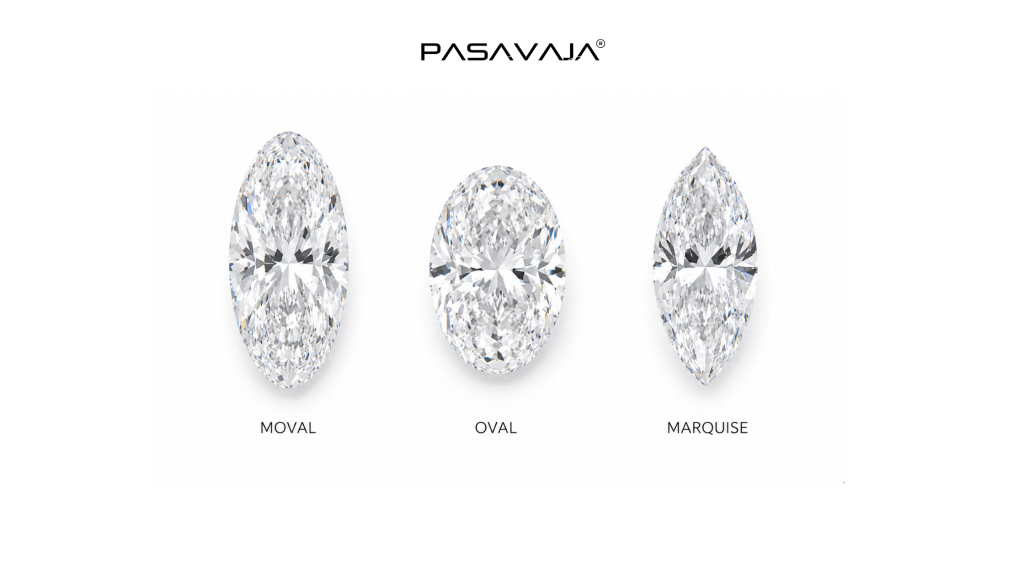
Moval vs Oval vs Marquise, How They Compare
| Characteristic | Moval | Oval | Marquise |
|---|---|---|---|
| End Shape | One or both ends gently tapered | Both ends softly rounded | Both ends sharply pointed |
| Typical L/W Ratio | 1.50 to 2.00 | 1.30 to 1.60 | 1.70 to 2.20 |
| Finger Elongation | High | Moderate to high | Very high |
| Face-Up Size vs Carat | Very generous | Generous | Very generous |
| Bow-Tie Risk | Moderate | Moderate | Moderate |
| Wing Chipping Risk | Low to moderate | Very low | Moderate to high |
| GIA Cut Grade | Not applicable | Not applicable | Not applicable |
| Availability | Rare | Common | Moderate |
| Best Setting | Solitaire, bezel, east-west | Solitaire, halo, pavé | Solitaire, two-stone |
The moval occupies an interesting sweet spot. It has the elongation and presence of a marquise without the fragility of its sharp points. It has the softness and brilliance of an oval without being as common or expected. For buyers who want something genuinely distinctive but still elegant and wearable, the moval is a compelling option.
The main trade-off is availability. Because the moval is not a standardised shape, you cannot simply walk into a retailer or search a database and filter for it. It requires sourcing from someone with access to specialty-cut stones, which is exactly where PASAVAJA’s network and expertise come in.
Expert Buying Tips for Moval Diamonds
When buying a moval diamond, focus on the stone in front of you rather than expecting a grading certificate to tell you everything. Here are the most important things to consider.
Always assess the stone in person or via a high-quality video. Because the moval is not a standardised cut, you cannot rely on a certificate alone to tell you whether the stone is beautiful. A good face-up video in natural and diffused lighting will show you the bow-tie, the scintillation, and how the outline actually flows.
Prioritise outline elegance above almost everything else. The moval’s beauty lives in its silhouette. If the outline has any flat edges, irregular transitions, or asymmetric proportions that feel unintended, the stone will never look right in a setting. Be selective.
GIA certification still matters. Even though GIA does not issue a cut grade for the moval, a GIA certificate gives you accurate color, clarity, and carat weight. For natural diamonds, always insist on GIA certification. This is non-negotiable at PASAVAJA. Our fancy shape diamonds education page explains more about how GIA approaches fancy shape grading.
Consider color grade carefully. Elongated brilliant shapes like the moval can retain a slight yellow or warm tint more visibly than round brilliants. For the whitest appearance, D to F color is ideal. G to H can still look clean when set in platinum or white gold, but assess the stone in daylight before committing.
The setting will shape the bow-tie perception. A bezel or partial bezel setting can actually minimize a visible bow-tie by adding metal around the stone’s perimeter, which changes how light enters from the sides. This is worth discussing with your jeweler before choosing a setting.
Rarity is real, be patient. A truly well-cut moval in a desirable size (above 1.50 carats) is genuinely uncommon. Do not settle for a poorly outlined stone simply because you found it quickly. The right moval is worth waiting for, and at PASAVAJA, we can source custom cuts through our network when the right stone is not immediately available.
Setting Recommendations for Moval Diamonds
The moval’s elongated shape suits a range of settings, but some work significantly better than others.
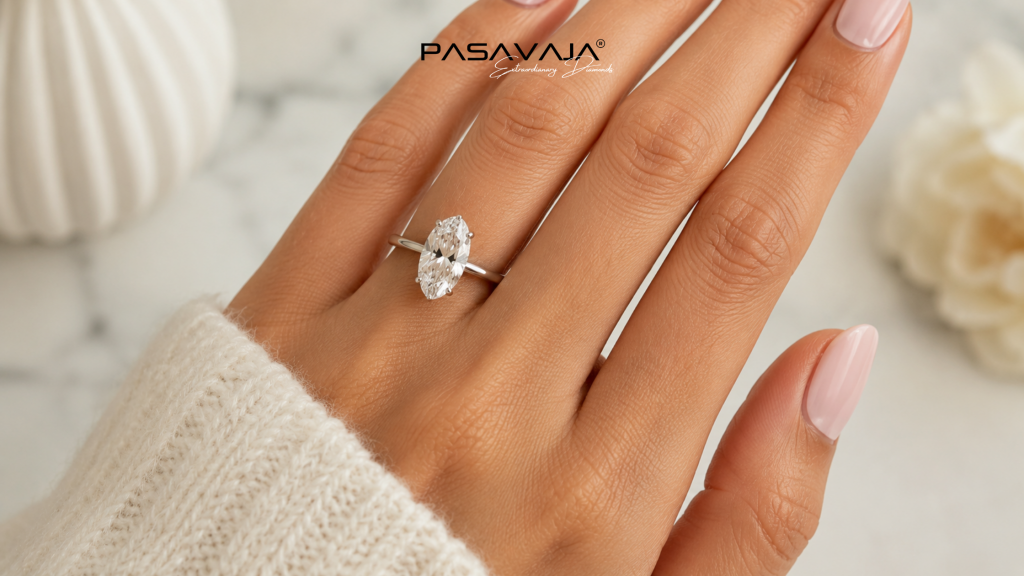
Solitaire settings are the natural first choice for a moval. They let the shape do all the talking. A thin platinum or white gold band with a four or six-prong head works beautifully, especially when the prongs are positioned to protect the tapered ends without obscuring them.
East-west settings, where the diamond is set horizontally across the finger rather than vertically, are a modern and unexpected choice for the moval. Because the shape is already elongated, setting it east-west creates a very wide, architectural look that suits long fingers especially well.
Bezel settings wrap the diamond fully in metal, which protects the tapered tips and minimises the bow-tie visually. This is a good practical choice and creates a very sleek, contemporary aesthetic. Rose gold bezels with a moval are particularly striking.
Metal choice affects how the diamond reads. Platinum or 18K white gold maximises the apparent whiteness of the stone for D to H color grades. For a warmer color diamond (I, J, or K), an 18K yellow gold setting can make the stone read as more intentionally warm and complementary rather than off-white.
For help thinking through setting options alongside your stone selection, visit our contact page and speak directly with the PASAVAJA team.
How to Source a Moval Diamond With PASAVAJA
The moval is one of the rarest diamond shapes to find at quality. Here is how PASAVAJA approaches the sourcing process.
Harsh Shah personally reviews specialty shape requests. Because the moval does not appear in most standard diamond inventories, PASAVAJA works through its direct network of cutters, rough dealers, and polished stone partners to locate or commission the right stone. This is not a search-and-filter process: it is genuine curation.
When you reach out to PASAVAJA for a moval diamond, expect to discuss:
- Your preferred carat weight and size on the finger
- Length-to-width ratio preference
- Color and clarity requirements
- Whether you already have a setting in mind
- Budget range and flexibility
All stones sourced by PASAVAJA for moval requests are GIA-certified natural diamonds. If a stone requires custom cutting to achieve the ideal moval outline, that can be arranged through the custom diamond cuts service.
PASAVAJA offers free worldwide shipping on all orders, fully insured delivery, and personalized buying assistance throughout the process. You are never dealing with a website or a call center: you are working directly with the people who sourced and selected your stone.
Conclusion
The moval diamond is one of the most interesting shapes you can choose, and one of the least written about anywhere online. It sits in a genuinely appealing space between two beloved parent shapes, offering the elongation and presence of a marquise with the softness and wearability of an oval. If you are looking for a diamond that stands apart without being eccentric, the moval is worth serious consideration.
The challenge is finding the right one. Because this is not a standardised shape, quality varies significantly between cutters. The outline, the proportions, and the light performance all need to be assessed stone by stone, by someone who knows what a great moval looks like.
That is exactly what PASAVAJA is here for.
Interested in sourcing a moval diamond? Harsh Shah and the PASAVAJA team would love to help you find the right stone.
WhatsApp: +91 887 9999 787 (fast reply guaranteed) Email: info@pasavaja.com
We can help you with:
- Rare and specialty diamond shapes including moval diamonds
- Custom diamond cut sourcing
- GIA-certified natural diamonds
- Bespoke fine jewelry manufacturing
- Free worldwide shipping with full insurance
Source a moval diamond with PASAVAJA
Frequently Asked Questions
Q: What is a moval diamond?
A: A moval diamond is a hybrid fancy shape that combines the rounded belly of an oval cut with the tapered, pointed ends of a marquise. It is not a standardised GIA cut category but a specialty shape that sits between the two parent shapes in both outline and visual character. Each moval is essentially unique.
Q: Is a moval the same as an oval diamond?
A: No. A moval has tapered ends that point more sharply than a standard oval, giving it a more elongated and directional silhouette. An oval has two evenly rounded ends with no taper or point. The moval is longer and more angular at its tips, even if those tips are softer than a marquise.
Q: How does a moval compare to a marquise diamond?
A: A moval is generally softer and more wearable than a marquise. Its tapered ends are less sharp than a marquise’s points, reducing the risk of chipping and creating a less aggressive outline. The moval looks more romantic and flowing, while the marquise looks more bold and geometric.
Q: Are moval diamonds rare? A: Yes. The moval is not a common inventory shape and is not produced by most cutting houses at scale. Finding a well-proportioned moval in a desirable size requires specialist sourcing. This rarity is part of what makes it appealing to buyers who want something genuinely different.
Q: Is the moval an official diamond cut?
A: No. The moval is not a standardised cut grade category recognized by the GIA or other major grading laboratories. GIA will grade a moval for color, clarity, and carat weight, but will not issue a cut grade the way it does for round brilliants. The shape falls under the broader “fancy shape” designation.
Q: Where can I buy a moval diamond?
A: Moval diamonds are best sourced through specialist diamantaires who have access to custom-cut or specialty-shape stones. PASAVAJA Gems sources moval diamonds through its direct network and can also commission custom cuts when the right stone is not immediately available. Contact the team via WhatsApp or email for a personalized search.
Q: What size moval diamond should I choose for an engagement ring?
A: Most buyers find that a moval between 1.00 and 2.00 carats offers the best balance of presence and wearability on the finger. Because the moval’s elongated shape distributes carat weight across a large surface area, a 1.20 carat moval will often look as large as a 1.50 carat round brilliant. Your diamantaire can guide you based on your preferred finger coverage and aesthetic.
Every stone is photographed and graded before it is listed. Join the list to see them before they reach the shop.
New stones only, no more than once a month. Unsubscribe any time.
Tell us the grade, shape and range. We will only send stones that genuinely match.