Kite Cut Diamond Guide
On this page
If you have been exploring non-round diamond shapes and found yourself drawn to something angular, architectural, and genuinely rare, the kite cut diamond deserves your full attention. Harsh Shah, Director at PASAVAJA Gems LLP and a second-generation diamantaire with credentials from GIA, De Beers Institute, and Rapaport Academy, has sourced and studied specialty-cut diamonds that most dealers have never even handled. Kite cuts are among his favorite geometric shapes precisely because they are so uncommon, and so visually commanding.
In this guide, you will learn exactly what a kite cut diamond is, how its geometry affects sparkle and setting requirements, what to expect on pricing, and how to wear one beautifully. Whether you are a jewelry designer, a collector, or someone building a one-of-a-kind ring, this is everything you need to know.
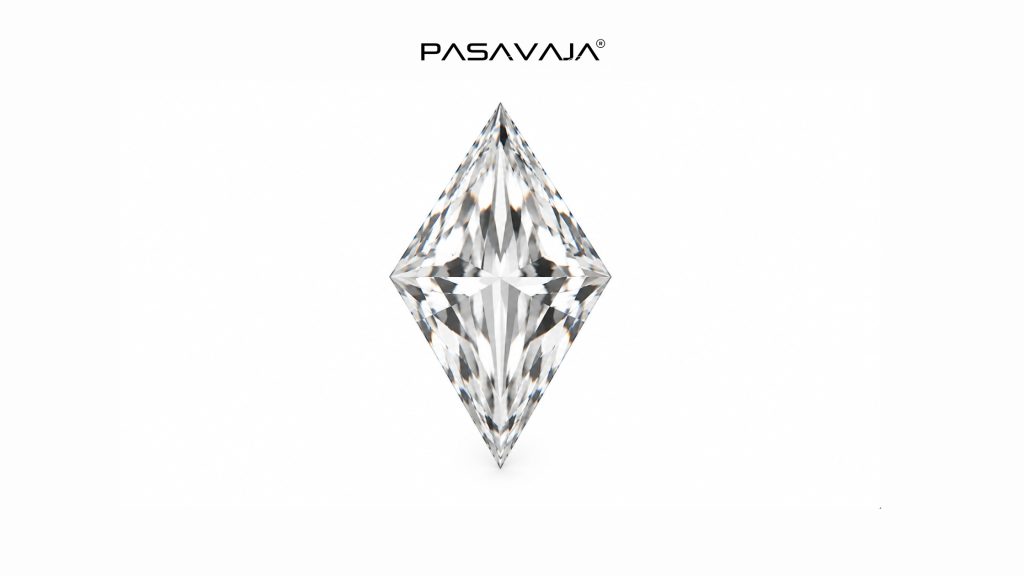
What Is a Kite Cut Diamond?
A kite cut diamond is a four-sided geometric diamond shape with two acute (narrow) angles and two obtuse (wider) angles, creating a silhouette that resembles the classic flying kite. It is a fancy shape diamond with a flat, elongated body and sharp pointed ends. Unlike round or oval diamonds, kite cuts are entirely non-traditional and are crafted by skilled cutters who prioritise geometric precision over conventional brilliance formulas.
The kite cut is not a standardised shape with fixed proportions the way a round brilliant is. Each stone is cut to honour the rough diamond crystal’s natural geometry, which means no two kite diamonds are exactly alike. That originality is a large part of what makes them so appealing to collectors and design-forward buyers.
Kite cuts are sometimes confused with lozenge or rhombus shapes, but the distinction is meaningful. A true kite is asymmetric along one axis, with two shorter sides and two longer sides meeting at four distinct points. A lozenge has four equal sides. If you are sourcing one, understanding this difference will help you communicate clearly with your dealer, and avoid buying the wrong shape.
You can learn more about the broader world of geometric and fancy shape diamonds on our Fancy Shape Diamonds education page.
Visual Characteristics of a Kite Cut Diamond
A kite cut diamond has sharp pointed corners at the top and bottom, with two wider corner angles on the sides. Face-up, it looks bold, graphic, and architectural. It tends to project a larger face-up appearance relative to its carat weight compared to round brilliants, because the shape is wide and flat.
Kite cuts are most commonly faceted as either step cuts or mixed cuts. Step-cut kite diamonds have long, parallel facets running across the stone, similar to an emerald cut, which creates a glass-like, hall-of-mirrors effect. Mixed cut versions incorporate brilliant-style facets that produce more light scattering and sparkle. The choice between the two entirely changes the mood of the stone.
Because the shape has four corners, each corner tip is a vulnerability point. Unlike the curved edges of an oval or round, pointed corners on a kite are exposed and can chip if knocked against a hard surface. This is not a reason to avoid the shape, but it is a reason to choose a setting that protects those points, which we will cover shortly.
One thing Harsh always flags with angular specialty shapes: inclusions can appear more noticeable in step-cut kite diamonds because the parallel facets act like a window into the stone rather than breaking up the light. If you are choosing a step-cut kite, clarity matters more than it would for a round brilliant of the same grade.
Kite Cut vs Shield vs Hexagon: How These Geometric Shapes Compare
| Characteristic | Kite Cut | Shield Cut | Hexagon |
|---|---|---|---|
| Number of sides | 4 (asymmetric) | 5 | 6 |
| Point count | 2 sharp points | 1–2 pointed ends | 0 (flat edges) |
| Typical facet style | Step or mixed | Step or mixed | Step or brilliant |
| Face-up visual | Elongated, angular | Wider, irregular | Balanced, geometric |
| Corner vulnerability | High (2 points) | Moderate | Low |
| Rarity | Very rare | Rare | Rare |
| Best for | Statement rings, pendants | Statement solitaires | Art Deco designs |
| Typical carat range available | 0.30ct to 2.00ct | 0.50ct to 3.00ct | 0.50ct to 2.50ct |
Kite cuts stand apart from shield and hexagon diamonds because of their elongated silhouette and pointed ends, which create a more directional, almost arrow-like visual. Shield cuts feel broader and more irregular; hexagons feel balanced and structured. The kite has a kinetic energy to it, it moves visually in a way the others do not.

Setting Requirements for a Kite Cut Diamond
The most important thing to understand about setting a kite cut diamond is corner protection. The two sharp pointed ends at the top and bottom of the stone need to be either secured within a bezel, capped with a prong, or set into a V-tip prong specifically designed for pointed shapes.
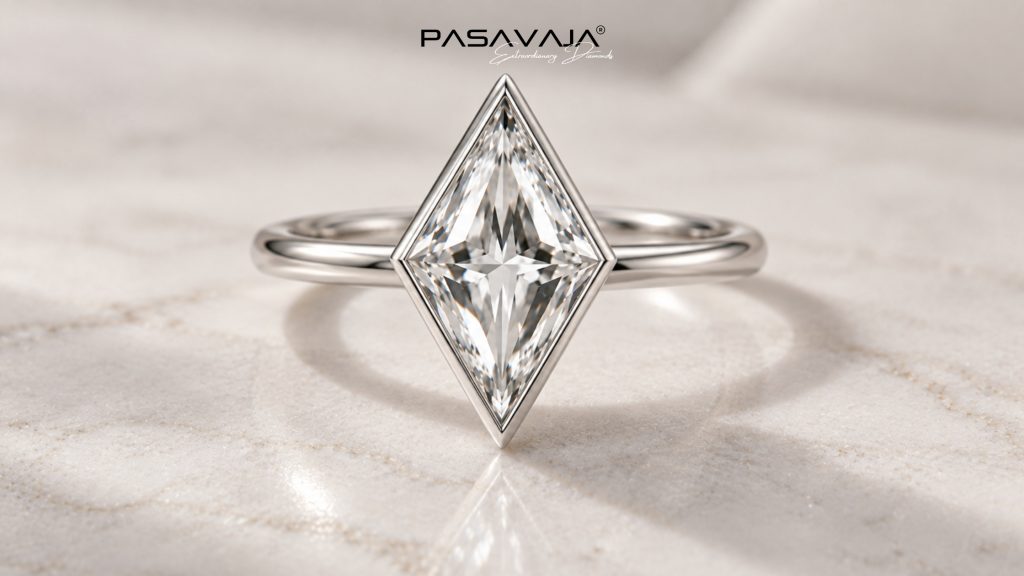
A full bezel setting is the safest and most popular choice for kite diamonds. The metal wraps all the way around the stone, protecting every corner. It also gives the ring a clean, minimal, architectural look that suits the geometry of the kite perfectly. This is the setting Harsh recommends most often for clients who want a kite cut for everyday wear.
East-west orientation is a striking alternative. Rather than setting the kite with its longest axis running north-south (pointing up toward the fingertip), some designers rotate it 90 degrees so the stone lies horizontally across the finger. The result is bold, wide, and completely unconventional. It works especially well for index finger or pinky rings.
Tension settings and bypass styles can also complement the angular nature of the kite, but these require expert craftsmanship to execute safely. At PASAVAJA, Harsh sources the diamond and works closely with the manufacturing team to ensure the stone dimensions are matched precisely to the setting before anything is made. You can explore that process through our Custom Diamond Cuts service.
Avoid claw or prong settings that do not specifically protect the corner points. A standard four-prong basket setting built for a round stone will not hold a kite safely. This is a shape where bespoke setting design is not optional: it is essential.
Kite Cut Diamond Pricing: What to Expect
Kite cut diamonds are specialty shapes and are priced differently from standard rounds or even popular fancy shapes like ovals and pears. Because they are uncommon, demand from the trade is lower, which means the price per carat can often be more accessible than a comparable round brilliant of the same weight and quality.
That said, the uniqueness of each kite diamond also means pricing varies widely. A step-cut kite in D-F color with VS1-VS2 clarity in the 0.75 to 1.00 carat range will typically range from USD $2,500 to $5,500 depending on the specific proportions, facet execution, and market availability. Larger stones over 1.50 carats become genuinely rare and command a strong premium.
For a GIA-certified kite cut natural diamond in the 0.50 to 1.00 carat range with good clarity (VS2 to SI1), expect to budget between USD $1,800 and $4,000. Below VS2, the step-cut faceting style can make inclusions visible to the naked eye, so clarity should not be compromised as aggressively as it might be with a round brilliant.
Color is less critical for kite cuts compared to colorless rounds, especially if the stone is being set in yellow gold or rose gold. G-H color in a kite cut will look beautiful and is where many experienced buyers find the best value.
It is also worth noting that GIA does not have a standardised grading system specifically for kite cut diamonds in the same way it does for round brilliants. When Harsh sources kite cuts, he evaluates symmetry, corner acuity, and facet quality by hand, not just by certificate. That hands-on sourcing expertise is something you simply cannot replicate by buying off a stock list.
For a personalized price quotation for a kite cut diamond, reach out through the PASAVAJA contact page and Harsh will respond directly.
Kite Cut Diamonds in Contemporary Jewelry Design
The kite cut diamond has found its audience among a specific type of jewelry buyer: design-conscious, minimalist-leaning, and tired of seeing the same shapes in every store. Interior designers, architects, and creative professionals are drawn to the geometric clarity of the kite for exactly the same reason they are drawn to good design in other areas of their lives. The shape is structural. It says something.
In recent years, kite cuts have appeared in avant-garde engagement rings as the center stone, set east-west or at a diagonal. They have also become a popular choice as accent stones flanking a colorless round brilliant or emerald cut, where their angular outline adds a graphic contrast to the main stone’s curves or lines.
Kite cuts work beautifully in:
- Minimalist solitaire rings in platinum or 18K white gold with a full bezel
- East-west set rings in 18K yellow gold for a bold contemporary look
- Stacking pendants where the angular silhouette catches the eye
- Art Deco-inspired pieces that lean into the geometric vocabulary of that era
- Three-stone rings where two kites flank a central round or emerald cut
If you are exploring antique diamond shapes and their modern interpretations, our Fancy Shape Diamonds education guide has a broader breakdown of specialty cuts and how to compare them.
PASAVAJA’s Expertise in Specialty and Geometric Diamond Shapes
At PASAVAJA, Harsh Shah personally evaluates every specialty-cut diamond before it is presented to a client. Kite cuts, shield cuts, hexagons, and other geometric shapes require hands-on assessment because no two stones are proportioned alike. There is no grading system that tells you whether a kite cut is beautiful or not, that requires eyes trained on thousands of stones.
Here is what PASAVAJA offers buyers exploring specialty shapes:
- Direct loose diamond sourcing from the cutting centers in Surat and global trade networks
- Personal curation by Harsh Shah with a focus on geometric symmetry and facet quality
- GIA certification on all natural diamonds
- Bespoke fine jewelry manufacturing to ensure the setting is designed for the stone, not the other way around
- Fully insured worldwide delivery
- Personalized guidance via WhatsApp or email throughout the process
PASAVAJA is a second-generation family diamond business. When you work with us, you are not buying from a catalog. You are working directly with the people who source and evaluate the stone. That level of access is rare.
If you are ready to source a kite cut diamond, connect with Harsh directly and let us know what you are looking for.
Conclusion: Is a Kite Cut Diamond Right for You?
The kite cut diamond is not for everyone, and that is precisely its appeal. It is a shape for buyers who want something that cannot be found in a high street jewelry store, something that sparks a conversation and reflects a deliberate, design-conscious sensibility.
If you love geometric design, architectural aesthetics, and the idea of wearing a stone that is genuinely uncommon, the kite cut is worth exploring seriously. The sourcing is harder than for a round or oval, the setting requires specialist craftsmanship, and clarity selection needs more care. But the result, when done right, is a piece of jewelry that is entirely singular.
Thinking about sourcing a kite cut diamond or exploring other specialty shapes? Harsh and the PASAVAJA team would love to help.
Connect with us directly:
WhatsApp: +91 887 9999 787 (fast reply guaranteed) Email: info@pasavaja.com
We can help you with:
- Specialty and geometric diamond shapes including kite, shield, and hexagon
- Loose natural diamonds sourced personally by Harsh Shah
- Bespoke fine jewelry designed around your chosen stone
- GIA-certified natural diamonds across all categories
- Custom sourcing for rare and one-of-a-kind cuts
- Fully insured worldwide shipping
Frequently Asked Questions
Q: What is a kite cut diamond?
A: A kite cut diamond is a four-sided geometric fancy shape with two acute and two obtuse angles, creating a silhouette that resembles a flying kite. It has two sharp pointed ends and a flat, elongated body. No two kite diamonds are proportioned identically. It is a rare specialty shape popular with minimalist and design-focused buyers.
Q: How many sides does a kite cut diamond have?
A: A kite cut diamond has four sides. Two of those sides are shorter, and two are longer, meeting at four corners: two narrow acute-angle points and two wider obtuse-angle sides. This four-sided geometry is what creates the kite silhouette and distinguishes it from shields (five sides) and hexagons (six sides).
Q: Is a kite cut diamond brilliant or step cut?
A: Kite cut diamonds can be faceted as either step cut or mixed cut. Step-cut kite diamonds have long parallel facets that create a glass-like, hall-of-mirrors effect. Mixed-cut kites incorporate brilliant-style facets that produce more sparkle. The facet choice changes the visual character of the stone significantly. Step cuts are more popular for their clean, architectural look.
Q: Are kite cut diamonds rare?
A: Yes. Kite cut diamonds are among the rarer specialty shapes in the market. They are not mass-produced by cutting houses, and each stone is shaped individually. Finding a well-proportioned kite cut with good symmetry and clean facets requires sourcing from specialist dealers rather than standard stock lists. This rarity also contributes to their appeal for collectors.
Q: What settings work best for a kite cut diamond?
A: A full bezel setting is the safest and most popular choice for kite cuts because it protects the vulnerable pointed corners. V-tip prongs are also used for the top and bottom points. East-west orientation is a bold alternative that places the stone horizontally across the finger. Standard four-prong settings built for round diamonds are not suitable for kite shapes.
Q: Is a kite cut the same as a lozenge diamond?
A: No. A kite cut and a lozenge cut are different shapes. A kite has two shorter sides and two longer sides meeting at four points, with asymmetry along one axis. A lozenge is a rhombus, meaning all four sides are equal. They can look similar at a glance but have distinctly different proportions. Always confirm which shape you are looking at before purchasing.
Q: What clarity grade should I choose for a kite cut diamond?
A: For step-cut kite diamonds, aim for VS2 or better. The parallel facets in a step cut act like windows into the stone, making inclusions more visible to the naked eye than they would be in a round brilliant. For mixed-cut kite diamonds, SI1 can sometimes be acceptable if the inclusion is positioned well. Always view the stone or request loupe images before purchasing.
Every stone is photographed and graded before it is listed. Join the list to see them before they reach the shop.
New stones only, no more than once a month. Unsubscribe any time.
Tell us the grade, shape and range. We will only send stones that genuinely match.