Shield Cut Diamond Guide
On this page
If you have spent any time exploring the edges of diamond design, the shapes that live beyond round brilliants, ovals, and cushions, you have probably encountered the shield cut diamond and wondered exactly what it is. It is one of those shapes that stops you. Harsh Shah, the colored diamond and specialty shape specialist at PASAVAJA, often describes the shield as a diamond for buyers who want geometry to do the talking.
This guide covers everything: what the shield cut actually is, how many sides it has, where it fits in a setting, and why collectors and bespoke jewelry designers keep coming back to it.
What Is a Shield Cut Diamond?
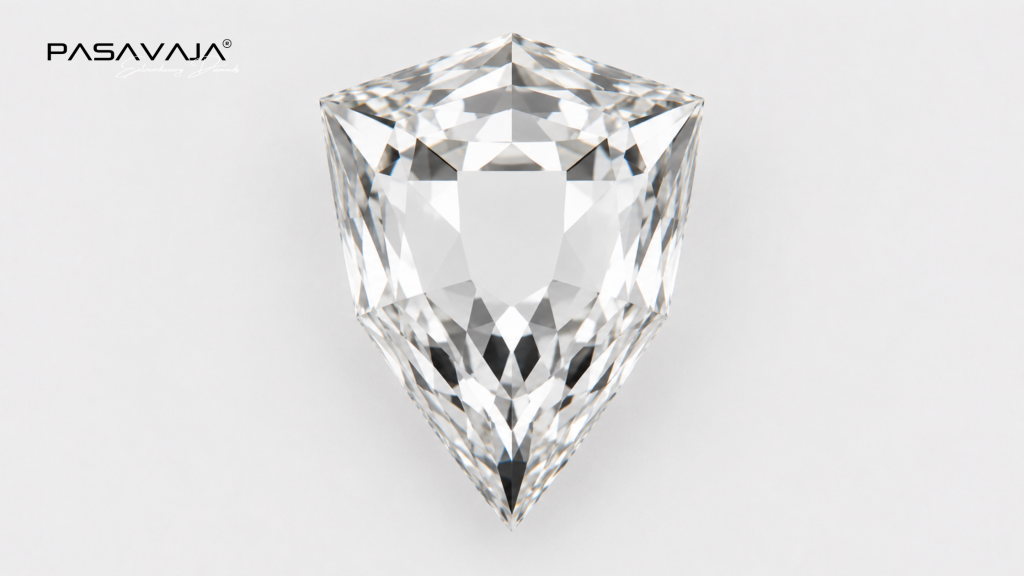
A shield cut diamond is an asymmetric geometric diamond with four to five sides, wider at the top and tapering to a point at the base. The resulting silhouette resembles a heraldic shield, which is precisely where the name comes from. It is not a brilliant cut in the traditional sense, and it is not a step cut. It sits in its own category: a specialty shape with a flat or lightly faceted crown and clean angular lines.
The cut is deliberately angular and non-traditional. That is the point. No two shield cut diamonds look identical, partly because the geometry can vary from cutter to cutter, and partly because the asymmetry of the shape responds to the rough diamond differently depending on the stone.
If you are new to fancy shapes, the diamond shapes guide at PASAVAJA is a good place to start before diving into the specialty cuts.
How Many Sides Does a Shield Cut Diamond Have?
Most shield cut diamonds have four or five sides. The classic configuration is a five-sided outline: a flat or slightly curved top edge, two gently angled sides, and two lower sides that converge at a single pointed tip. Some versions are cut with four sides for a more angular, kite-adjacent look.
The key characteristic is the taper, the stone is always wider at the top than at the bottom, and the bottom always resolves into a point or a narrow, rounded tip.
The facet pattern inside a shield cut varies. Some are table-cut style, with a large flat table facet and minimal additional faceting below. Others have a more developed facet pattern on the crown that produces some brightness and contrast. Neither version produces the rapid scintillation of a round brilliant. The visual character of a shield cut is about clarity, geometry, and bold line, not fire and flash.
Shield Cut as a Side Stone vs. Center Stone
The shield cut is most commonly encountered as a side stone in bespoke and custom ring designs. Set on either side of a larger center stone, whether round, oval, emerald, or cushion, a pair of shield cuts creates a deeply architectural frame that no other side stone shape can replicate.
The pointed tip of the shield is usually oriented downward, pointing toward the shank, with the wider top edge sitting close to the center stone. This orientation creates a beautiful visual flow from center to side stone.
As a center stone, the shield cut is rarer but it works well for collectors who want something genuinely distinctive. At a center stone carat weight of 1.00 carat or above, the geometry reads clearly and the shape makes an unmistakable statement.
| Application | Setting Style | Carat Range | Notes |
|---|---|---|---|
| Side stone (pair) | Three-stone, custom flanking | 0.30 to 0.70 ct each | Most common use; matched pairs required |
| Center stone | Solitaire, bezel, custom mount | 0.80 ct and above | Statement piece; very rare |
| Accent stone | East-west ring designs | 0.15 to 0.40 ct | Used by jewelry designers for geometric accent |

Setting Requirements for Shield Cut Diamonds
The pointed tip of a shield cut diamond requires protection. Like pear and marquise shapes, the tip is the most vulnerable part of the stone. A V-prong or a bezel setting that wraps around the tip is essential, especially if the diamond will be worn daily.
The flat, wide top edge of the shield also benefits from a flat or low-profile setting. A high-profile prong setting can look awkward on a shield because the shape is naturally flat and architectural. Low-profile bezels, half-bezels, or custom channel work tend to suit the shield’s geometry best.
Harsh Shah notes that one of the most exciting things about shield cut diamonds is that they almost always require a custom-made setting. There is no off-the-shelf mount for a shield cut. That means working with a designer who can build the setting around the stone, which is exactly the kind of bespoke work that PASAVAJA specialises in through the custom diamond cuts service.
Are Shield Cut Diamonds Rare?
Shield cut diamonds are genuinely rare. They are not produced at scale by any major cutting house. Most shield cuts you encounter in the market are either antique examples, one-off cuts produced for a specific designer, or stones cut to order from a specific piece of rough.
Because the shape requires the rough to taper cleanly to a point on one axis while remaining broad at the top, the yield from any given piece of rough is lower than for round, oval, or cushion cuts. Cutters do not typically produce shields unless there is a specific purpose for them.
That rarity has two practical implications. First, sourcing a matched pair of shield diamonds for side stone use is a genuinely specialist task. Second, shield cut diamonds do not trade on secondary markets at the same frequency as round brilliants or even most fancy shapes, which means price comparisons are difficult and direct expert guidance is essential.
For buyers interested in specialty and geometric diamond shapes, the kite cut diamond guide covers a closely related angular shape that is often considered alongside the shield.
Shield Cut Diamond Varieties
Not all shield cut diamonds look the same. The cut has evolved differently across different cutting traditions and design eras.
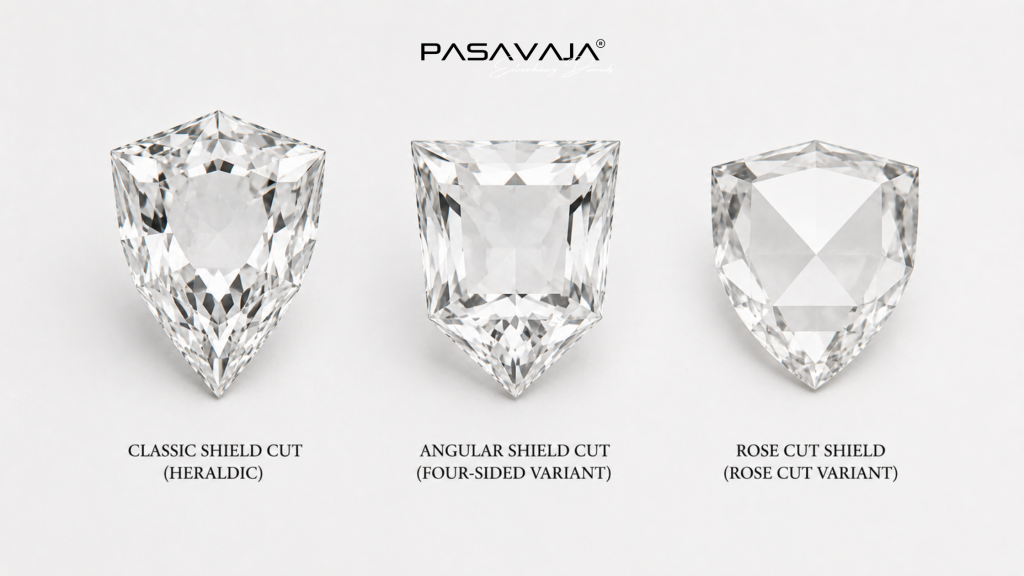
Classic heraldic shield: The five-sided version with the flat top, angled sides, and central point at the base. This is the most recognisable configuration.
Four-sided shield (angular variant): More acute angles at the sides, closer in character to a kite cut, with a sharper overall silhouette. Used more often in minimalist and architectural jewelry.
Softened shield: Some contemporary cutters introduce a slight curve to the top edge or upper sides, producing a shape that reads as shield but with a softer, more organic outline. Less strictly geometric.
Rose-cut shield: A flat-base shield with a domed rose-cut crown instead of a flat table. Produces a soft, antique-feeling glow rather than bright scintillation.
Each variety responds differently to light and each works better in different settings. Knowing which variant suits your project is part of what PASAVAJA’s sourcing and consultation process addresses.
PASAVAJA’s Expertise in Specialty Diamond Shapes
Finding a shield cut diamond is not a simple search on an online marketplace. It requires direct relationships with cutters, knowledge of which rough can yield this geometry, and the ability to assess whether a given shield has been cut with the proportions and symmetry required for it to look right in a setting.
This is where PASAVAJA’s specialty shape sourcing makes a genuine difference. Harsh Shah works directly with manufacturers to source shield cuts, kite cuts, hexagons, movals, and other non-standard shapes on behalf of clients, stones that simply are not available through conventional retail channels.
PASAVAJA offers:
- Loose specialty shape natural diamonds, personally sourced by Harsh Shah
- Custom bespoke jewelry manufacturing through Heer Shah’s design team
- GIA-certified natural diamonds across all categories
- Free worldwide shipping, fully insured
- Personalized sourcing assistance via WhatsApp or email
- Platinum and 18K gold settings for bespoke commissions
- Education-first approach, understanding your project before recommending a stone
Whether you need a matched pair of shield side stones for a bespoke three-stone ring, or a one-of-a-kind shield center stone for a collector piece, the PASAVAJA team can help you find it.
Conclusion: Is a Shield Cut Diamond Right for You?
The shield cut diamond is not for everyone, and that is part of its appeal. It is a shape for buyers who have already explored the mainstream and want something that no one else has. It is for jewelry designers who think in geometry. It is for collectors who understand that rarity is not just about color and clarity: it is also about form.
If you are drawn to the shield cut, you are looking at a stone that requires bespoke treatment at every stage: custom sourcing, custom setting, and usually a custom design brief. That is a commitment, but it produces results that are genuinely singular.
Thinking about adding a shield cut or other specialty diamond shape to your collection or commission? We would love to help.
Connect with Harsh and the PASAVAJA team directly:
WhatsApp: +91 887 9999 787 (fast reply guaranteed) Email: info@pasavaja.com
We can help you with:
- Specialty and geometric loose natural diamonds
- Matched pairs for side stone use
- Antique and rare diamond shapes
- Bespoke fine jewelry manufacturing
- GIA-certified investment-grade diamonds
- Custom sourcing for rare and one-of-a-kind stones
Frequently Asked Questions
Q: What is a shield cut diamond?
A: A shield cut diamond is an asymmetric geometric shape with four or five sides, wider at the top and tapering to a point at the base. It is named for its resemblance to a heraldic shield. It is most commonly used as a side stone in bespoke rings, though it can also be set as a distinctive center stone.
Q: How many sides does a shield cut diamond have?
A: Most shield cut diamonds have five sides, forming a classic heraldic shield outline with a flat or curved top, angled sides, and a central pointed tip at the base. A four-sided variant also exists and sits closer in geometry to a kite cut, with sharper, more angular sides.
Q: Is a shield cut diamond used as a side stone?
A: Yes. The shield cut is most commonly used as a side stone in pairs, flanking a round, oval, or emerald cut center stone. The pointed tip is oriented downward toward the shank and the wider top sits adjacent to the center stone, creating a clean architectural frame.
Q: Are shield cut diamonds rare?
A: Yes, shield cut diamonds are genuinely rare. They are not mass-produced by major cutting houses and most are cut to order or produced as one-off specialty cuts. Sourcing a matched pair for side stone use requires direct manufacturer relationships and specialist knowledge.
Q: What setting is best for a shield cut diamond?
A: The pointed tip of a shield cut requires a V-prong or bezel setting to protect it from chipping. Low-profile mounts suit the flat, angular geometry of the shape better than high-profile prong settings. Because there is no standard off-the-shelf mount for a shield cut, a custom-made setting is almost always required.
Q: Is a shield cut the same as a kite cut?
A: No, though they are related. Both are asymmetric geometric shapes with a pointed tip. The kite cut is typically four-sided with two long equal sides and two shorter sides, resembling a kite in flight. The shield cut has a flat or wider top edge and a more gradual taper, giving it a broader, more shield-like silhouette.
Q: Can I commission a bespoke ring with shield cut diamonds at PASAVAJA?
A: Yes. PASAVAJA specialises in sourcing specialty shapes including shield cuts, and Heer Shah’s design team can commission a bespoke setting built precisely around the stones. Contact the team via WhatsApp at +91 887 9999 787 or email info@pasavaja.com to discuss your commission.
Every stone is photographed and graded before it is listed. Join the list to see them before they reach the shop.
New stones only, no more than once a month. Unsubscribe any time.
Tell us the grade, shape and range. We will only send stones that genuinely match.