Oval Cut Diamond Guide
On this page
The oval cut diamond is one of the most flattering, most searched, and most misunderstood shapes on the market today. If you are considering an oval for an engagement ring or as a statement loose stone, this guide will walk you through everything you need to know before you buy.
Harsh Shah, Director at PASAVAJA Gems LLP and Graduate Diamonds (GIA), has sourced ovals for two decades. His test is simple and unforgiving: turn the stone under a single light and watch the bow-tie. A well-cut oval stays alive across its whole length; a poorly cut one goes dark through the middle no matter what the certificate says.
We will cover what an oval cut actually is, how to evaluate the bow-tie effect, which length-to-width ratios to look for, how much oval diamonds cost, and which settings bring out the best in this shape.

What Is an Oval Cut Diamond?
An oval cut diamond is an elongated brilliant-cut stone with an elliptical outline and 58 facets, the same number as a round brilliant. It was developed in its modern form by Lazare Kaplan in the early 1960s and has been growing in popularity ever since. Oval diamonds combine the fire and scintillation of a round brilliant with a visually larger face-up appearance due to their elongated shape.
The oval belongs to the brilliant-cut family, meaning its facets are designed to maximize light return and sparkle. Unlike step cuts such as the emerald or Asscher, an oval diamond catches and reflects light rapidly across its entire surface, giving it a lively, energetic sparkle.
What makes ovals especially appealing to buyers is that they appear larger than their carat weight suggests. A well-cut 1-carat oval will typically look visually bigger than a 1-carat round of the same weight because the elongated shape covers more surface area face-up. For buyers who want maximum visual impact within a specific budget, this is a meaningful advantage.
Ovals have also become one of the most requested shapes for engagement rings globally, a trend that shows no sign of slowing. Their versatility across setting styles, metal choices, and finger types makes them exceptionally wearable every day.
You can explore how ovals compare with other brilliant shapes in our diamond shapes guide.
How the Bow-Tie Effect Works in Oval Cut Diamonds
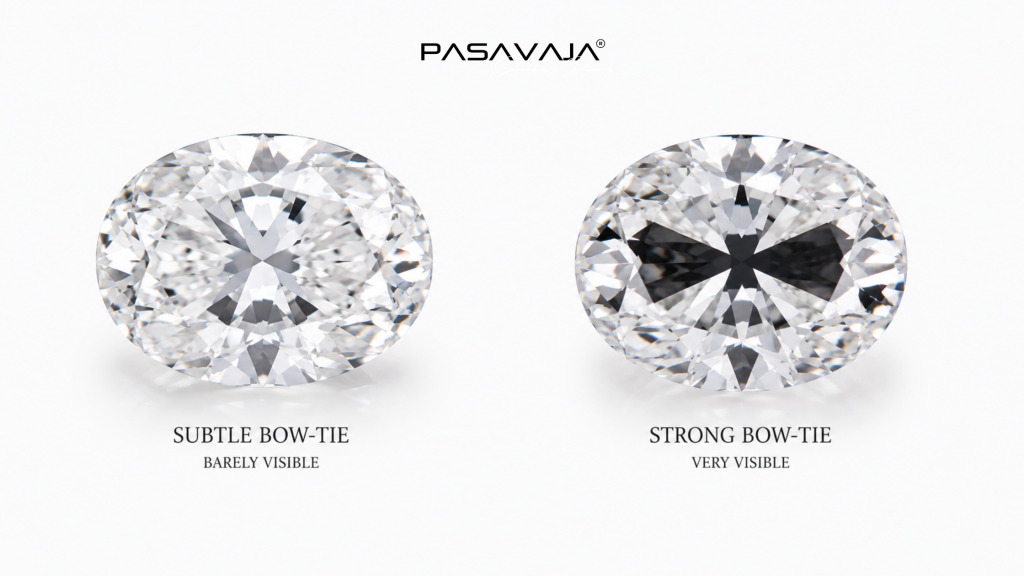
Every oval cut diamond has a bow-tie. This is a natural optical phenomenon caused by the elongated shape of the stone, where two triangular dark areas appear across the center of the diamond when viewed face-up. It looks like a man’s bow tie.
The question is not whether an oval has a bow-tie, they all do. The question is whether the bow-tie is subtle and unobtrusive, or strong and visually dominant.
A subtle bow-tie is perfectly normal and does not detract from the beauty of the stone. In fact, a faint bow-tie adds a certain depth and character to the oval’s appearance that many buyers find appealing. What you want to avoid is a strong, dark bow-tie that draws the eye immediately and dulls the diamond’s overall brilliance.
The challenge is that bow-tie intensity cannot be determined from a GIA certificate. It is visible only when you look at the diamond in person or in a high-quality video. This is one of the most important reasons to view an oval diamond before purchasing.
At PASAVAJA, Heer evaluates every oval’s bow-tie personally before it is recommended to a client. This is the kind of hands-on assessment that makes a real difference when you are choosing a diamond that will be worn daily.
For more on why viewing diamonds in person matters so much, see our white diamond education guide.
Length-to-Width Ratio: Choosing the Right Oval Shape
The length-to-width ratio (L/W ratio) describes how elongated an oval diamond looks. It is calculated by dividing the longer measurement by the shorter measurement. A ratio of 1.00 would be a perfect circle. Most oval diamonds fall between 1.30 and 1.60.
The L/W ratio is a matter of personal preference, but certain ranges are more balanced and widely preferred than others.
| L/W Ratio | Visual Appearance | Best For |
|---|---|---|
| 1.20 to 1.30 | Compact, almost round | Short fingers, wide bands, classic look |
| 1.30 to 1.45 | Classic oval, balanced and elegant | Most buyers, all finger types |
| 1.45 to 1.55 | Noticeably elongated | Slim fingers, longer look, vintage aesthetic |
| 1.55 to 1.65 | Dramatically elongated | Statement pieces, collector preference |
| Above 1.65 | Extreme elongation | Rare, specialist choice |
The most popular range for engagement rings sits between 1.35 and 1.50. This ratio gives the oval its distinctive elegance without making the stone look disproportionately stretched.
Heer’s preference when designing bespoke pieces tends to be in the 1.40 to 1.50 range. In his experience, this is where ovals look their most flattering across a wide range of hand sizes and band widths.
One important note: the L/W ratio must be read alongside the actual millimetre dimensions on the GIA certificate. Two ovals with the same L/W ratio can have very different visual impacts depending on how they are proportioned. Always look at both the ratio and the actual measurements.

How Much Does an Oval Cut Diamond Cost?
Natural oval cut diamonds are generally priced 10 to 20 percent lower than round brilliants of equivalent cut, color, clarity, and carat weight. This is partly because more rough diamond is retained in the cutting process for ovals, and partly because round brilliants have historically commanded the highest premium in the market.
For GIA-certified natural oval cut diamonds at PASAVAJA quality standards:
| Carat Weight | Color | Clarity | Approximate Price Range (USD) |
|---|---|---|---|
| 0.70 to 0.90 ct | D to F | VS1 to VS2 | $3,000 to $6,500 |
| 1.00 ct | D to F | IF to VS2 | $7,000 to $15,000 |
| 1.50 ct | D to F | IF to VS2 | $14,000 to $30,000 |
| 2.00 ct | D to F | IF to VS2 | $28,000 to $65,000 |
| 3.00 ct | D to F | VS1 to VS2 | $70,000 to $160,000+ |
Prices vary significantly depending on the specific color, clarity, and most importantly the quality of the cut, bow-tie presence, symmetry, and overall visual appeal.
A lower clarity grade such as VS2 or SI1 can still be eye-clean in an oval, but this needs to be verified in person or via video. Not all SI1 ovals are eye-clean, and some VS2 stones have inclusions in positions that affect brilliance.
Fancy color ovals, such as fancy yellow or pink oval cut diamonds, carry their own pricing entirely separate from white diamond benchmarks. You can learn more about how those are priced in our colored diamonds guide.
Expert Buying Tips for Oval Cut Diamonds
Buying an oval well means looking beyond the GIA certificate. Here is what Heer pays attention to when sourcing and evaluating ovals for PASAVAJA clients.
Always assess the bow-tie before committing. The GIA certificate does not grade bow-tie intensity. You need to see the diamond in a video or in person. A subtle bow-tie is fine. A strong one will distract you every time you look at the stone.
Focus your budget on cut quality and visual symmetry. An oval with slightly lower color, say G rather than D, but exceptional visual symmetry and a minimal bow-tie will almost always look more beautiful than a D color stone with a pronounced bow-tie or poor symmetry.
Check symmetry carefully. An oval must be symmetrical from tip to tip and from side to side. Uneven curves on one side, or a lopsided outline, will be obvious once the stone is set. Ask to see the diamond from all angles.
Consider going slightly below a magic size. Ovals just under 1.00 ct or 1.50 ct are priced notably lower than stones that hit those exact weights, and they are visually indistinguishable once set. This is one of the most reliable budget strategies for oval buyers.
Verify color from the side, not just face-up. Ovals can show more color when viewed from the side or at an angle than rounds do. For white metal settings, stick to D through H. For yellow gold, I through J can look warm and beautiful rather than visibly yellow.
GIA certification is non-negotiable. For any oval over 0.50 carats, you want a GIA grading report. It is your guarantee that the color, clarity, and carat weight have been assessed by the world’s most rigorous grading laboratory. PASAVAJA stocks only GIA-certified natural diamonds across all categories.
Popular Settings and Jewelry Styles for Oval Cut Diamonds
Heer Shah, Director at PASAVAJA and the designer behind our bespoke commissions, works with oval diamonds regularly. His perspective on what flatters an oval in a finished piece, rather than on paper, shapes the recommendations below.
The oval is one of the most versatile diamond shapes for jewelry design. It works beautifully in a wide range of settings and metal choices.
Solitaire in platinum or 18K white gold. A simple four or six prong solitaire in platinum lets the oval diamond speak for itself. The high clarity of platinum keeps the color clean and the metal durable. This is the most classic choice for oval engagement rings and consistently one of Heer’s most requested bespoke designs.
Halo setting. Surrounding the oval with a row of smaller round brilliants creates a stunning visual effect, making the center stone appear even larger than it already does. Halo settings work particularly well with ovals in the 1.00 to 1.50 carat range where the elongated shape pairs naturally with the surrounding sparkle.
East-west orientation. One of the most modern and fashion-forward ways to set an oval diamond is horizontally across the finger rather than vertically. Heer has incorporated the east-west oval into several bespoke commissions, and the look is striking. It tends to suit narrower fingers and works best in bezel or partial bezel settings for security.
Yellow gold solitaire. Ovals in warmer color grades, G through J, look exceptional in 18K yellow gold. The warmth of the metal actually flatters the stone rather than working against it. This pairing has become increasingly popular for buyers who want a warmer, more vintage-inspired aesthetic.
Three-stone ring. An oval center flanked by pear shaped diamonds or round brilliants is a deeply romantic and timeless design. Heer selects the side stones carefully to complement the center’s L/W ratio and ensure the overall ring feels balanced.

PASAVAJA’s Expertise in Oval Cut Diamonds
At PASAVAJA, every oval diamond is personally evaluated before it reaches a client. Heer Shah reviews each stone for bow-tie quality, symmetry, visual color, and how the stone will perform in its intended setting.
We source GIA-certified natural oval diamonds across a wide range of grades and carat weights, from classic white D to F color stones to warmer near-colorless grades that pair beautifully with yellow gold.
Our bespoke jewelry service lets you commission a piece built around the specific oval you choose. Heer will guide you through the entire process: diamond selection, metal choice, setting style, and final design. Every piece is manufactured to the highest standard in platinum or 18K gold.
What we offer:
- Loose GIA-certified natural oval cut diamonds across all grades and sizes
- Personal bow-tie and symmetry evaluation for every stone
- Bespoke engagement rings and jewelry in platinum and 18K gold
- Transparent pricing with no hidden costs
- Free worldwide insured shipping
- Direct personal guidance via WhatsApp or email
PASAVAJA is a second-generation natural diamond business. When you ask us a question, you get a direct answer from Heer or Harsh Shah, not a sales script.
Conclusion, Is an Oval Cut Diamond Right for You?
The oval cut diamond earns its popularity. It has the brilliance of a round, a more generous face-up appearance at the same carat weight, and a shape that flatters almost every hand. It is romantic without being conventional, and versatile enough to work in everything from a classic solitaire to a modern east-west bezel.
The key buying decisions for an oval are the bow-tie assessment, the length-to-width ratio, and color grade relative to your chosen metal. Get those three right and you will have a diamond that looks beautiful in any light and wears wonderfully for decades.
Thinking about an oval cut diamond? We would love to help you find the right stone.
Connect with Heer and the PASAVAJA team directly:
WhatsApp: +91 887 9999 787 (fast reply guaranteed) Email: info@pasavaja.com
We can help you with:
- Loose GIA-certified natural oval cut diamonds
- Bow-tie and symmetry evaluation for every stone
- Bespoke fine jewelry in platinum and 18K gold
- Custom sourcing for specific carat weights, ratios, and grades
- Engagement ring design and consultation
FAQ
1. Does every oval cut diamond have a bow-tie?
Yes. Every oval cut diamond has some degree of bow-tie due to its elongated brilliant-cut structure. A faint to moderate bow-tie is perfectly acceptable. Only a strong, dark bow-tie that dominates the stone’s face is worth avoiding.
2. What is the best length-to-width ratio for an oval diamond engagement ring?
Most buyers find ratios between 1.35 and 1.50 the most balanced and flattering. This gives the oval its distinctive elongated elegance without looking overly stretched. Personal preference matters most, slimmer fingers often suit higher ratios, while wider hands may prefer a lower, more compact ratio.
3. Is an oval diamond bigger than a round diamond of the same carat weight?
Yes, ovals appear visually larger than round brilliants of equivalent carat weight because their elongated shape covers more surface area face-up. A 1-carat oval typically measures around 7.0 x 5.0 mm while a 1-carat round measures approximately 6.5 mm in diameter.
4. What color grade should I choose for an oval cut diamond?
For platinum or white gold settings, D through H color grades look clean and white. For yellow gold, I through J can appear warm rather than visibly tinted. Ovals show color slightly more than rounds, so going one grade warmer than you would for a round is reasonable if budget is a consideration.
5. Is an SI1 oval cut diamond eye-clean?
Some SI1 oval cut diamonds are eye-clean and some are not. The GIA clarity grade alone does not confirm whether inclusions are visible to the naked eye. You must view the stone in person or via a high-quality video before purchasing. Never assume eye-clean without seeing the diamond first.
6. How much does a 1-carat oval cut diamond cost?
A GIA-certified natural 1-carat oval cut diamond in D to F color and VS1 to VS2 clarity typically ranges from USD 7,000 to USD 15,000. Ovals are generally priced 10 to 20 percent below equivalent round brilliants, making them appealing for buyers seeking maximum face-up size within a set budget.
7. What is the best setting for an oval cut diamond?
A six-prong or four-prong solitaire in platinum is the most classic choice. Halo settings add visual size and drama. East-west orientation in a bezel setting is a modern alternative growing rapidly in popularity. Choose a setting that reflects your lifestyle, a bezel protects an active daily wearer better than a high prong setting.
Every stone is photographed and graded before it is listed. Join the list to see them before they reach the shop.
New stones only, no more than once a month. Unsubscribe any time.
Tell us the grade, shape and range. We will only send stones that genuinely match.