Portrait Cut Diamond Guide
On this page
If you have ever held a Georgian locket up to the light and noticed something unusual, a flat, almost glass-like stone sitting over a hand-painted miniature portrait, you were likely looking at a portrait cut diamond. This is one of the rarest and most misunderstood diamond cuts in the world, and it is the kind of stone Harsh Shah at PASAVAJA genuinely gets excited about. Harsh’s expertise in antique and heritage diamond cuts means he can identify, date, and evaluate a portrait cut diamond in ways that few people anywhere in the trade can.
Portrait cut diamonds sit at the intersection of art history and gemology. They are not cut for brilliance. They are not meant to sparkle the way a modern round brilliant does. They serve an entirely different purpose, and understanding that purpose is what makes them so fascinating to collectors, jewelry historians, and bespoke designers.
This guide covers everything you need to know: what a portrait cut diamond is, how it was used historically, how to identify one, its collector value today, and how PASAVAJA sources and works with these extraordinary stones.

What Is a Portrait Cut Diamond?
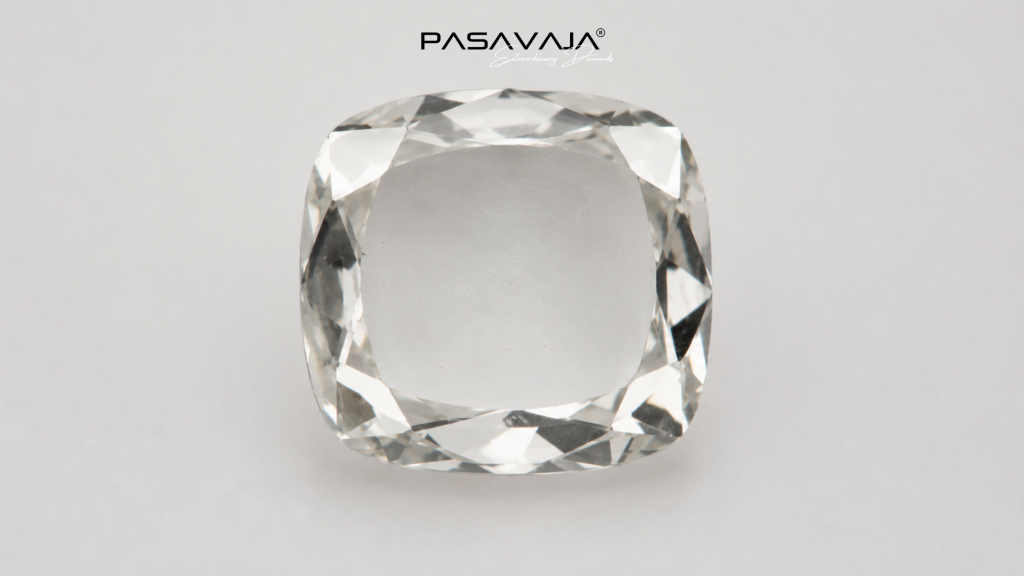
A portrait cut diamond is an extremely flat, table-cut stone with minimal faceting, cut to be nearly transparent. Unlike modern diamonds shaped to maximize light return and brilliance, portrait diamonds are finished thin and flat so they can sit as a protective transparent cover over painted miniatures, silhouettes, or hair art, objects that were commonly preserved inside lockets during the Georgian and early Victorian periods (approximately 1714 to 1860).
The defining characteristic is the depth, or rather, the near-total absence of it. Portrait cut diamonds are cut so thin they are sometimes called glazed diamonds or glazing stones. The table facet dominates the entire surface. There is little or no pavilion to speak of. The stone functions almost like a piece of bespoke gemological glass, incredibly rare, incredibly flat, and historically significant.
Some portrait cuts have a very shallow dome or slight curvature on the underside. Most are essentially planar. They were polished to optical clarity on the surface so the painted miniature beneath remained perfectly visible.
This makes the portrait cut unlike any other diamond shape in the history of gemology. For a deeper comparison of how antique cuts differ from one another, the fancy shape diamonds education page gives a useful overview of the broader antique and heritage cut family.
The Historical Context: Georgian Lockets and Mourning Jewelry
Portrait cut diamonds were created for a specific cultural moment in European history that no longer exists in quite the same way. Before photography, the painted miniature portrait was how people preserved the likenesses of those they loved. Small ivory or vellum portraits, sometimes just a few centimeters across, were set into lockets, brooches, and rings as personal keepsakes.
The challenge was preservation. These miniatures were fragile, susceptible to moisture, dust, and handling. A protective cover was needed, something transparent enough to show the portrait but durable enough to protect it.
Flat glass was one solution. But for the wealthiest patrons of Georgian England and continental Europe, a flat diamond was the ultimate statement of devotion and status. A stone was cut specifically for this function: thin, flat, table-dominant, and as transparent as the craftsmen of the period could achieve.
Portrait cut diamonds were also used extensively in mourning jewelry, a significant cultural practice during the Victorian period. After the death of Prince Albert in 1861, Queen Victoria popularized the wearing of mourning jewelry as a mark of respect, and portrait diamonds protecting hairwork or the likeness of a departed loved one became symbols of grief and remembrance.
These stones were not afterthoughts or repurposed offcuts. They were purpose-cut by skilled lapidaries to precise specifications. That intentionality is part of what makes them genuinely collectible today.
Visual Characteristics of a Portrait Cut Diamond
Portrait cut diamonds have a very distinctive appearance that separates them immediately from any other cut:
- Extreme flatness. Depth-to-width ratio is unusually low, sometimes as shallow as 1 to 2 millimeters across a stone that may be 8 to 12 millimeters in diameter.
- Dominant table facet. The entire face of the stone is essentially one large polished surface. Minor faceting may appear around the edges but the table is the defining feature.
- Optical clarity without brilliance. Portrait cuts do not return light the way a modern brilliant does. Instead, they transmit light, making whatever is beneath them clearly visible. The effect is closer to a fine crystal lens than a sparkling gemstone.
- Irregular outlines. Many portrait diamonds are not perfectly round or oval. They were cut to fit specific lockets or portrait shapes, so you will encounter rectangular, shield-shaped, oval, and even irregular freeform outlines.
- Old surface characteristics. Authentic period stones show period-appropriate polishing marks, naturals (unpolished crystal surface remnants), and sometimes minor surface wear consistent with their age and use.
GIA does not apply a standard modern cut grade to portrait diamonds. Their grading language acknowledges the unique nature of antique cuts, and Harsh works directly within that framework when evaluating these stones. For an understanding of how GIA approaches diamond certification broadly, GIA’s official education resources provide excellent background.
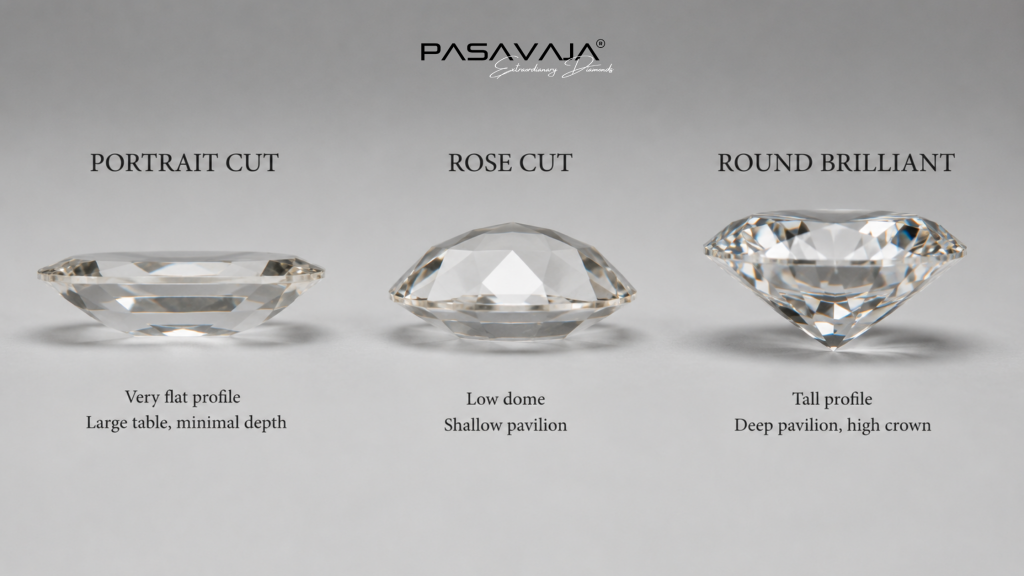
Portrait Cut vs Rose Cut vs Round Brilliant: Key Differences
| Characteristic | Portrait Cut | Rose Cut | Round Brilliant |
|---|---|---|---|
| Depth profile | Extremely flat | Domed top, flat base | Deep pavilion |
| Number of facets | Very few (often 3-8) | 6 to 24 triangular facets | 57 to 58 facets |
| Light behavior | Transmissive, lets light through | Soft, diffuse reflection | High brilliance and fire |
| Primary purpose | Protective cover for miniatures | Fashion jewelry, rings | Maximum sparkle, engagement |
| Era of peak use | Georgian to early Victorian | Georgian, Art Nouveau, contemporary revival | 1920s to present |
| Collector rarity | Extremely rare | Moderately available | Widely available |
| GIA cut grading | Not applicable | Context-dependent | Excellent to Poor scale |
| Best setting style | Lockets, display pieces, bespoke art jewelry | Rings, pendants, earrings | All jewelry types |
The portrait cut is the flattest of all historical diamond forms. Even the rose cut, which is already considerably shallower than a modern brilliant, has substantially more depth than a genuine portrait stone. For those interested in the rose cut in particular, the rose cut diamond guide covers its history and characteristics in detail.
Portrait Cut Diamonds in Contemporary Jewelry
While portrait cuts were historically functional objects, they have found a new life in contemporary bespoke jewelry design. The reasons are several.
First, their extreme rarity. Genuine period portrait cut diamonds are not commonly available in the modern trade. Most are held in private collections, historical jewelry pieces, or occasional estate sales. Finding a well-preserved, properly documented portrait cut requires specialist knowledge and access.
Second, their aesthetic uniqueness. Designers who want to move away from the visual language of modern brilliant-cut diamonds are increasingly drawn to portrait stones for their quiet, unconventional beauty. A portrait diamond in a contemporary ring or pendant reads as completely different from anything else on the market.
Third, their storytelling quality. Portrait cuts carry history in every facet. A collector who owns one owns a piece of material culture from the Georgian or Victorian period. That narrative has genuine value in a market where buyers are increasingly interested in provenance, rarity, and meaning.
Contemporary applications include:
- Rings where the flat diamond sits like a window, sometimes with imagery or enamel beneath
- Pendant designs that reference the original locket tradition
- Collector display pieces and curated antique jewelry ensembles
- Bespoke commissions where a client wants a one-of-a-kind stone with documented history
These are not mass-market pieces. They are made for a specific kind of buyer, someone who appreciates rarity, history, and the unusual.
Collector Value of Portrait Cut Diamonds
Portrait cut diamonds occupy a niche within a niche. Their collector value is determined by factors that are quite different from those applied to modern diamonds:
Authenticity and period provenance. A diamond with documented Georgian or early Victorian origins, ideally still set in its original locket or mounting, commands a meaningful premium. Provenance matters enormously in antique diamond collecting.
Size and clarity. Because portrait cuts are valued for their transparency, eye-visible inclusions that obstruct the transmitted light view significantly affect desirability. Larger stones in this cut are exceptionally rare.
Condition of the original context. Where possible, portrait cuts with intact miniature portraits beneath, original hairwork, or original locket mounts represent complete historical artifacts. These are of significant interest to jewelry historians and museum-quality collectors.
Documentation. Any documentary trail, an auction record, a historical estate inventory, even a period photograph showing the piece being worn, adds substantially to collector confidence and price.
Harsh Shah has sourced and evaluated portrait cut diamonds through his network in the antique diamond trade and can advise collectors on both identification and valuation. If you are interested in understanding antique diamond shapes more broadly, the antique and rare diamond shapes section at PASAVAJA is a good starting point.
Portrait diamonds do not have a standard Rapaport price list. They trade on rarity and individual assessment. Expect significant price variation depending on all the factors above.

Expert Buying Tips for Portrait Cut Diamonds
Buying a portrait cut diamond requires a different mindset from buying a modern brilliant. Here is what Harsh Shah recommends:
Prioritize authenticity verification. A genuine Georgian or Victorian portrait cut will show period-appropriate tool marks, consistent with hand-lapidary work of the era. Modern reproductions exist. Get specialist evaluation before any significant purchase.
Understand that GIA grading applies differently. GIA can certify a portrait cut diamond, but their standard cut grade scale does not apply. Focus on the GIA documentation of the stone’s physical characteristics rather than any numerical cut score.
Assess clarity through transmitted light. Hold the stone up to a light source and look through it. For a portrait diamond, the transmitted clarity, how clearly you can see through the stone, matters more than its face-up appearance.
Do not apply modern brilliance standards. A portrait cut that does not sparkle is not a defective diamond. It is working exactly as intended. Buyers who evaluate portrait cuts through the lens of modern brilliant expectations will misread the stone every time.
Consider the original context when it exists. If a portrait cut diamond is still in its original Georgian or Victorian locket with an intact miniature, think carefully before removing it. The complete object may have significantly more historical and monetary value than the stone alone.
Work with a specialist. Portrait cuts are not stocked by mainstream diamond dealers. They require specialist sourcing, specialist evaluation, and specialist context. PASAVAJA’s expertise in antique and rare cuts is genuine and directly relevant here.
PASAVAJA’s Expertise in Antique and Portrait Cut Diamonds
At PASAVAJA, antique and rare diamond shapes are a genuine area of passion and deep expertise, not a secondary category. Harsh Shah has spent years building knowledge and sourcing relationships in the antique diamond trade specifically because these stones represent what natural diamonds are at their most historically resonant.
Portrait cut diamonds represent the most specialized corner of this market. Harsh’s ability to identify, date, and evaluate these stones comes from hands-on experience with period pieces, direct relationships with antique jewelry specialists, and a deep knowledge of historical lapidary traditions.
PASAVAJA works with collectors and bespoke designers who want stones with genuine history and rarity. If you are looking for a portrait cut diamond, whether for a collection, a bespoke jewelry commission, or an investment in historical significance, the team can assist with:
- Private sourcing of authentic period portrait cut diamonds
- Documentation and provenance research
- GIA certification where applicable
- Bespoke jewelry manufacturing to incorporate portrait stones in contemporary settings
- Educational consultations for collectors entering the antique diamond space
All sourcing is handled personally, with fully insured delivery and transparent communication throughout. Reach out via WhatsApp or email for a direct conversation about what is currently available or to discuss a specific sourcing brief.
Conclusion: The Portrait Cut Diamond, Rarity That Goes Beyond Brilliance
The portrait cut diamond is not for everyone, and that is precisely the point. It was never designed to sparkle on a finger under a spotlight. It was designed to preserve what mattered most to the people who commissioned it: the face of someone they loved, held close, under a stone cut to the thinnest possible expression of a natural diamond.
That purpose gives portrait cut diamonds a depth of meaning that very few gemstones in the world can match. Their rarity is real. Their history is documented. And their beauty, once you understand it, is unlike anything in the modern diamond market.
If you are a collector, a jewelry historian, or a designer looking for something genuinely different, the portrait cut deserves serious attention.
Interested in exploring antique diamond cuts including portrait diamonds? Harsh Shah and the PASAVAJA team would love to help.
WhatsApp: +91 887 9999 787 (fast reply guaranteed) Email: info@pasavaja.com
We can assist with:
- Antique and rare diamond shapes including portrait cuts
- Loose fancy color natural diamonds
- GIA-certified investment-grade diamonds
- Bespoke fine jewelry manufacturing
- Custom sourcing for one-of-a-kind stones
Ask About Antique Diamond Cuts
Frequently Asked Questions
Q: What is a portrait cut diamond?
A: A portrait cut diamond is an extremely flat, table-dominant stone with minimal faceting, cut to be nearly transparent. Historically used as a protective cover over painted miniatures in Georgian and Victorian lockets, portrait diamonds transmit light rather than reflecting it for brilliance. They are one of the rarest antique diamond cuts in existence.
Q: What is a glazing stone or glazed diamond?
A: A glazing stone is another name for a portrait cut diamond. The term refers to the stone’s function as a transparent protective glaze over miniature portraits or hairwork preserved inside historical jewelry pieces. The name describes how the stone behaves optically, like a fine transparent glaze rather than a sparkling gem.
Q: What is a table cut diamond?
A: A table cut is an early form of diamond faceting where the natural octahedral crystal point is ground flat to create a large table facet on top. Portrait cuts are an evolution of the table cut concept, taken to an extreme of flatness for functional use. Table cuts were common from the medieval period onward and are considered among the earliest deliberate diamond faceting styles.
Q: Were diamonds really used inside Victorian lockets?
A: Yes. Flat portrait cut diamonds were used as transparent covers over painted miniature portraits, hair art, and memorial mementos inside Georgian and Victorian lockets. For wealthy patrons, a portrait diamond offered both protection and a statement of status and devotion. These pieces survive today and are considered historically significant jewelry artifacts.
Q: Are portrait cut diamonds valuable today?
A: Portrait cut diamonds have genuine collector value, particularly when they retain original period mounts, intact miniatures, or documented provenance. Their value is determined by authenticity, size, clarity, condition, and historical context rather than a standard Rapaport price grid. Specialist evaluation is essential before any purchase or sale.
Q: What is the difference between a portrait cut and a rose cut diamond?
A: The main difference is depth and faceting. A rose cut has a domed top with triangular facets and a flat base, giving it some visual dimension. A portrait cut is essentially fully flat on both surfaces with minimal faceting throughout. Rose cuts reflect light softly; portrait cuts transmit light through them. Portrait cuts are considerably rarer than rose cuts.
Q: Can portrait cut diamonds be used in contemporary jewelry?
A: Yes. Portrait cut diamonds are increasingly sought by bespoke designers and collectors for contemporary settings. Their extreme flatness and optical transparency create a visual effect that is completely different from any modern cut. They work well in ring designs where the flat stone sits like a window, or in pendant and locket commissions that reference the original historical tradition.
Every stone is photographed and graded before it is listed. Join the list to see them before they reach the shop.
New stones only, no more than once a month. Unsubscribe any time.
Tell us the grade, shape and range. We will only send stones that genuinely match.