Emerald Cut Diamond Guide
On this page
The emerald cut diamond is one of the most distinctive and sophisticated shapes you can choose. With its long rectangular outline, cropped corners, and rows of parallel step facets, it creates an effect unlike any other diamond on the market. Harsh Shah, Director of PASAVAJA Gems, Graduate Diamonds (GIA), with deep expertise in diamond shapes and grading, calls the emerald cut “the most honest of all the cuts, it shows you exactly what a diamond is, with nowhere to hide.” That honesty is both its greatest appeal and the reason why buying one demands careful expert guidance.
This guide covers everything you need to know: from the hall-of-mirrors light effect to the clarity grade you must not compromise on, the proportions that matter most, and how to choose a setting that does this elegant shape full justice.

What Is an Emerald Cut Diamond?
An emerald cut diamond is a rectangular step-cut diamond with cropped corners and rows of elongated, parallel facets on both the crown and pavilion. Unlike brilliant cuts that scatter light into thousands of tiny flashes, the emerald cut uses 57 to 58 facets in a layered, parallel arrangement that creates long, mirror-like reflections of light. It was originally developed for cutting emerald gemstones (hence the name) and became hugely popular in the Art Deco period of the 1920s and 1930s. Today it is prized for its understated elegance, graphic clarity, and the sense of depth it creates.
The shape belongs to the step-cut family, alongside the Asscher cut and the baguette. You can learn more about how step cuts differ from brilliant cuts in our complete diamond shapes guide.
The Hall-of-Mirrors Effect
The emerald cut produces a light pattern completely unlike any brilliant-cut diamond. Rather than rapid scintillation and tiny sparkle, you get long, sweeping reflections of light and dark that shift as the diamond moves, a phenomenon known as the hall-of-mirrors effect. It is dramatic, cinematic, and deeply architectural. Many buyers describe looking into an emerald cut as looking down a mirrored corridor.
This effect comes from the step facets. Because they run parallel and in layers, light bounces between them in controlled, elongated reflections rather than scattering outward in all directions. The result is a quieter, more sophisticated sparkle that suits buyers who prefer elegance over maximum flash.
If you love the look of the hall-of-mirrors effect but want something with a more square outline, explore the Asscher cut diamond, which delivers a similar concentric-square version of the same visual effect.
Why Clarity Is Critical for Emerald Cut Diamonds
VS2 is the minimum clarity grade you should consider for an emerald cut diamond. VS1 is strongly preferred. An SI1 emerald almost always has a visible inclusion that you can see without magnification: this is not a shape where you can stretch to a lower clarity grade and hope for the best.
This is the single most important piece of buying advice for this shape, and it comes down to simple optics. Brilliant cuts use a large number of small facets that scatter light and break it into thousands of points of reflection. That visual complexity naturally conceals inclusions. Step cuts do the opposite. Their large, flat facets act like mirrors, and anything inside the diamond is reflected and amplified rather than hidden.
Harsh Shah puts it directly: “In step cuts like emerald, clarity matters more than in any other shape. An SI1 emerald almost always has a visible inclusion. This is a category where buyers regularly overpay in the wrong direction, selecting a lower color grade they cannot see, while undergrading the one factor that will visibly affect the stone.”
For an emerald cut, the grades that consistently deliver eye-clean results are VS1 and VS2. Some VS2 stones are perfectly eye-clean; others are borderline. This is exactly where you need an expert to evaluate the specific stone rather than relying on a grade alone.
For a deeper understanding of how clarity is graded and what eye-clean really means, read our guide to diamond clarity and all 11 GIA grades.

Ideal Length-to-Width Ratio for Emerald Cut Diamonds
The length-to-width (L/W) ratio determines how elongated your emerald cut looks when viewed face-up. A ratio of 1.00 means perfectly square; a ratio of 1.50 means significantly more rectangular. The sweet spot for most buyers is between 1.30 and 1.50, which gives the classic elegant rectangle that the shape is known for.
| L/W Ratio | Visual Character | Best For | PASAVAJA View |
|---|---|---|---|
| 1.00 to 1.10 | Nearly square | Buyers who prefer Asscher but want step facets | Consider Asscher cut instead |
| 1.20 to 1.30 | Subtle rectangle | Balanced, versatile, modern look | Excellent choice for most buyers |
| 1.35 to 1.50 | Classic rectangle | Traditional emerald cut proportion | The most sought-after range |
| 1.55 and above | Very elongated | Bold, graphic, finger-lengthening | Strong style statement |
Ratios around 1.35 to 1.45 are the most popular in the current market. They give enough elongation to create the elegant finger-lengthening effect the shape is known for, without looking overly rectangular or unbalanced.
Key Proportions to Look For
Beyond the L/W ratio, these are the proportions that affect how an emerald cut diamond performs:
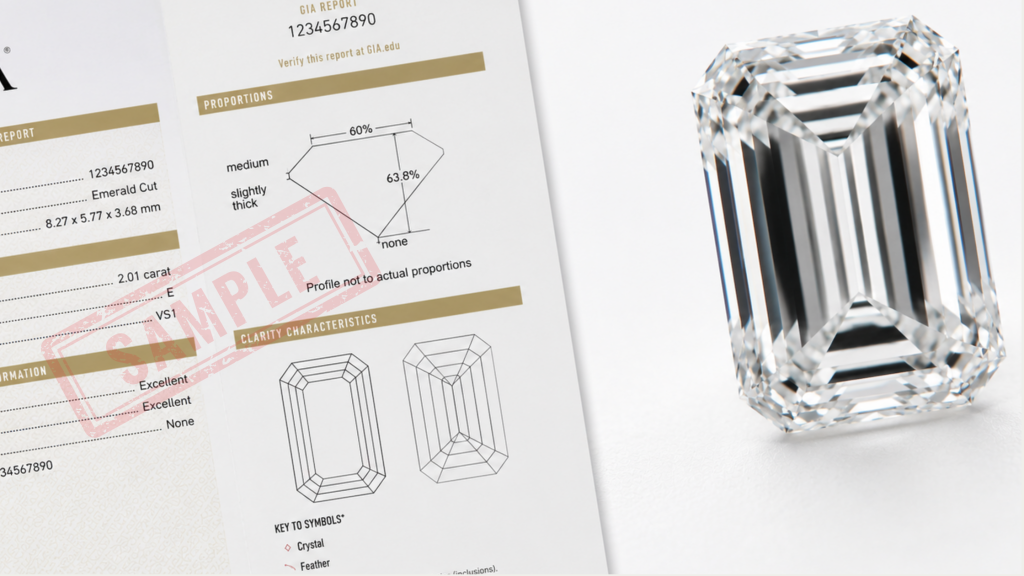
Table percentage: 60 to 68 percent is the range most emerald cuts fall within. Slightly higher tables are acceptable for step cuts, unlike brilliant cuts, a very high table in an emerald does not significantly harm performance.
Depth percentage: 60 to 70 percent. Stones with depths above 72 percent can look smaller face-up than their carat weight suggests.
Girdle: Thin to slightly thick. An extremely thin girdle on an emerald cut is more of a concern than in a brilliant, because the long edges of the stone are more exposed.
Symmetry and polish: Minimum Very Good for both. The parallel facets in a step cut make symmetry defects visually obvious in a way they simply are not in a brilliant cut. A non-symmetrical emerald looks noticeably off.
One thing to note: GIA does not assign an overall cut grade to emerald cut diamonds the way it does for round brilliants. You evaluate proportions and symmetry grades directly from the GIA report.
Emerald Cut vs Round Brilliant: Key Differences
| Characteristic | Emerald Cut | Round Brilliant |
|---|---|---|
| Facet structure | Step cut, parallel facets | Brilliant cut, 58 facets |
| Light effect | Hall-of-mirrors, flowing reflections | Rapid scintillation, intense sparkle |
| Clarity requirements | VS2 minimum, VS1 preferred | SI1 can be eye-clean in many cases |
| Face-up size (same carat) | Larger (10 to 15% more face-up area) | Baseline reference |
| Price vs round (same carat/grade) | Typically 20 to 30% less expensive | Premium shape, highest demand |
| GIA cut grade | Not assigned for fancy shapes | Assigned: Poor to Excellent |
| Best for | Understated elegance, Art Deco lovers | Maximum brilliance, classic appeal |
| Setting versatility | Solitaire, bezel, three-stone | Any setting type |
The price difference between an emerald cut and a round brilliant of the same carat and quality is significant, often 20 to 30 percent less for the emerald. This makes it possible to purchase a larger or higher-quality stone for the same budget. The trade-off is the more demanding clarity standard.

Emerald Cut vs Asscher Cut: Which Step Cut Is Right for You?
Both are step cuts from the same family, but they have distinct visual personalities. The choice comes down to shape preference.
The emerald cut is rectangular and elongating. It makes fingers appear longer and is often described as modern, architectural, and confident. The Asscher cut is square with a deeper octagonal outline and produces a more concentric, symmetrical light pattern. It reads as more vintage and jewelry-forward.
If you are drawn to the step-cut aesthetic but want to compare both shapes, visit the Asscher cut diamond guide for a full breakdown.
If you want the brilliance of a modified brilliant cut in a rectangular outline, the radiant cut diamond is worth comparing. It shares the emerald cut’s rectangular silhouette but uses brilliant facets underneath, producing far more sparkle with far less demanding clarity requirements.
Settings for Emerald Cut Diamonds
The emerald cut’s clean lines and rectangular geometry suit a specific group of settings particularly well.
Simple solitaire: The most popular choice for emerald cuts, and for good reason. A four-prong or six-prong solitaire in platinum or white gold lets the stone speak completely for itself. The hall-of-mirrors effect is most visible with no surrounding stones to compete with it.
Bezel setting: The full metal border of a bezel setting complements the emerald’s geometric outline beautifully and provides maximum protection for the long, exposed edges of the stone. It is also the most secure setting for an active wearer.
Three-stone setting: An emerald cut center stone flanked by two baguettes, tapered baguettes, or smaller emerald cuts creates an exceptionally elegant and cohesive Art Deco look. The step-cut visual family stays consistent across all three stones.
Halo: Less common for emerald cuts than for brilliant cuts, but when done well, a thin channel-set halo of small round brilliants adds brilliance to the more restrained emerald without overwhelming it.
Metal choice: Platinum and 18K white gold are the most popular choices, as they complement the cool, architectural character of the shape. Yellow gold can be used beautifully, particularly for estate-inspired or vintage designs, and in D to G color grades where the slight warmth of yellow gold has minimal impact.
PASAVAJA’s Expertise in Emerald Cut Diamonds
At PASAVAJA, every emerald cut diamond we source is personally evaluated by Harsh Shah before it is offered to a client. For step cuts, this evaluation goes beyond the certificate. Harsh assesses the specific placement and character of any inclusions, the symmetry of the step facets under magnification, and how the stone actually performs in natural light versus gem lab lighting.
This matters for emerald cuts more than almost any other shape. Two VS2 emerald cuts with identical certificates can look completely different face-up. One may be perfectly eye-clean; the other may have an inclusion positioned directly under the table facet where it is immediately visible. Only a stone-by-stone evaluation catches this difference.
PASAVAJA offers:
- Loose emerald cut natural diamonds, GIA-certified
- Personal sourcing by Harsh Shah for specific proportion, clarity, and carat requirements
- Bespoke setting design by Heer Shah for your chosen stone
- 18K gold and platinum setting options
- Free worldwide insured shipping
- Personalized buying guidance via WhatsApp or email
We work with buyers across the United States, United Kingdom, Europe, and Australia who want access to expert-level guidance before making a significant diamond purchase.
Conclusion
The emerald cut diamond rewards buyers who value sophistication, elegance, and depth over raw sparkle. Its hall-of-mirrors effect is genuinely unlike anything a brilliant cut produces, and its Art Deco heritage gives it a timeless, design-forward appeal that transcends fashion cycles.
But the emerald cut is also the shape that demands the most careful clarity evaluation of any shape in the diamond world. VS2 is your floor. VS1 is your comfort zone. And the individual stone must be assessed face-up, not just on paper.
If you are considering an emerald cut diamond, connect with Harsh Shah and the PASAVAJA team before you buy.
WhatsApp: +91 887 9999 787 (fast reply guaranteed) Email: info@pasavaja.com
We can help you with:
- Loose emerald cut natural diamonds, GIA-certified
- Eye-clean clarity evaluation for your specific stone
- Bespoke settings designed by Heer Shah
- Antique and Art Deco-inspired emerald cut sourcing
- Full price quotation, request one here
Frequently Asked Questions
Q: What is an emerald cut diamond?
A: An emerald cut is a rectangular step-cut diamond with cropped corners and rows of elongated parallel facets. It creates a distinctive hall-of-mirrors light effect rather than the rapid sparkle of a brilliant cut. Originally developed for cutting emeralds, it became widely popular during the Art Deco era and remains one of the most elegant diamond shapes available.
Q: What is the hall-of-mirrors effect in an emerald cut?
A: The hall-of-mirrors effect refers to the long, sweeping reflections of light and dark that the emerald cut’s parallel step facets create. Rather than scattering light into thousands of tiny flashes like a brilliant cut, the emerald reflects light in elongated, mirror-like patterns that shift as the diamond moves. It is architectural and deeply elegant.
Q: What clarity grade do I need for an emerald cut diamond?
A: VS2 is the minimum clarity grade you should consider for an emerald cut, and VS1 is strongly preferred. The step facets act like mirrors and amplify inclusions that brilliant cuts would conceal. An SI1 emerald cut almost always shows a visible inclusion to the naked eye. Always evaluate the specific stone face-up, not just the grade on the certificate.
Q: Does emerald cut sparkle less than round brilliant?
A: Yes, by design, not by defect. An emerald cut produces fewer but broader flashes of light compared to the intense scintillation of a round brilliant. It is a different visual character, not an inferior one. Buyers who want quiet, sophisticated elegance often prefer the emerald cut’s light pattern precisely because it is more restrained and distinctive.
Q: Is emerald cut good for an engagement ring?
A: Absolutely. The emerald cut is one of the most timeless engagement ring choices: it was favoured by icons of style throughout the 20th century and beyond. Its elongating shape flatters the finger, it photographs beautifully, and its Art Deco heritage means it looks as contemporary today as it did a century ago. Just ensure you select a VS2 or VS1 clarity grade.
Q: Why is emerald cut less expensive than round brilliant?
A: Emerald cuts typically cost 20 to 30 percent less than round brilliants of the same carat weight and quality grades. This is primarily because round brilliant cutting wastes more of the rough diamond crystal and is the most in-demand shape globally. The lower price makes it possible to buy a larger or better-quality emerald cut for the same budget as a smaller round.
Q: What L/W ratio is best for emerald cut?
A: The most popular and widely regarded sweet spot is 1.35 to 1.50. This gives the classic elongated rectangle that the shape is known for, with enough elongation to create the finger-lengthening effect without looking overly stretched. Ratios between 1.20 and 1.30 give a subtler, more balanced rectangle. Above 1.55, the stone reads as very bold and graphic.
Every stone is photographed and graded before it is listed. Join the list to see them before they reach the shop.
New stones only, no more than once a month. Unsubscribe any time.
Tell us the grade, shape and range. We will only send stones that genuinely match.